Showing posts with label my fiction. Show all posts

Saturday, 16 August 2025

'The Obscured': A Magic Realism Novel

 The Obscured: A Magic Realism Novel


The Obscured: A Magic Realism Novel eBook : Rooksmoor, Alexander: Amazon.co.uk: Kindle Store

I read 'The Glamour' (1984) by Christopher Priest in 1993, having bought it in a remaindered book store in London along with 'A Dream of Wessex' (1977) and 'The Quiet Woman' (1990) by the same author. Priest wrote straight contemporary set novels as well as science fiction and fantasy. 'The Glamour' straddled genres in that it is set in 1980s UK, but there is one element which is fantastical, i.e. that there are people who have the ability not to be seen by the general public. The term 'glamour' while having a contemporary meaning of glossy appearance in the media, had an older meaning as a kind of spell to cast an illusion of what people saw.

At the time magic realism a genre which had been recognised since the 1920s, was going through a popular phase for authors writing in English rather than translated from Spanish or Portuguese. Thus, this book fitted in quite well, though it differed from a lot of what else Priest wrote, it was a phase of 'quiet' novels by the author before he reached a new peak in his career with 'The Prestige' (1995; movie 2006). While I have read many of Priest's novels, admired his deftness in writing and enjoyed the breadth of topics that he covered, my opinion of him was soured by reading his 'Fugue for a Darkening Island'  (1972) which could be on the reading list for any aspiring Reform party member or apostle of Donald Trump in its racist view on human migration.

Still, in the years after I read 'The Glamour' I remained fascinated by the concept. I kept envisaging various scenes which have now gone on to feature in 'The Obscured'. Alongside 'Death in Amiens' (2018), this is probably the novel which features locations that I know personally. Scenes in West and East London, at Sandown racecourse and other locales in Surrey, plus those in Devon all came from places I had visited. Even some of the striking outfits that Peri wears were ones I had seen in southern England and Germany, worn by real women. Having read work by Carlos Ruiz Zafón and 'The Armageddon Rag' (1983) by George R.R. Martin, in 2024, I decided it was time to bring together the various scenes together into a novel.

I was determined in part to 'get back at' what I felt had been Priest's racist writing in  'Fugue for a Darkening Island' by taking his magic realist concept and placing it in the genuinely multi-cultural context of London, which was multi-cultural in his day as well. Apprehensive about cultural appropriation for some reason I had been drawn to Iranian mythology and in exploring this came across the ideal being to be the originator of the obscured. For the readers of Farsi, the language used in Iran, text on the front cover gives away a clue about how the story unfolds. The novel touches a little on the differences between pre- and post-revolutionary Iran, but primarily from the perspective of Westerners' engagement with the country.

This aspect also meant the novel explores issues around identity and families in the UK worrying about the colouring of their children's children, raised to prominence with questions asked of the Duchess of Sussex when she was pregnant, given her mixed-race background. This then began to connect with the British context, especially those families who had been involved with the oil industry especially living around the Weybridge and Walton areas of Surrey. Furthermore, between me first reading Priest's books and the mid-2020s I had become familiar with Dorset and Devon, the latter of which featured in 'The Glamour' and naturally in a particular form in  'A Dream of Wessex'.

The other prime challenge is how far technology has advanced since the mid-1980s. These days it is typical that you have to gurn at your smartphone to get it to open up for you. Facial recognition software is habitually used in many public spaces. Perhaps I could have gone into this a bit further, but I do look at the advantages and disadvantages of being 'obscured' when so much of our appearance and activity is being judged not by other people but by machines. Another challenge is the decline in the use of cash. This shifted the types of crimes that an obscured person would have to, might be able to, pull off. Simple pickpocketing is less fruitful in 2024 than it would have been in 1984. However, 'shoulder surfing' as people use electronic devices in public and the ability to take such devices, sometimes even just temporarily, can open up access to other opportunities to steal funds. These questions had been part of my mulling over these scenarios in the past few decades and I feel I explore them in this novel without it becoming an essay on identity and technology in our era.

While there is action and jeopardy in this novel, in contrast to many of my novels 'The Obscured' is more a character arc as Tara Houghton comes to learn more about herself and the condition she has had thrust upon her.

Sunday, 3 August 2025

The Otto Braucher Stories - Revisiting the Weimar Germany Detective


https://www.amazon.com/gp/product/B008FRHKY4?ref_=dbs_m_mng_rwt_calw_tkin_0&storeType=ebooks&qid=1754231531&sr=8-3

https://www.amazon.com/gp/product/B008GEA2WS?ref_=dbs_m_mng_rwt_calw_tkin_1&storeType=ebooks&qid=1754231531&sr=8-3

https://www.amazon.com/gp/product/B0FKZZMC12?ref_=dbs_m_mng_rwt_calw_tkin_2&storeType=ebooks&qid=1754231531&sr=8-3

Very influenced by the Maigret novels by Georges Simenon plus teaching modern history, back in 1995 I decided to write a series of crime novels set in 1920s Germany. Not only was it a period that I knew a lot about, but it seemed that it offered ample opportunities for crimes given the political and economic turbulence and the availability of guns as a result of the First World War. Berlin would have been a logical location but I realised that as Munich had suffered less as a result of the Second World War, finding out what it looked like in the 1920s would be rather easier. I was very fortunate to be given a tourist guide to the city published in that period. 

You have to remember that back in 1995 the public did not have the internet. Email tended to be restricted to academia. Libraries had moved to computer-based lists of their books, but you still had to go and find the physical book and read it. Having moved to London in 1994, I was in a better position to access a variety of libraries. I had a GCSE in German that I had got three years earlier when unemployed, so with the aid of a large German dictionary I was able to get material from German-language texts too. Friends also lent me books, notably about the German Army in the First World War. I assembled a huge file of notes (which I still have) including hand copied and photocopied maps and long lists of names from the era. 

I was determined that my detective would be in contrast to so many would be a family man rather than a loner. I also felt it was appropriate for him to be a serious Catholic and knew this would impinge on how he went about his work. Him having a family also allowed me to bring in connections to different elements of society through his wife and children. He was to maintain a positive outlook, though given the context it is unsurprising that he becomes cynical. I revisited the idea of a positive detective in 'Death in Amiens' (2016) which drew heavily on my very depressed time I spent in that town and the police detective was an intentional counterpoint to my perspective on the place.

Otto Braucher started out as Otto Beckmann, using the name of a German family I had known in West Germany in the 1980s. It was also supposed to reference the artist of the inter-war Weimar Germany era, Max Beckmann (1884-1950). However, then in 1996 there was the UK TV crime series 'Beck' and in 1997, the Swedish police series also called 'Beck', began. The German series, 'Beckmann' which began in 1999, was a chat show, but still I felt the name was getting too much usage. So, looking for an alternative name, I switched to 'Braucher' which I saw used in the USA but had a German ring to it and as a German friend said to me, it had an analogous meaning which might seem useful/appropriate.

Anyway, through the late 1990s and into the 2000s, I was writing these stories, 15,000-20,000 words, so novellas very influenced by Simenon. I did not have an idea of publishing them and any hopes seemed dashed when I encountered the first three Bernie Gunther novels of Philip Kerr published 1989-1991. Though set in Berlin, I felt I was be seen to be aping his novels. However, especially in the covers of these first three (there was a shift in style when he revived the series in 2006), which echoed the Penguin crime novel editions of the 1960s, I had to go with that green urban style myself. Of course, since then we have seen numerous crime novels set in the Weimar Germany era, the most successful being the Gereon Rath novels of Volker Kutscher, published since 2007. Berlin has primarily remained the focus, but Rory Clements has now left crime in 16th Century England for 1930s Munich with 'Munich Wolf' (2024).

Self-publishing ebooks did not really become a thing until the 2010s. My wife, a published author, suggested I got into it and having already produced 12 Braucher stories and even faked up some covers for them (pretending that Penguin had taken me up), these seemed sensible ones to start with. My original idea had been 3 x 6-story anthologies and I launched 'Braucher's Solution' and 'Braucher's Inheritance' on this basis. However, in the mid-2010s, there was a real fade for short and episodic ebook fiction, stories people could complete in a single train journey, so I disaggregated the stories and launched them as stand-alone novellas. I was rather uncomfortable selling them in that way, but it seemed to work. I continued writing more finally reaching 17 novellas in total.


https://www.amazon.com/gp/product/B0174OXGA0?ref_=dbs_mng_crcw_0&storeType=ebooks&qid=1754231531&sr=8-3

In 2015 I finally got around to completing the full-length Braucher prequel novel, set in 1922, 'Munich White' which I had started at the same time as the novellas back in 1995 but had run out of steam. Having worked more with Braucher and his setting, but the 2010s I was ready to come back and complete the novel. Having three story threads that occasionally bisected was probably rather over-ambitious but we can put that down to the confidence of my youth back then. There have long been plans for 'Munich Brown' set during Munich's Beer Hall Putsch of November 1923, but, despite lots of ideas for what might happen in it and some of the roots of these being laid in the Braucher novellas, I have been unable to come up with a satisfactory structure whether the three-story strand or a focus just on Braucher. This is often a challenge with historical novels, having an appropriate set of characters able to witness what you need them to witness without them teleporting all over the place or having to employ a whole platoon of characters as I ended up doing for 'Scavenged Days' (2018) and some would argue, unsuccessfully.

Now the fad of the 2010s for short or episodic ebooks seems to have died, indeed ebooks themselves seem to be waning, I still felt uncomfortable when speaking about my books having to say, 'well, of course, 17 of those crime novels are just novellas, not full-length [read 'proper'] novels.' Thus, I decided to reassemble the novellas back into the three anthologies I had originally envisaged. I was short the 18th story to complete the third anthology. For a long time I had intended to write 'Braucher and the Circle' which would be around spiritualism something which was extremely popular in Britain and Germany in the post-First World War period - Sir Arthur Conan Doyle was very into it. However, again despite coming at it from different angles I could not get a satisfactory structure. Thus, I decided to swap it with 'Braucher and the Expectation' which I had intended to be set in 1924, but seemed to work instead in October 1923, rounding out the third anthology. I decided to title that anthology 'Braucher's Value' referencing the hyperinflation of mid to late 1923 that is in the background and influenced a lot of what happened at the time in Germany.

Of course, reaggregating the novellas I took the opportunity to check and revise the writing. I realised how far my writing has come since 2012, let alone 1995 and I feel these revised editions are more lucid than the approach I had back then. In addition, it is so much easier to get hold of detailed information about the era especially on political groups and the law. Accessing maps and images is also incredibly easy certainly compared to having to read through scores of books. This has allowed me to expand and indeed correct some of the details that I featured, notably on the A.G.V.K. political grouping which is mentioned in all three anthologies. Details of when certainly newspapers, cars and weapons were available is also so much easier, indeed I can access German newspapers of the time from the comfort of my own desk at home, something that would have seemed very futuristic back in 1995.

Thus, while I have always been proud of my Braucher stories, I do feel these three re-released anthologies do show the stories at their best and the 'train spotters' of historical novels might be more satisfied that anything even mildly anachronistic has been corrected. While the competition is much stiffer now than thirty, let alone thirteen years ago, I do hope that even a few readers enjoy the Braucher books, cheaper and more accessible than before, simply with fewer of those green-tinted photograph covers that myself and others have long enjoyed.

Thursday, 6 March 2025

The Books Of My Life: Alexander Rooksmoor

As I have noted before, I am regular reader of various features in 'The Guardian' newspaper. I know I am never going to be famous so they would not ask me to respond to these features for real. Still that does not stop me from thinking how I would respond and it is nice to be able to get these thoughts out of my system. Back in 2010, I did this for their 'Tell Us About Yourself' feature: https://rooksmoor.blogspot.com/2010/12/tell-us-about-yourself.html Looking back on that now I would not disagree with many of the responses I gave then, even 15 years on. My fears of that time were well placed as we did lose our house in 2012 and our family was broken up living with wider family members, in rented rooms or B&Bs. We did manage to live back together again in 2015 after I managed to get a job which in total lasted 7 years, the longest one I have ever held.

Today I am going to have a go at the 'The Books Of My Life' feature in 'The Guardian': https://www.theguardian.com/books/series/the-books-of-my-life I accept it is arrogance to think that anyone might consider me a 'leading author'. Back in 2010, though I had written novels over the preceding 22 years, I had none on sale. Self-publishing and then being taken up by Sea Lion Press https://www.sealionpress.co.uk/ enabled me to get my books out there and in turn it really fuelled my writing. I have now written 70 books, most of which are now on sale in e-book format. I might not be a best seller, 2014 was my peak year of sales and as with the marketplace in general there has been a decline since then. It is often said that everybody has at least one book in them, but clearly I have had a lot more than that and I have no idea how many more I will produce before I die. Thus, while I may not be renowned author and certainly am not 'leading', I feel it is reasonably legitimate for me to respond to the sort of questions that might be asked of such people.


Alexander Rooksmoor: 'Some Saturdays I would go through them all before I got out of bed'

My earliest reading memory
I did not learn to read before going to school aged 4 years and 11 months. We had lots of books at home, but I tended to treat them in a visual way, looking at the images rather than the words. I understood the power of the printed word because my parents read so much. Apparently, aged 3, loath to attend playschool picked up a magazine (probably a Sunday supplement) and waved it at my parents insisting that it said that parents should not send their sons to play school. Thus, it was almost like a magic talisman rather than something to engage with myself. In terms of books, like most children of my generation in England, we started with the Peter & Jane books published by Ladybird. I remember the images of the book '1a. Play with Us' (1964 edition) better than I remember the words. I was a very slow reader and like many children of my generation sub-vocalised everything because we read aloud so much.

My favourite book growing up
The first fiction book I remember actually expressing a like for was 'The Grey Apple Tree' (1965) by Vera Cumberlege. However, the books I came back to most regularly was the series by R.J. Unstead about British history. These were published in the early 1970s and I remember us working to collect them all (in the age before online book ordering!). They ran from 'Invaded Island' (1971) from Stone Age to 1066; 'Kings, Barons and Serfs' (1971), 1066-1300; 'Years of the Sword' (1972), 1300-1485; 'Struggle for Power' (1972), 1485-1689; 'Emerging Empire' (1972), 1689-1763; 'Freedom and Revolution' (1972), 1763-1815; 'Age of Machines', (1974), 1815-1901 to the 'Incredible Century' (1974), 1901-1970. Some Saturdays I would go through them all before I got out of bed. They were highly illustrated A4-sized hardbacks which could be found in most school and public libraries but as a history fan, I had my own set. I note that their subtitle is 'A Pictorial History' and I realise now, I did simply look at the pictures rather than read the text.

The book that changed me as a teenager
I remember that in the larger library in the nearest town, they had a children's section and then around the other side of a row of shelves was a single set of shelves for 'older children'. It actually was at the start of the 'adult' bit of the library and I think the librarians had designed it to tempt teenagers to move from the picture and project books and indeed the 'Doctor Who' novelisations, on to something a bit more mature. A lot of the books there were kind of 'kitchen sink' books for teenagers. I first cycled alone to this library (2.5 miles away) aged 11, which these days would probably terrify parents. I was very conscious of not going into age inappropriate areas (I was never someone who would sneak into movies older than for myself or try to drink alcohol underage). I remember one day hesitantly going round the corner to this section and borrowing the novelisation of 'Bugsy Malone' (1976?) not the script or graphic novel that are dominant now. I was struck by the fact it had one chapter that lasted less than a single page. I also remember a book of eyewitness accounts of various events, including the sinking of the 'Titanic'. 

It was the next step which came quicker than I had long realised which really changed me. I discovered the science fiction and fantasy fiction section of the library. I borrowed both 'The Colour of Magic' (1983) and 'The Final Programme' (1968). While I thoroughly enjoyed 'The Colour of Magic', 'The Final Programme' was the first book I had sat up through the night to complete. I had probably been attracted to it by the pop art/graphic novel book cover, but went on to read a lot of Michael Moorcock books in my life (and indeed all of Pratchett's work). For some reason my sixth form college library had the complete works of Moorcock as they were in the mid-1980s. I do not think the current librarian had ever explored the themes, i.e. lots of drugs and sex, that featured in many. I remember, aged 14 checking with my mother whether I should even be reading 'The Final Programme' given it mentioned sex on the cover, but she felt I was mature enough and ultimately it was more about needle guns and hallucinogenic security systems. What I think I learnt from Moorcock was that science fiction need not be all about big spaceships and robots. Furthermore, I went from 'The Final Programme' to 'The Warlord of the Air' (1971) which really sparked my interest in alternate history. My third novel, 'His Majesty's Dictator', which I completed in 1991, was heavily influenced by it.

The book that changed my mind
I have never really read a book that has altered my opinion on big issues. Maybe that reflects a dogmatism on my part. Friends use to often recommend me books that I 'must' read though it later turned out one was just getting rid of books he thought were terrible and wanted disposed of had misunderstood what lending a book to someone usually entailed. A couple of friends insisted I read 'The Bridge Across Forever: A Love Story' (1984) by Richard Bach which I found tedious and fatuous. It was very arrogant in believing his story needed that kind of output. I see now that it was along these lines of annoyance that in 2009 I came to 'Chimera' (1972) by John Barth. I had bought it assuming it was a straightforward fantasy novel. However, it became clear it was simply a vanity project to show off how much cleverer than the reader Barth knows he is. He even says openly that some readers will not 'get' what he is writing as if that is our problem rather than his.

While I had realised that 'in jokes' rarely work and had sought to remove anything that people might not get because it was too personal to me or my culture, Barth made me realise that any author who does not work with the reader is actually failing. We should both not pander to them but also we should not treat them with disdain simply because they cannot crack our own personal code. It also made clear to me that the books that get published are not necessarily 'good' books, they can simply be out one sale because the author has been fortunate and/or has contacts. I was alert from then on of books which were primarily the author parading their 'greatness' when in fact what they tend to produce in such circumstances is the literary equivalent of the Emperor's new clothes. I would put 'Auto da Fé' (1935) by Elias Canetti which I read in 2000, in this category too.

The book that made me want to be a writer
There was no book which did this. Creative writing was an assessed part of the English curriculum from age 5-16, though I got 'let off' early as I sat my English Language 'O' Level a year early, aged 15. Thus, creative writing was something we did almost weekly. We were all writers. As a consequence I was not conscious of being 'a writer' probably until about 2012, some 24 years after I had completed writing my first novel. I guess I had never really registered that other people did not write in their spare time too.

I knew I got good marks for my creative writing and recall two of my stories being put up on the wall when I was in 3rd Year of primary school. One of them was called 'Wings for a Day' and apparently the teacher noted my knowledge (aged 7) of world events as I featured the fall of the Colonels junta in Greece writing 'in Greece there was a war' and mention of the Arab-Israeli Conflict (the Yom Kippur War had been the preceding year and my parents had an illustrated book about it), though unaware of the politics, rather than the simple news coverage of violence. As the 'Not the Nine O'Clock News' team were shown in one of their spin-off books, as children we were obsessed by Moshe Dayan's eyepatch.

While I got good grades for my creative writing, this actually misled me because teachers would focus in their feedback (not called that back then) on my imagination and not the fact that I was screwing up a lot of the punctuation. This seems to have stemmed largely from my 3rd Year Middle School (nowadays Year 6) teacher, Mrs. Simmons, who had a real aversion to pupils using direct speech and would insist we stuck to reported speech. It was only as an adult that I realised I had been punctuating direct speech wrongly. If I had been a poorer writer, I would have been alerted to this sooner. If I had actually looked at what I had been reading then maybe I would have noticed I was not doing it the same way, though, of course, we tended to see what was done in books was not what we were doing in English at school. Many/most of us believed all poetry had to rhyme.

The book I came back to
In fact there are two, though both on a similar theme. 'Great Escape Stories' (1977) by Eric Williams and 'Colditz' (1974), the anthology version combining 'The Colditz Story' (1952) and 'The Latter Days' (1953) by P.R. Reid. I abandoned the Williams book as from daring stories of Second World War escapes by PoWs, it moved into civilians and then the Korean War. While I found the early stories, of the twelve, 'cosy' if it is legitimate to say that - and was especially impressed by the account of Airey Neave escaping Colditz dressed as a German officer - the later ones were much more unsettling. In the 1970s there were lots of people still around who had been adults during the Second World War. There were a lot of books like 'I am David' (1963) by Anne Holm which was read to us and a copy of 'The Diary of Anne Frank' (1947) was in our classroom when in what is now Year 6, not just the school library. You could watch 'Carrie's War' (the 1974 series of the 1973 book by Nina Bawden) after school and 'The World at War' (first broadcast in 1973) on Sunday afternoons so the Second World War was pretty much 'currency' for us much more than the 1950s or 1960s. The headmaster of my school later chided me for abandoning the book but even then, fearful of nightmares, I did not return to until I was an adult, still very certain about my aversion to torture, but having seen and read a lot more.

It is difficult now to remember why I felt so drawn to escape stories at the time, it is not something that seems to have continued after I went to secondary school. I abandoned 'Colditz' because I foolishly looked ahead while reading it on holiday in 1978 and finding that Lieutenant Albert Michael Sinclair (1918-1944) nicknamed the 'Red Fox' was killed on his final escape attempt in 1944. His repeated escapes made him a hero of mine and I had been using the codename 'Red Fox' in various secret clubs we tended to form as adolescents. It was chilling to read he had been killed and not, like Neave, got clear away. I lost all heart in reading the book and only came back to it and also read 'Colditz: The German Story' (1961) by Reinhold Eggers, as an adult in the late 1990s.

The book I could never read again
Aside from 'Chimera' and 'Auto da Fé' I have already mentioned I would add 'The Quincunx' (1989) by Charles Palliser. I had come across the term 'quincunx' when studying Latin (at a non-selective, comprehensive school - it did happen back then and I did want to be a professional historian) at school, meaning a pattern of five-twelfths (though to me it looked like five-ninths) and a design for the layout of trees in a garden (I was later into garden history), so I thought it would be a story about a sort of code perhaps concealed in a garden and to some extent the synopsis sustained that misapprehension. What it is instead is an unrelenting account of a boy and his mother who are tricked out of their relatively meagre middle class wealth in early 19th Century England. They then proceed to be subjected to all the worst privations of the era. The mother, Mary, having lost her house and all her savings due to a scam, after living as a squatter in an abandoned East London building ends up as a prostitute tied to a brothel. The boy, John, in turn is abused at a horrendous school where he has to literally fight for his food, in a mental asylum and as a scavenger in London sewers. Yes, we know that life was bleak and people were abused but the contorted path the two protagonists are taken along so that they can suffer as many different kinds of abuse as possible is perverse, almost ridiculous.

In second place in this category I would add, 'The New Pelican Guide to English Literature 7. From James to Eliot' (1988 edition) ed. by Boris Ford. Why they bothered to assemble 23 writers to comment on an era of writing that all of them appear to believe was much lesser in so many ways to what preceded, I have no idea. It was a real waste of time for them as well as the reader.

The book I discovered later in life
I am now 57 and am constantly discovering books. I imagine this question is about one which I may have read earlier in my life but only came to far later than that. I would point to 'Renaissance Europe 1480-1520' (1971) by J.R. Hale. I have read a lot of 'survey' books of European history but among them Hale's book really stands out. See my review here: https://rooksmoor.blogspot.com/2021/09/books-i-read-in-september.html Hale really is command of the information he has and writes in such an engaging way for a non-fiction historical book. A lot of historians could learn from his approach. I bought this book in the late 1980s but it was over 30 years before I got round to reading it and I wished I had turned to it much sooner rather than leaving it in storage.

The book I am currently reading
'The Sussex Downs Murder' (1936) by John Bude [Ernest Elmore], the third of his novels I have read in the British Library Crime Classics series republication of his books.

My comfort read
While, as back in 2010, I still have a lot of affection for 'The Book of Heroic Failures' (1979) by Stephen Pile, the default book I turn to these days is the 'The Penguin Atlas of World History. Volume 2: From the French Revolution to the Present' (1964/2004). Doing this exercise has rather revealed that I am not really a reader at heart, I am more a looker at books so I guess this is why a book of lots of colourful maps is comforting to me.

Saturday, 23 November 2024

The Hated Chapters: A What If? Novel of an Arab State in Southern Iberia in the 1990s

While stories set in the latter part of the 20th Century do appear in some of my anthologies such as 'Mark in the Sea' (2018) and 'Detour' (2014), I had never written an alternate history novel set as recently as 1990. It was both interesting and fun to explore the culture and technologies that were available within my own lifetime. I had to be careful not to misremember what was available or popular later in the 1990s rather than right at the start of the decade. As I have noted on a few occasions, as I age I find this exploration of alternative culture to be the most engaging element of writing alternate history, more so than the alternate battles or political schemes, that might be the main attraction for many readers of alternate history fiction.

As I am sure many readers will guess, this book was very influenced by the experience of the author Salman Rushdie, whose novel, 'The Satanic Verses' (1988), led to a call by the Iranian regime for Muslims to assassinate him. I wondered if this could be looked at from a 'flipped' perspective, so my story features a female author, Maryam Hamdi who has produced a novel called 'Palm-Strewn Road' featuring a man called Joe Carpenter living on Cypress Avenue in New York in the 1980s who is killed at a crossroads with a nail gun. This book provokes the anger of US Christian fundamentalists and one church the Independent Fundamental Bible Church dispatches a team of paramilitaries under Vietnam veteran, Brandon Travis to abduct Hamdi and compel to denounce her own novel. 

I began writing this novel before the attack on Rushdie at Chautauqua in August 2022 which left him severely injured and losing the sight in one eye. I thought about shelving this book, but given that Rushdie has written about the incident himself in 'Knife: Meditations After an Attempted Murder' (2024), I though it would not be disrespectful to progress with having my own book on this alternate path, published.

As the subtitle to this novel indicates, it is set in an Arab state which has endured in what in our world are southern Spain and Portugal. The reason for this divergence is mentioned in passing in the novel. It envisages that the Battle of Poitiers/Tours in 732 CE was a victory for the Umayyad Caliphate which already controlled most of Iberia, thus allowing them to conquer large areas of modern-day France. As a result the 'reconquest' by Christian forces took longer than in our history. As a result Emirate/Caliphate of Córdoba, while pushed back southwards and was not successfully invaded in the 13th and 14th Centuries. Thus, whereas the last Muslim state in Iberia was conquered in 1492, as progress down the peninsula has been slowed by more than a century compared to our world by the time of the Reformation, the Emirate of Córdoba, still exists and persists into the 20th Century. This alternative has also meant that the Spanish states have not come together as they did in our world.


This has had an impact on Spanish colonisation of the Americas, with, for example, Texas remaining a French colony, as it was for a short period in our world. The dialect of Spanish spoken in Latin America also tends to be Leónese rather Castilian. I have envisaged that Al-Andalus has followed a similar path to countries of North Africa, notably Morocco, Tunisia and Libya. Thus, in 1967, Brigadier General Hamzah Salhi has become military dictator after the overthrow of the last emir.

In the novel Al-Andalus forms and important bridge between Europe and North Africa and indeed has territory on both sides of the Straits of Gibraltar, encompassing what in our world are Morocco, Western Sahara, parts of Algeria, the Canary Islands, Madeira and Ibiza.


Given this geographical connection, it is not only Arabic culture which has thrived in south-western Europe, but also Berber culture. In part this is because people often forget that the Almoravids who ruled the emirate 1085-1147 were Berbers rather than Arabs. Thus, I have envisaged that this Al-Andalus has been a channel through which Berber culture has better reached Europe.

Featuring an author as a leading character led to me creating a whole set of books and authors coming out of this rich culture. However, I was able to reference real historical writers. In particular this alternative saw the continuation of the University of Córdoba which being founded in 786 was the oldest university in Europe. In our world it was closed following the Spanish conquest of the city in 1236, but in this alternative it has endured. Pope Sylvester II (946-1033; Pope from 999) graduated from it and it attracted the children of Christian monarchs. There were 80 libraries and colleges in Cordoba, holding 400-500,000 books at a time when an average abbey held 600 books, thus it is to be expected that Al-Andalus would have a strong literary culture. Interestingly the current cathedral of Cordoba was built as a mosque between 785-787. Not all that had been created by the Muslim emirate was deemed as inappropriate for Castile.

There were some other aspects that I sought to explore in this novel. One was the rise of fundamentalism in the late 20th Century both among Christians and Muslims. People these days may not recognise the impact that the Iranian Revolution of 1979 had not simply on that country, but in terms of Muslims globally. Certainly living in an area with a large Muslim population, it was apparent to me that the effects were rippling even into the UK in terms of dress and the appearance of extracts of the Koran displayed publicly. 

Thus, while in counter-balance to Travis, the journalist Kaima Ziani is the other point of view for the novel, she in turn is a counter-balance to her erstwhile friend, Maryam Hamdi. The novel is an adventure story but also looks at how two women who were both students in New York in the 1970s have taken different paths as they have reached middle age. Maryam while proud of her background adheres more to modern, largely secular culture. In contrast, especially in the light of the Iranian Revolution, Kaima is rediscovering her faith and adhering to its fundamental principles to a greater extent. Though we never see through Maryam's eyes, she does act as the third protagonist and one that provokes mixed reactions from Kaima as they are drawn into danger together.

This book was fascinating to research and I really felt that the characters evolved without slipping into stereotypes which would have been so easy, not simply given the current UK perspective on Islam across the world, but also of Christians in the USA. As most of my stories are, this is an adventure with jeopardy but hopefully it remains responsible to the characters, their viewpoints, the culture and the technology of the alternate world it shows.


https://www.amazon.com/Hated-Chapters-Novel-Southern-Iberia-ebook/dp/B0DMT1ZSQK?ref_=ast_author_dp_rw&dib=eyJ2IjoiMSJ9.NOFlQZ1Ywk5nlMCwC0JkwLw1qbe8P6lacYPIsNf26Sj5uLkm8NDU8_0jtYCOfJOX5XXLk0tdRif9IWcOslIKcW6B4T0omEeVlzurTiO3B5lvhh4XSLtujeoBi_AzbIvQquCvheWSNUGftG-kqyE31SB-T14QvW0pOSzOpphN5_G3seM8XonDGf377PQH8HqNVQg9VZHfqA1CzBybRsTobt0s7F94WnZFG0vq0LknTGE.rrGAtMngZ2dyQaBSjp-jZHCnljnoKarCmeQKXZnTV80&dib_tag=AUTHOR

Friday, 22 November 2024

The Loyal Pursuit: The American Forces are more Successful in the War of 1812


The War of 1812 actually ran until 1815. It was about the USA, not yet 50 years old, asserting itself in North America. Researching the conflict led me to feel that it was also effectively a 'rematch' between the Americans and the British who still held vast swathes of North America. Following the British defeat in the American War of Independence (1776-83), thousands of Americans who had remained loyal to the British fled northwards, this included slaves who were granted their freedom. This was despite the fact that slavery persisted in the regions which would become Canada, until 1834. It did mean there was a free black population especially to the eastern side of British North America.

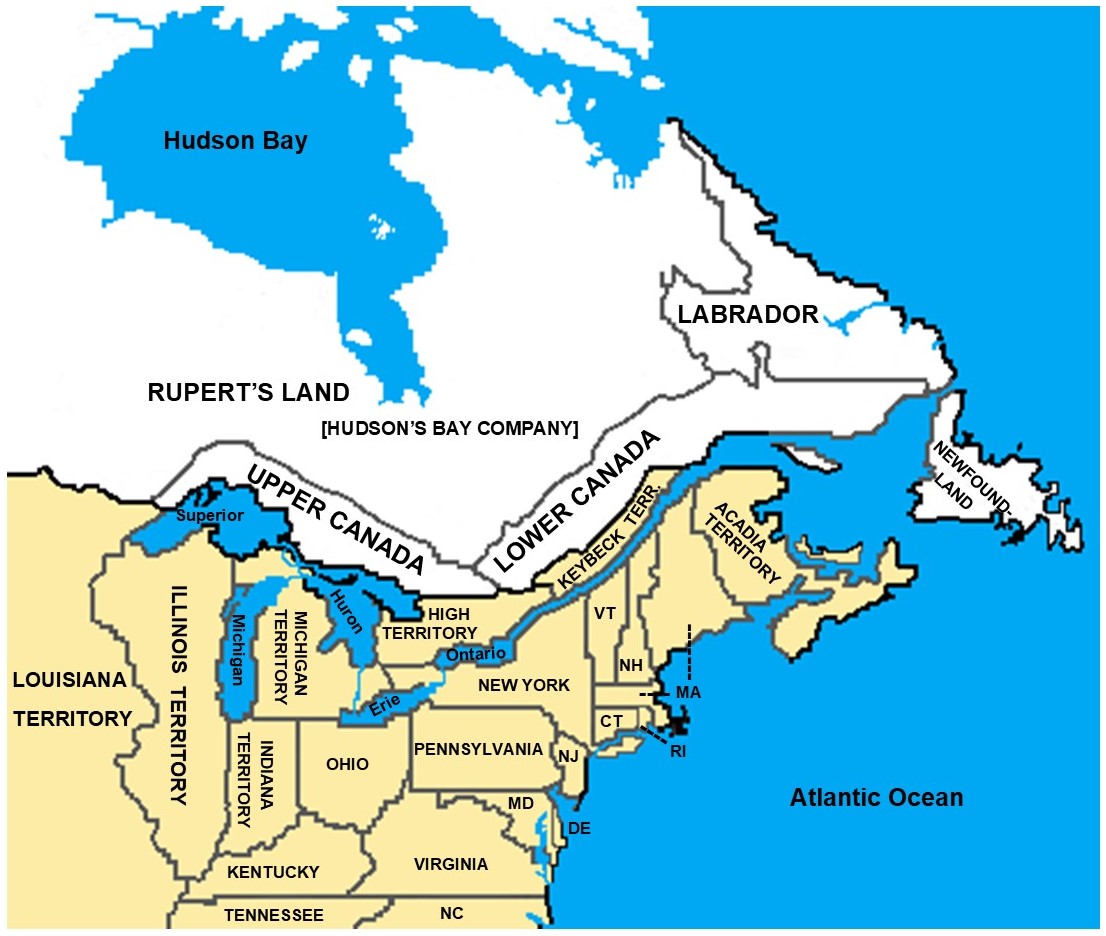
The American invasion of the British territory both overland and across the Great Lakes, did have some successes and secured towns such as Detroit. However, the invasion was undermanned and rather poorly commanded meaning that the impetus soon ran out. With the defeat of Napoleon in 1814 and again in 1815, the British government was able to refocus its efforts away from Europe. In this alternative, the invasion was better planned and supplied and as a result much of the areas settled by Europeans have been overrun by American forces. However, distance and terrain eventually prevent a total conquest of all of the territory under British control at the time. 

It is envisaged that the conquered areas are annexed to the USA either in the extension of existing state and territories or by the creation of the new territories, i.e. the organisation of a region before it becomes a US state. It might be argued that given the rows between states of the USA, especially around the Great Lakes, that there would not have been the extension of existing states. However, given the terrain, especially the land between the lakes, it seemed more feasible than having small fragments of new territories. In this alternative by 1815, the USA would have had greater control around the Great Lakes and along both shores of the St. Lawrence Seaway.


It is assumed that those who could not bear to live under US rule would have fled to the interior of Upper and Lower Canada making use of the trading stations that had been developed to handle the fur trade. Those most likely to have fled would have been those families of Loyalists and the black population especially if their families had found freedom in Canada fleeing the USA after the American War of Independence. It seems feasible that they would have been treated as runaway slaves and hauled back to those deemed their owners in the USA.

The pattern of laws around slavery varied quite considerably from state to state, but the recovery of escaped slaves was permitted at the time even from states which themselves did not have slavery. In addition, it is interesting to note that even as slavery was being eroded in some of the northern states, laws permitting indentured labour continued, notably for former slaves or their children up to a certain age.

Especially given that some leading individuals in the USA at the time wanted to introduce slavery to the Great Lakes region, while they were unsuccessful, I have assumed that they found it easier in the conquered territories taken from British control. Anger at the Loyalists does not seem to have declined much in the thirty years since the end of the American War of Independence so I felt it probable that Loyalists taken in the Canadas - and in New Brunswick and Nova Scotia which had actually received more Loyalist refugees than the other regions - would be punished by being put into indentured labour. I imagined they would be especially sent to aid the development of the new US states. Kentucky had become a state in 1792, Tennessee in 1796, Ohio in 1803 and Louisiana in 1812. 

I particularly became interested in Louisville as a destination for those Canadians captured in this war. In part because Kentucky was more distant from the conquered lands and because Louisville was known very much as a slave trading city and an important link in the trade between the so-called Upper South, i.e. those states south of the Mason-Dixon line but north of the northern borders of the states running east-west from Texas to South Carolina and the Lower/Deep South.

Dealing with the aftermath of the invasion and the selling into slavery and indentured labour of Canadians became the focus of this novel. I decided on using two families - Daniel and Mehitable Jarvis and their children, George and Charlotte and Cyrus and Madeleine Hartwood and their sons Lysander and Pharas. Daniel is a master cabinet maker in York (nowadays Toronto) who employs Cyrus as his journeyman. Both men are part of the York militia so are drawn into the fight against the invading Americans. I found a great resource on the York militia which really helped my story: The War of 1812 Project: https://www.wikitree.com/wiki/Project:War_of_1812 While Madeleine and the Hartwood children escape northwards into the less populated areas of Upper Canada, Cyrus and the Jarvises are captured, separated and shipped to Kentucky.

It is important to know that the Jarvises are white, Cyrus is black and Madeleine is mixed-race with one black grandparent and three white. At the time much was made of categorising races and there was a plethora of terms for different categories of mixed race people for example mulatto, quadroon and octaroon. On the 'drop of blood' principle even someone with one great-great-grandparent who was black, i.e. a  hexadecaroon, would be considered black and thus could be enslaved even if all their other relatives had been white. It seemed important to explore these aspects and note that while indentured labour was bad, slavery was worse.

Immediately this led me to worry about whether people would say I was not permitted to write black or mixed race characters especially in a story set when slavery was in force. Not to do so would have led to a very distorted story and it would almost have been as if I was ignoring that experience. In addition I reflected that while commentators might say I could not get 'inside the head' of a black person or indeed as a man write two women as main characters. I would argue that the same kind of charges could be laid against anyone in 2024 writing about anyone in 1813, not matter what their own or the characters' race. I do accept that me writing the story especially of Cyrus Hartwood is going to accept some readers and commentators, but the alternative was either to produce a very skewed novel that would have looked to be brushing certain aspects under the carpet or to have abandoned the novel entirely.

Much of the action takes place in the rural areas between the towns and especially in the Canadian sections interaction with the indigenous peoples who had settlements and had established routes that the European settlers made use of. The characters cover a great distance going through terrain from northern Kentucky to the northern shores of Lake Huron and I was keen to make sure that the plants and wildlife they encountered were authentic for each area. It did become apparent, especially for the sections in Kentucky and Ohio, how climate change has already altered this and trees, for example, that in 1813 would only have been found in more southern latitudes in the USA have now crept much further north.

This then is the background of the novel. It rotates between the perspectives of the four adults to show different elements of the conflict and its consequences. As such it is very much an adventure story as each of the characters seek to escape American control and keep their children safe. I have tried to reflect how brutal and cheap life was, and how assiduous Americans were in trying to recapture what they felt was theirs. While my alternate history novels are often adventure stories, it is unusual for me to write family dramas, but I enjoyed writing this one. I hope you will enjoy reading it and looking at your own views of how different North America might have been if this often forgotten war had gone down just a slightly different path.


https://www.amazon.com/Loyal-Pursuit-What-novel-1812-ebook/dp/B0DLJT9Z1Y/ref=sr_1_1?crid=TPTQCHWXHXU8&dib=eyJ2IjoiMSJ9.HOIwlRsPbLnrffcDzIim_A.oHox1Qr5v5WJzSJlovo7KesA1obZoBx9gP0lR_mCL70&dib_tag=se&keywords=alexander+Rooksmoor+the+loyal+pursuit&qid=1732304680&s=digital-text&sprefix=alexander+rooksmoor+the+loyal+pursuit%2Cdigital-text%2C169&sr=1-1

Thursday, 21 November 2024

Taken In Lycia: The Treaty of Sèvres Enforced Giving Fascist Italy a Zone in Anatolia


Of the peace treaties signed following the First World War, one which envisaged some of the greatest changes to the defeated Power was the Treaty of Sèvres imposed on the Ottoman Empire in 1920. While it did not entirely tear apart the empire in the way that happened to Austria-Hungary, it did treat the country more like a colonial territory than a lesser Power. The British, French and Italians had been hacking away at the Ottoman Empire throughout the 19th and early 20th Centuries, depriving it of all its North African territories as well as Cyprus and the Dodecanese Islands closer to Anatolia. Its European borders had been pushed back starting with the independence of Greece and the emergence of Romania, Bulgaria, Albania and an enlarged Serbia out of Ottoman territory. British, French and German companies had become heavily involved in exploiting the Ottoman economy.

The Treaty of Sèvres took this erosion a step further as can be seen in the map below. Britain, France, Italy and Greece received mandates - effectively colonies in all but name - and zones of influence in Anatolia. The Straits between the Mediterranean and Black Seas were internationalised. Remaining non-Turkish territories, i.e. Palestine, Transjordan and Syria largely came under the control of the British and French. Arabia, Kurdistan and Armenia were to be granted independence.


While all the defeated countries railed against the treaties imposed on them, the Turks fought back against the Treaty of Sèvres. Following the war with Greece, there was an exchange of populations. The sultanate was overthrown and the Turkish Republic established. Even the British and French, while able to hold their mandates in the Arab states could not introduce the zones in Turkish areas. Kurdistan has still not been established and Armenia only reappeared and then much farther North, following the collapse of the USSR in the 1990s. Unlike all the other defeated Central Powers, a second treaty, the Treaty of Lausanne was signed in 1923 enabling control of the Turkish Republic over Anatolia.

The leader of the founding of the Turkish Republic and the prevention of the establishment of the zones of control, was Mustafa Kemal Pasha (1881-1938) later known as Mustafa Kemal Atatürk. He served as a Colonel in the Ottoman resistance to the attempt to capture the Gallipoli Peninsula, 1915-16. He went on to lead the forces that opposed the Sultanate and the Greeks. In this novel it is envisaged that he was instead killed while at Gallipoli and consequently those trying to oppose the treaty impositions, the Sultan and the Greeks have remained disunited and as a result have been defeated. Consequently, the Treaty of Sèvres has been enforced in full. There is still a Sultan on the throne but very much as a puppet of the British.

Benito Mussolini came into office as premier in Italy in 1922 and by 1925 had established the Fascist dictatorship which was to persist across the Italy and its colonies into the Second World War. In this alternative the Italian Empire has come to include a large slice of southern Anatolia. It is named 'Lycia' the name given to part of the region during the Roman Empire, a period Mussolini liked to reference in his propaganda.

This novel is set in 1937 when the Governor of the Italian mandate of Lycia is abducted. Lieutenant Colonel Michele Tartaglia, head of the Italian detective squad is assigned to this most challenging case. Tartaglia is from the poor Molise region of Italy and coming the 'backwater' of Lycia has allowed his career to advance and for him to send money back home to his family. He is soon caught up in the internecine conflicts of the Fascist state. Since the 1970s, historians have recognised that rather than being monolithic states, the European dictatorships of the mid-20th Century were in fact more like regimes of rival 'baronies' with different individuals and bodies within the regimes competing for power. Even more than Nazi Germany, Fascist Italy had a range of centres of power, including the Fascist Party, various police and economic bodies, the Army, the King and the Church. This novel looks at the frictions inherent in such a regime as well as the tensions arising in a colony in an era of rising nationalism and sense of national identities across the world.

This book, then, is a novel both featuring a detective story but also one of political conflict within a regime and between a colonial power and its subject peoples. While Italy was never able to establish itself in its Anatolian zone, I have thoroughly researched the way it ran its empire and what groups and individuals were important in that to hopefully give a portrayal of what the running of Lycia would have been like, if it had occurred. I was very fortunate to be able to access the doctoral thesis of Dr. Dih Wang, 'The Judicial System of Fascist Italy' which was submitted at the London School of Economics in June 1939. It is clear that Wang was not only fluent in Italian as well as English, but had managed to gain deep access to the Italian judicial system of the 1930s and so provides possibly unique insight into how it functioned thus giving me a wonderfully solid basis for how it might have been translated into the Anatolian context.

It can be a challenge when writing a protagonist who is a functionary, especially a police officer in a dictatorship. However Philip Kerr with his Bernie Gunther novels, Martin Cruz Smith with Arkady Renko and Josef Škvorecký with Lieutenant Boruvka managed to do this successfully. Tartaglia is not a devoted Fascist but I wanted a protagonist who would not be unfeasible or anachronistic for the context in which he is working. He is devoutly religious and has the prejudices such as misogyny and homophobia that would be common across Europe and the wider world, in the democracies as well as the dictatorships. He is more understand of the Turkish, Greek and Armenian populations of Lycia than many of his colleagues but at best has a paternalistic attitude of a coloniser towards the subject peoples. He does have faith in due process and in a sense of justice, both of which were eroded in the Fascist state, again raising a point of tension and hopefully interest as he seeks to resolve this high profile case.

As always I hope readers will not only enjoy this novel as a detective and political conspiracy novel, but that it will provoke thought on how our history could have gone down this path rather than the one it took and what the implications would have been for the people caught up in this alternative.

Saturday, 9 November 2024

'What If?'s I Have Written About

Now that I have been publishing 'what if?' analysis books and collections of short stories for eight years, I thought it might be useful to identify the topics I have explored and in which book. I intend to update this as I publish more, so it is a snapshot of what is currently available. My 'what if?' books divide into three categories, those which had chapters of analysis; those with fictional short stories and full-length novels set in one alternative context.

'What If?' Novels
'Against the Devil’s Men: A ‘What If?’ Novel of the Continuation of the Mongol Invasion of Europe'
'Between Protector and Pretender'
'The Blood and The Ghost'
'Byzantium Express'
'The Dijon Conspiracy'
'Each Brother's Shadow'
'Eve of the Globe’s War: A ‘What If?’ Novel of the Coming of the Second World War without an Industrial Revolution'
'The Hated Chapters'
'His Majesty's Dictator'
'In the Absence of Powder'
'The Kerensky Defence'
'The Loyal Pursuit'
'Mark in the Sea: A ‘What If?’ Novel of the Persistence of Islands of Doggerland'
'The Pictish Groom'
'Provision: A What If? Novel of the Second World War'
'Scavenged Days: A ‘What If?’ Novel of the Impact of the Assassination of President De Gaulle'
'Streseland'
'Stop Line: A ‘What If?’ Novel of Resisting the 1940 Nazi Invasion of Britain'
'Taken in Lycia'
'The Three Eagles: A ‘What If?’ Novel of the U.S.A., Mexico and the First World War' 

Collections of 'What If?' Fiction
'Another World’s War: What If? Stories of the Second World War’
'From Another Infamy: What If? Stories of the Second World War'
‘Detour: What If? Stories of Americans’

'Taking the Detour: What If? Stories of Americans'
‘Déviation: What If? Stories of the French’
‘Diversion: What If? Stories of the British’
‘Route Diverted: What If? Stories of the British’
‘Umleitung: What If? Stories of Germany’

'Wars to End: What If? Stories of the First World War'

Books of Alternate History Analysis
‘Other Roads: Alternate Outcomes of the Second World War’
‘Other Roads II: Further Alternate Outcomes of the Second World War’
‘Other Roads III: Additional Alternate Outcomes of the Second World War’
‘In Other Trenches: Alternate Outcomes of the First World War’
‘In Other Trenches II: Further Alternate Outcomes of the First World War’
'Other Lives: Alternate Outcomes for Famous People in History'

‘In Another America: Views and Reviews of Alternate Histories for the USA in the 17th-20th Centuries’
‘Down Other Tracks: Alternate Outcomes of the 19th Century’
'Other Exits: Alternate Outcomes for Tudor and Stuart Monarchs’
'On Other Fields: Alternate Outcomes of the Middle Ages'
‘Other Earths: Alternate Outcomes of Geological Developments and Prehistoric Times’


In the following list, the date shown in brackets is the date of the divergence from our history. Some chapters reflect on a number of different divergences so you will see some repeated next to different dates.

An 'A' indicates that the chapter is analysis; 'S' that it is a story and 'N' shows a full-length novel. Very often I have produced a story to match a piece of analysis. The date in brackets after the 'S' or 'N' shows when the story is set. Some stories are set years or even centuries after the divergence in order to show how the world would have developed differently from that time.

The titles of the different books featuring a specific chapter should be obvious. The number after 'Ch.' is the chapter in the book which has that analysis or story.

Summary of Counterfactuals

4.54 Billion Years Ago: Earth's Axis at 0° to the Sun's Axis
– A: ‘Other Earths’ Ch. 01

4.54 Billion Years Ago: Earth's Axis at 90° to the Sun's Axis
– A: ‘Other Earths’ Ch. 01

4.54 Billion Years Ago: No Metal on Earth
– A: ‘Other Earths’ Ch. 02

3.6 Billion Years Ago: Inverted Earth – land as seas; sea as land
– A: ‘Other Earths’ Ch. 04

200 Million Years Ago: Pangea Did Not Break Up
– A: ‘Other Earths’ Ch. 03

100 Million Years Ago: Inland Sea in Australia
– A: ‘Other Earths’ Ch. 07

75 Million Years Ago: Western Seaway Remained in North America
- S (1817): 'Taking the Detour' Ch. 01

55 Million Years Ago: Greenland Farther South
– A ‘Other Earths’ Ch. 06

55 Million Years Ago: Horses did not Evolve
– A: ‘Other Earths’ Ch. 10

35 Million Years Ago: Antarctica Farther North
– A: ‘Other Earths’ Ch. 05

15 Million Years Ago: No Isthmus Developed Between North and South America
- S (1998): 'Taking the Detour' Ch. 16

200,000 Years Ago: Women are as Strong as Men
– A: ‘Other Earths’ Ch. 11

30,000 Years Ago: Dover Isthmus Continued
– A: ‘Other Earths’ Ch. 09

6200 BCE: Islands of Doggerland Not Inundated
 – N: ‘Mark in the Sea’

5600 BCE: Crimea Became an Island
– A: ‘Other Earths’ Ch. 08

4000 BCE: Sahara Desert Remained Green
– A ‘Other Earths’ Ch. 12

323 BCE: Alexander the Great Lived Longer
– A: ‘Other Lives’ Ch. 01

55 BCE: Julius Caesar's Invasion of Britain Defeated; Caesar Killed
- N (262 CE): 'The Pictish Groom'

52 BCE: Julius Caesar Defeated and Killed in Gaul
- S (52 BCE): ‘Déviation’ Ch. 16

44 BCE: Julius Caesar not Assassinated
– A: ‘Other Lives’ Ch. 02 

9: German Tribes Defeated in Teutoberg Forest
- S (21): ‘Umleitung’ Ch. 03

43: Roman Invasion of Britain Defeated
- N (262): 'The Pictish Groom'

62: Romans Expelled from Britain
- S (62): ‘Route Diverted’ Ch. 03
     Third Roman Invasion of Britain Defeated
- N (262): 'The Pictish Groom'

337: Paganism Persisted
– A: ‘On Other Fields’ Ch. 01

520: Romano-British Rule Persisted in Britain
- S (801): ‘Diversion’ Ch. 03

732: Umayyad Forces Won at Poitiers
– A: ‘On Other Fields’ Ch. 02
- S (1699): ‘Déviation’ Ch. 03
- N (1990): 'The Hated Chapters'

878: Alfred the Great Defeated
– A: ‘On Other Fields’ Ch. 03
- S (879): ‘Route Diverted’ Ch. 13
- N: 'The Blood and The Ghost'

900s: Gunpowder Not Invented
- N: (1815): 'In the Absence of Powder'

1002: Burgundy Persisted
– A: ‘On Other Fields’ Ch. 04
- N (1868): 'The Dijon Conspiracy'

1020: Viking Colonies Established Around Chesapeake Bay
- S (1586): 'Taking the Detour' Ch. 15

1035: William the Bastard Did Not Become Duke of Normandy
– A: ‘Other Lives’ Ch. 03
- S (1041): ‘Déviation’ Ch. 13

1066: King Harold II Defeated at Stamford Bridge
– A: ‘On Other Fields’ Ch. 05

           King Harold II Victorious at Battle of Hastings
- A: ‘On Other Fields’ Ch. 06
- S (1088): ‘Diversion’ Ch. 14

1071: The Byzantines Won the Battle of Manzikert
– A: ‘On Other Fields’ Ch.17
- N (1914): 'Byzantium Express'

1098: The 1st Crusade Failed to Capture Antioch
- S (1098): ‘Déviation’ Ch. 04

1099: The 1st Crusade Failed to Capture Jerusalem
– A: ‘On Other Fields’ Ch. 07

1135-47: A Different Anarchy
– A: ‘On Other Fields’ Ch. 08

1181: Abu Ya'qub Yusuf I Lived Longer
– A: ‘On Other Fields’ Ch. 19

1190: Friedrich Barbarossa Survived; 3rd Crusade Very Successful
- S (1193): ‘Umleitung’ Ch. 14 

1203: Duchy of Brittany Remained Independent
– A: ‘On Other Fields’ Ch. 13
- S (2011): ‘Déviation’ Ch. 02

1204: The 4th Crusade Did Not Damage the Byzantine Empire
– A: ‘On Other Fields’ Ch. 17
- N (1914): 'Byzantium Express'

1217: Prince Louis of France Became King of England
– A: ‘On Other Fields’ Ch. 09
- S (1686): ‘Diversion’ Ch. 05

1230s: A Larger Moorish State Remained in Iberia
- A: ‘On Other Fields’ Ch. 19
- N (1990): 'The Hated Chapters'

1241: The Mongols Did Not Turn Back from Europe
– A: ‘On Other Fields’ Ch. 12
- N (1267): ‘Against the Devil’s Men’
- S (1272): ‘Déviation’ Ch. 06

1268: The Crusader States Persisted
- A: ‘On Other Fields’ Ch. 11

1270: The Chinese Discovered the Americas
– A: ‘On Other Fields’ Ch. 10
- S (1524): 'Taking the Detour' Ch. 09

1328: The English Won the Battle of Bannockburn
- S (1346): ‘Route Diverted’ Ch. 17

1346: No Black Death
– A: ‘On Other Fields’ Ch. 14

          Black Death Killed a Majority of Europeans
– A: ‘On Other Fields’ Ch. 15

          The French Won the Battle of Crécy
- S (1346): ‘Route Diverted’ Ch. 17

1376: The Black Prince Lived Longer
– A: ‘On Other Fields’ Ch. 16 

1415: The English Lost the Battle of Agincourt
- S (1415): ‘Diversion’ Ch. 10

1422: England Won the Hundred Years’ War
– A: ‘On Other Fields’ Ch. 16
- S (1432): ‘Déviation’ Ch. 11
- S (1649): ‘Déviation’ Ch. 20

1453: The Byzantine Empire Persisted
– A: ‘On Other Fields’ Ch. 17
- N (1914): 'Byzantium Express'

1475: German Explorer Discovered America
- S (1475): ‘Umleitung’ Ch. 06

1481: Sultan Mehmed II Lived Longer
– A: ‘On Other Fields’ Ch. 18

         Christopher Columbus Sailed to the Americas for Genoa rather than Spain
- S (1512): 'Taking the Detour' Ch. 03

1485: King Richard III Won at Bosworth Field
– A: ‘Other Exits’ Ch. 01
- S (1783): ‘Diversion’ Ch. 13

1492: A Moorish State Remained in Iberia
- A: ‘On Other Fields’ Ch. 19
- N (1990): 'The Hated Chapters'

1492: Italian City States Colonised North America
 – S (1512): ‘Taking the Detour’ Ch. 03
           
1493: Refugees from the Emirate of Granada Settled in North America
- S (1493/1978): 'Taking the Detour' Ch. 18      

1502: Prince Arthur Came to the English Throne
– A: ‘Other Exits’ Ch. 02

1511: Catherine of Aragon Had a Surviving Son
– A: ‘Other Exits’ Ch. 04
- S (1534): ‘Route Diverted’ Ch. 10
- N (1622): 'Each Brother's Shadow'

1517: Martin Luther Died Younger
- S (1517): ‘Umleitung’ Ch. 08

1534: England Remained Catholic
- N (1622): 'Each Brother's Shadow'

1536: King Henry VIII Died in a Jousting Accident
– A: ‘Other Exits’ Ch. 05
- S (1536): ‘Diversion’ Ch. 06

          Anne Boleyn Did not Miscarry
– A: ‘Other Exits’ Ch. 05

1537: Jane Seymour Did not Die in Childbirth
– A: ‘Other Exits’ Ch. 06

1538: King Henry VIII Married Marie of Guise
– A: ‘Other Exits’ Ch. 07

1540: King Henry VIII Found Anne of Cleves Attractive
– A: ‘Other Exits’ Ch. 08

1553: King Edward VI Lived Longer
– A: ‘Other Exits’ Ch. 09

1554: Queen Elizabeth I Brought to the Throne Earlier
– A: ‘Other Exits’ Ch. 10

1558: Calais Remained English
- S (1790): ‘Diversion’ Ch. 02

          Princess Elizabeth Did Not Become Queen
– A: ‘Other Exits’ Ch. 11

1564: Queen Elizabeth I Married and Had Children
– A: ‘Other Exits’ Ch. 12

1571; 1578; 1583; 1586: Queen Elizabeth I Assassinated
– A: ‘Other Exits’ Ch. 13
- S (1573): ‘Diversion’ Ch. 16

1588: The Spanish Armada was Victorious
– A: ‘Other Exits’ Ch. 14 

1605: The Gunpowder Plot was Successful
– A: ‘Other Exits’ Ch. 15

1632: King Gustavus Adolphus Lived and Won the 30 Years’ War
- S (1635): ‘Umleitung’ Ch. 17

1643: Oliver Cromwell Killed in Battle
– A: ‘Other Lives’ Ch. 04

          King Charles I Won the Civil War
– A: ‘Other Exits’ Ch. 16
- S (1654): ‘Diversion’ Ch. 17

1650: A Constitution Introduced to Britain
– A: ‘Other Exits’ Ch. 17
- N (1706): 'Between Protector and Pretender'
- S (1717): ‘Route Diverted’ Ch. 08

1664: Nieuw Nederland Persisted
– A: ‘In Another America’ Ch. 01
- S (1986): ‘Detour’ Ch. 05

1685: The Duke of Monmouth Victorious
– A: ‘Other Exits’ Ch. 18
- S (1687): ‘Diversion’ Ch. 11

1688: King James II Remained on the Throne
– A: ‘Other Exits’ Ch. 19 

1745: The Jacobite Rebellion Succeeded
- S (1749): ‘Route Diverted’ Ch. 02

1750s: No Industrial Revolution
– A: ‘Down Other Tracks’ Ch. 01
- N (1938): ‘Eve of the Globe’s War’

1759: North America became Largely French
– A: ‘In Another America’ Ch. 02
- S (1763): ‘Déviation’ Ch. 19
- S (1768): ‘Detour’ Ch. 13

1760: Prussia Destroyed
– A: ‘Down Other Tracks’ Ch. 02
- S (1760): ‘Umleitung’ Ch. 01

1770s: Steam Car Racing Became A Sport
- S (1785): ‘Déviation’ Ch. 10

1777: George Washington Died at Valley Forge
– A: ‘Other Lives’ Ch. 05
- S (1778): ‘Detour’ Ch. 09

1778: The British Won the American War of Independence
– A: ‘In Another America’ Ch. 03
- S (1983): 'Taking the Detour' Ch. 02

1787: Federal Convention Led to Independent American States
– A: ‘In Another America’ Ch. 04
- S (1976): ‘Detour’ Ch. 16

1790: French Revolution Defeated
- S (1890): ‘Déviation’ Ch. 09

1792: Japan Opened Up to the World Earlier
– A: ‘Down Other Tracks’ Ch. 10

1794: Napoleon’s Career Less Successful
– A: ‘Down Other Tracks’ Ch. 03
- S (1794): ‘Déviation’ Ch. 07

1799: Napoleon Made No Impact on French Politics
– A: ‘Down Other Tracks’ Ch. 05

          Napoleon Did Not Abolish Balloon Troops
- S (1810): ‘Déviation’ Ch. 15 

1803: Duke of Wellington Killed in India
– A: ‘Other Lives’ Ch. 06
- S (1811): ‘Route Diverted’ Ch. 06

          Louisiana Not Sold to the USA
- S (1992): ‘Detour’ Ch. 10

1805: France Conquered Britain
- S (1809): ‘Diversion’ Ch. 07

1812: Napoleon More Successful
– A: ‘Down Other Tracks’ Ch. 04
- S (2000): ‘Déviation’ Ch. 12

          USA More Successful in War of 1812
– A: ‘In Another America’ Ch. 05
- N (1813): 'The Loyal Pursuit'
- S (1815): 'Taking the Detour' Ch. 11

          USA Less Successful in War of 1812
– A: ‘In Another America’ Ch. 05
- S (1814): ‘Detour’ Ch. 17

          Indian Reserve Preserved
- S (1828): 'Taking the Detour' Ch. 05

1813: Saxony Rather than Prussia Joined 6th Coalition
- S (1815): ‘Umleitung’ Ch. 13

1830s: Colonialism Did Not Catch On
– A: ‘Down Other Tracks’ Ch. 17

            Otto von Bismarck Remained a Lawyer
- S (1872): ‘Umleitung’ Ch. 09

1839: Belgium not Created
– A: ‘Down Other Tracks’ Ch. 06

1840: Napoleon III Executed
– A: ‘Down Other Tracks’ Ch. 07

          Queen Victoria Assassinated
– A: ‘Down Other Tracks’ Ch. 08
- S (1840): ‘Diversion’ Ch. 04

           Republic of Rio Grande Survived
- S (1863): 'Taking the Detour' Ch. 07

1842: Britain Held Afghanistan
– A: ‘Down Other Tracks’ Ch. 09
- S (1963): ‘Diversion’ Ch. 12

1844: Henry Clay Became US President
– A: ‘In Another America’ Ch. 07

          Congresswoman Elected in New Jersey
- S (1845): ‘Detour’ Ch. 12

1845: Texas Remained an Independent Republic
– A: ‘In Another America’ Ch. 06
- S (1945): ‘Detour’ Ch. 15

1848: Hungary Broke Entirely from Austria
- A: ‘Down Other Tracks’ Ch. 14

          King Friedrich III came to the Prussian Throne
– A: ‘Down Other Tracks’ Ch. 18

          Mexico Remained Larger
– A: ‘In Another America’ Ch. 08
- S (1996): ‘Detour’ Ch. 01

1852: Earlier American Civil War and Earlier Deseret
- S (1856): ‘Detour’ Ch. 06

1857: Deseret was Sustained
– A: ‘In Another America’ Ch. 09

          The Indian Mutiny Succeeded
- S (1871): ‘Route Diverted’ Ch. 04

1858: Napoleon III Assassinated
– A: ‘Down Other Tracks’ Ch. 07

1861: King Friedrich III came to the Prussian Throne
– A: ‘Down Other Tracks’ Ch. 18

          The Confederacy Won the American Civil War
– A: ‘In Another America’ Ch. 10
- S (1868): ‘Route Diverted’ Ch. 11

1862: Otto von Bismarck was Less Successful
– A: ‘Other Lives’ Ch. 08

1863: Abraham Lincoln Assassinated Sooner; Herbert Hamlin Died of Pneumonia
- S (1863): 'Taking the Detour'

1865: Abraham Lincoln Not Assassinated
– A: ‘Other Lives’ Ch. 07
- S (1867): ‘Detour’ Ch. 03

1866: Kaiser Wilhelm I was Restrained Less
– A: ‘Down Other Tracks’ Ch. 13

1867: Hungary Broke Entirely from Austria
– A: ‘Down Other Tracks’ Ch. 14

          Russian Colonies Remained in North America
– A: ‘In Another America’ Ch. 11
- S (1940): ‘Detour’ Ch. 20

1870: France Won the Franco-Prussian War
– A: ‘Down Other Tracks’ Ch. 15
- S (1871): ‘Déviation’ Ch. 17

1871: The Taiping State Persisted
– A: ‘Down Other Tracks’ Ch. 11

          Italy not Unified
– A: ‘Down Other Tracks’ Ch. 12

1878: War between Britain and Russia
– A: ‘Down Other Tracks’ Ch. 16
- S (1878): ‘Route Diverted’ Ch. 14

          Kaiser Friedrich III Came to the Throne
- A: ‘Down Other Tracks’ Ch. 18

1883: The Channel Tunnel was Constructed Earlier
- S (1883): ‘Route Diverted’ Ch. 19

1888: Kaiser Friedrich III Lived Longer
– A: ‘Down Other Tracks’ Ch. 18

          The Boulanger Coup D’État Succeeded
– A: ‘Down Other Tracks’ Ch. 19

1889: DC Electricity Used for US Supply to Homes
- S (1937): 'Taking the Detour' Ch. 20

1892: Winston Churchill Died Younger
– A: ‘Other Roads 1’ Ch. 02

1895: Extensive Monorail Network Built in Germany
- S (1909): ‘Umleitung’ Ch. 10

1898: France Victorious in the Fashoda Crisis
- S (1898): ‘Déviation’ Ch. 21 

1900: King Edward VII Assassinated
– A: ‘Down Other Tracks’ Ch. 20

          The Boers Won the 2nd Anglo-Boer War
- S (1902): ‘Route Diverted’ Ch. 18

1902: Japan Became an Ally of Germany
– A: ‘Other Trenches 1’ Ch. 04
- S (1914): ‘Wars to End’ Ch. 03

1907: Stalin Died before the October Revolution
– A: ‘Other Lives’ Ch. 09

          The State of Sequoyah was Formed
– A: ‘In Another America’ Ch. 12
- S (1927): ‘Detour’ Ch. 03

1910s: Oil Exploration in North Sea Began Sooner
- S (1941): ‘Diversion’ Ch. 08

1912: Theodore Roosevelt Re-Elected US President
– A: ‘In Another America’ Ch. 13
- S (1915): ‘Detour’ Ch. 07

          Irish Free State Covered All of Ireland
- S (1913): ‘Route Diverted’ Ch. 15

         British Admiralty Began Developing Tanks 
– S (1916): ‘Wars to End’ Ch. 15

1914:
          Mussolini Remained a Left-Wing Journalist
– A: ‘Other Lives’ Ch. 11

          The First World War Never Occurred
– A: ‘Other Trenches 1’ Ch. 01
- S (1916): ‘Wars to End’ Ch. 16

          Archduke Franz Ferdinand Not Assassinated
 – S ‘Wars to End’ Ch. 01

          Third Balkans War
– A: ‘Other Trenches 2’ Ch. 01

           Austria-Hungary and Bulgaria War with Serbia
- S (1915): ‘Wars to End’ Ch. 11

          Industrial Action Halted the First World War
- A: ‘Other Trenches 2’ Ch. 02

          Britain Did not Enter the First World War
– A: ‘Other Trenches 1’ Ch. 02
- S (1914): ‘Route Diverted’ Ch. 01

          Germany Invaded the Netherlands
– A: ‘Other Trenches 1’ Ch. 03
- S: ‘Wars to End’ Ch. 02

          The German Plans Succeeded
– A: ‘Other Trenches 2’ Ch. 03

           French Plan XVII Fully Implemented
- S: ‘Wars to End’ Ch. 04

          Italy Fought as Part of the Triple Alliance
– A: ‘Other Trenches 2’ Ch. 04
- S (1915): ‘Wars to End’ Ch. 06

          The Ottoman Empire Remained Neutral
– A: ‘Other Trenches 2’ Ch. 05

          Germany Conquered Britain
- S (1941): ‘Diversion’ Ch. 15

1915:
          Germany Ran Out of Raw Materials
– A: ‘Other Trenches 1’ Ch. 05

          Unrestricted Submarine Warfare Introduced Sooner
– A: ‘Other Trenches 2’ Ch. 06
– N (1948): ‘His Majesty's Dictator’

          The Gallipoli Offensive Succeeded
– A: ‘Other Trenches 1’ Ch. 06

           Allied Landings in Thrace Not Gallipoli
- S: ‘Wars to End’ Ch. 07

          Seaborne Invasion of Germany’s Baltic Coast
 - S: ‘Wars to End’ Ch. 08

          Ottoman Forces Invade Egypt
 - S: ‘Wars to End’ Ch. 10

          Austria-Hungary Defeated by Russia
– A: ‘Other Trenches 2’ Ch. 07

           Gorlice–Tarnów Offensive Successful
– S (1940): ‘Wars to End’ Ch. 22

          Second Christmas Truce on Western Front
 - S: ‘Wars to End’ Ch. 05

1916:
          Russia Collapsed Earlier
– A: ‘Other Trenches 1’ Ch. 07

            Romania Entered War in April 1916; Aided Russian Offensive
- S: ‘Wars to End’ Ch. 14

          Sustained US-Mexican War
– A: ‘Other Trenches 1’ Ch. 08
- N: ‘The Three Eagles’

          Full Scale British-German Naval Battle
– A: ‘Other Trenches 2’ Ch. 13

            German North Sea Battle Plan More Effective
- S: ‘Wars to End’ Ch. 12

           Austria-Hungary Captured Venice 
- S: ‘Wars to End’ Ch. 13

          Germans Developed Effective Tanks
– A: ‘Other Trenches 1’ Ch. 13
- S (1918): ‘Umleitung’ Ch. 12

          Germans Captured Verdun Fortresses
– A: ‘Other Trenches 2’ Ch. 08
- S (1915): ‘Wars to End’ Ch. 09
- S (1916): ‘Déviation’ Ch. 18

          Charles E. Hughes Won the US Presidential Election
– A: ‘In Another America’ Ch. 14

          British Developed an Airship Force
- S (1916): ‘Umleitung’ Ch. 02

1917:
          Negotiated Peace
– A: ‘Other Trenches 1’ Ch. 09

          Austria-Hungary Defeated by Russia
– A: ‘Other Trenches 2’ Ch. 07

          USA Did not Enter the First World War
– A: ‘Other Trenches 2’ Ch. 09
- S (1923): 'Taking the Detour' Ch. 12
- N (1917): 'The Three Eagles'

          French Army Mutinies More Extensive
– A: ‘Other Trenches 1’ Ch. 10

          British Army Mutinied Extensively
- S: ‘Wars to End’ Ch. 17
- S (1919): ‘Diversion’ Ch. 19

           Lenin and Trotsky Arrested by the French and British
- N (1917): 'The Kerensky Defence'

          The Bolshevik Revolution Failed
– A: ‘Other Trenches 2’ Ch. 10

           The Kornilov Coup Succeeded
- S: ‘Wars to End’ Ch. 18

          Treaty of Brest-Litovsk Less Extreme
– A: ‘Other Trenches 1’ Ch. 11

1918:
          Kaiserschlacht Sustained
– A: ‘Other Trenches 1’ Ch. 12
- S: ‘Wars to End’ Ch. 19

          French Developed Stormtroopers
– A: ‘Other Trenches 2’ Ch. 12

          Britain Did Not Impose Conscription on Ireland
– A: ‘Other Trenches 2’ Ch. 11

           Biological Weapons Used Extensively
- S: ‘Wars to End’ Ch. 20

1919:
       The First World War Continued
– A: ‘Other Trenches 2’ Ch. 14
- S: ‘Wars to End’ Ch. 21

1920: Treaty of Sèvres Enforced
– A: ‘Other Trenches 1’ Ch. 14
- N (1937): 'Taken in Lycia'

          Prohibition not Introduced
– A: ‘In Another America’ Ch. 15

1924: Lenin Lived 10 Years Longer
– A: ‘Other Lives’ Ch. 10

         Hitler Deported from Germany
- A: ‘Other Roads 3’ Ch. 01
- S (1925): ‘Umleitung’ Ch. 16
- N (1937): 'Streseland'

1929: Gustav Stresemann Lived Longer
– A: ‘Other Lives’ Ch. 13
- S (1936): ‘Umleitung’ Ch. 07
- N (1937): 'Streseland'

          No Wall Street Crash
- S (1938): 'Taking the Detour' Ch. 17

1931: Winston Churchill Died Younger
– A: ‘Other Roads 1’ Ch. 02

          Stronger Chinese Resistance to Japanese Invasion
– A: ‘Other Roads 1’ Ch. 03
- S (1931): ‘From Another Infamy’ Ch. 05

1932: Hitler not Granted German Citizenship
- A: ‘Other Roads 3’ Ch. 02

1933: Germany-Poland War
- A: ‘Other Roads 3’ Ch. 02
- S (1933): ‘Umleitung’ Ch. 04

1934: Franklin Roosevelt Overthrown by a Coup D’État
– A: ‘Other Lives’ Ch. 12
- S (1944): ‘Detour’ Ch. 11

          Mao Zedong was Killed
– A: ‘Other Lives’ Ch. 17

          Coup D’État in France
– A: ‘Other Roads 1’ Ch. 04
- S (1939): ‘Déviation’ Ch. 14

          Nazi Coup D’État in Austria Successful
– A: ‘Other Roads 2’ Ch. 01
- S (1934): ‘Another World’s War’ Ch. 10

           King Alexander of Yugoslavia Not Assassinated
- S (1943): ‘Another World’s War’ Ch. 15

1935: Mussolini Overthrown
- A: ‘Other Roads 3’ Ch. 11

1936: Edward VIII Remained King of the United Kingdom
– A: ‘Other Lives’ Ch. 14
- S (1955): ‘Route Diverted’ Ch. 07

          The Maginot Line was Built Along the Belgian Border
– A: ‘Other Roads 1’ Ch. 06

          Italy and Germany Did Not Become Allies
– A: ‘Other Roads 2’ Ch. 02
- S (1941): ‘Another World’s War’ Ch. 07

          Remilitarisation of the Rhineland Resisted
- A: ‘Other Roads 3’ Ch. 03

1937: The Republicans Won the Spanish Civil War
- A: ‘Other Roads 3’ Ch. 04

          The USA Joined Second World War from the Start
- A: ‘Other Roads 3’ Ch. 06
- S (1938): ‘From Another Infamy’ Ch. 12

1938: Appeasement Succeeded in Avoiding War
– A: ‘Other Roads 1’ Ch. 05
- S (1940): ‘From Another Infamy’ Ch. 07
- S (1948): ‘Another World’s War’ Ch. 14

          Neville Chamberlain was a German Collaborator
– S (1938): ‘Other Roads 2’ Ch. 03

          Germany-Czechoslovakia War of 1938
– A: ‘Other Roads 1’ Ch. 07
- S (1938): ‘Another World’s War’ Ch. 04

          Hitler Assassinated
- A: ‘Other Roads 2’ Ch. 18

          Mussolini Assassinated
- A: ‘Other Roads 3’ Ch. 11

          Stalin Debilitated by a Stroke
- S (1938/1941): ‘From Another Infamy’ Ch. 19

1939:
         Allies Unable to Break the Enigma Cipher
- A: ‘Other Roads 1’ Ch. 14

         France Invaded Germany to Support Poland
 - S (1939): ‘From Another Infamy’ Ch. 16

1940:
           Jewish Refuge Established in Alaska
– A: ‘In Another America’ Ch. 17

          Britain Invaded Norway
- S (1940): ‘Another World’s War’ Ch. 05

          German Invasion of Norway Defeated
– A: ‘Other Roads 1’ Ch. 08

          USSR Invaded Norway
- A: ‘Other Roads 3’ Ch. 07
- S (1940): ‘From Another Infamy’ Ch. 13

          Japan Invaded the USSR
- A: ‘Other Roads 3’ Ch. 08
- S (1942): ‘From Another Infamy’ Ch. 09

          Lord Halifax Became British Prime Minister
– S (1940): ‘Other Roads 3’ Ch. 05

          German Invasion of Belgium Halted
- A: ‘Other Roads 2’ Ch. 04

          German Invasion of France Defeated
- A: ‘Other Roads 3’ Ch. 09
- S (1940): ‘Another World’s War’ Ch. 01

          Anglo-French Union Formed
- A: ‘Other Roads 2’ Ch. 05
- S (1965): ‘Diversion’ Ch. 18

          The BEF was Eliminated at Dunkirk
– A: ‘Other Roads 1’ Ch. 10

          Charles De Gaulle Killed in an Aeroplane Crash
- S (1949): 'Taking the Detour' Ch. 08

          Italy Did not Enter the Second World War
– A: ‘Other Roads 1’ Ch. 09

          French Government Went to the Brittany Redoubt
- S (1940): ‘Another World’s War’ Ch. 13

          The French Government Relocated to Algeria
– A: ‘Other Roads 1’ Ch. 11
- S (1941): ‘Déviation’ Ch. 01
- S (1942): ‘From Another Infamy’ Ch. 06

          Germany Invaded Switzerland
– A: ‘Other Roads 1’ Ch. 12
- S (1940): ‘From Another Infamy’ Ch. 10

          Germany Invaded Spain and Portugal
– A: ‘Other Roads 1’ Ch. 15

          Spain and Portugal Fought Actively for the Axis
- A: ‘Other Roads 2’ Ch. 09
- S (1940): ‘Another World’s War’ Ch. 16

          German Invasion of Britain Failed
- A: ‘Other Roads 2’ Ch. 06
- S (1940): ‘Another World’s War’ Ch. 11
- N (1940): ‘Stop Line’
- S (1941): ‘Diversion’ Ch. 01

          German Invasion of Ireland
- A: ‘Other Roads 3’ Ch. 13

          Germany Invaded Iceland
- A: ‘Other Roads 2’ Ch. 10

          Italy Victorious in Greece
- A: ‘Other Roads 2’ Ch. 07
- S (1940): ‘From Another Infamy’ Ch. 04

          Italy Invaded Palestine
- S (1940): ‘Another World’s War’ Ch. 03

          Mussolini Dismissed Earlier
- A: ‘Other Roads 3’ Ch. 11

          Poison Gas Weapons Used
- A: ‘Other Roads 2’ Ch. 17

1941:
         Franklin Roosevelt Only Allowed to Serve 2 Terms
– A: ‘In Another America’ Ch. 16
- S (1951): ‘Detour’ Ch. 02

         Yugoslavia Remained Independent
- S (1943): ‘Another World’s War’ Ch. 15

         The British Held Crete
- A: ‘Other Roads 3’ Ch. 14
- S (1966): ‘From Another Infamy’ Ch. 20

          Germany Invaded Cyprus
– A: ‘Other Roads 1’ Ch. 16

          Germany Invaded Bulgaria
- A: ‘Other Roads 2’ Ch. 11

          Soviet Response to German Invasion More Effective
- A: ‘Other Roads 2’ Ch. 08
- S (1941): ‘From Another Infamy’ Ch. 19

          Latvia Became an Ally of Germany
- S (1943): ‘Another World’s War’ Ch. 12

          Vichy France Fought Actively for the Axis
- A: ‘Other Roads 3’ Ch. 12

          USA Concentrated on Fighting in the Pacific
- S (1944): ‘Another World’s War’ Ch. 09

1942:
          Germans Won the Second World War
– A: ‘Other Roads 1’ Ch. 01
- S (1968): ‘Another World’s War’ Ch. 20

          Japan Won the Pacific War
- A: ‘Other Roads 2’ Ch. 18

          Allies Unable to Break Shark Version of Enigma Cipher
- N (1943): 'Provision'

          Singapore was Better Defended
- S (1942): ‘From Another Infamy’ Ch. 17

          Japan Invaded Ceylon
– A: ‘Other Roads 1’ Ch. 13
- S (1942): ‘From Another Infamy’ Ch. 02

          Allies Invaded Norway
- A: ‘Other Roads 2’ Ch.12

          German Forces Reached Palestine and Iraq
- A: ‘Other Roads 2’ Ch. 13
- S (1942): ‘From Another Infamy’ Ch. 03

          Germans Victorious at Leningrad and Stalingrad
- A: ‘Other Roads 3’ Ch. 16
- S (1942): ‘Another World’s War’ Ch. 18

          German Forces Captured Grozny
- S (1942): ‘Another World’s War’ Ch. 06

1943:
Japan Invaded India
– A: ‘Other Roads 1’ Ch. 13

          Allies Lost Battle of the Atlantic
- A: ‘Other Roads 3’ Ch. 15
- S (1943): ‘Route Diverted’ Ch. 09
- N (1943): ‘Provision’

          Allies Invaded Brittany
– A: ‘Other Roads 1’ Ch. 17
- S (1943): ‘Another World’s War’ Ch. 19

          Allies Tried to Liberate the Channel Islands
- A: ‘Other Roads 3’ Ch. 17

          Operation Mincemeat Failed
– A: ‘Other Roads 1’ Ch. 18

          Allies Invaded Greece Rather than Italy
- S (1943): ‘From Another Infamy’ Ch. 15

          Italian Armistice Handled Better
- A: ‘Other Roads 2’ Ch. 14

          A Civil War in Hungary
- S (1943): ‘From Another Infamy’ Ch. 14

1944:
         Germany Developed an Atomic Bomb
– A: ‘Other Roads 1’ Ch. 19
- S (1944): ‘Another World’s War’ Ch. 17

          Soviets Developed an Atomic Bomb First
- A: ‘Other Roads 2’ Ch. 20

          D-Day Landings in Pas-de-Calais
- A: ‘Other Roads 2’ Ch. 16

          France Became a Communist Country
- S (1945): ‘From Another Infamy’ Ch. 11
- S (1974): ‘Déviation’ Ch. 08

          Hitler Assassinated
- A: ‘Other Roads 2’ Ch. 19
- S (1944): ‘Another World’s War’ Ch. 02

          Germans Used Numerous Jet Bombers
- A: ‘Other Roads 3’ Ch. 19
- S (1956): ‘From Another Infamy’ Ch. 18

          Bridge at Arnhem Held by Allies
- A: ‘Other Roads 3’ Ch. 18
- S (1944): ‘From Another Infamy’ Ch. 08

          Communists Won Greek Civil War
- A: ‘Other Roads 3’ Ch. 20

          The Soviets Aided the Warsaw Uprising
- S (1957): ‘Another World’s War’ Ch. 08

          No US Atomic Bomb Built and Invasion of Japan
- S (1946): ‘From Another Infamy’ Ch. 01

1945:
         Morgenthau Plan Implemented
– A: ‘Other Roads 1’ Ch. 20

         Bakker-Schut Plan Implemented
- S (1956): ‘Umleitung’ Ch. 11

1946: Joseph McCarthy not Elected a Senator
– A: ‘In Another America’ Ch. 18

1948: More Alert US Foreign Policy
– A: ‘In Another America’ Ch. 19

          Britain Became Part of the USA
- S (1952): ‘Route Diverted’ Ch. 16

          Thomas Dewey Elected US President as Expected
- S (1950): 'Taking the Detour' Ch.10

1950: USA Defeated in Korean War
- S (1950): 'Detour' Ch. 18

          USA Used Atomic Bombs in Korean War
- S (1985): 'Taking the Detour' Ch. 14

1952: Robert Taft Elected US President; Nixon, Vice-President
- S (1963): ‘Detour’ Ch. 08

1956: British Victorious in Suez Crisis; Invaded Libya
- S (1956): ‘Route Diverted’ Ch. 12

1960: Richard Nixon Won the 1960 US Presidential Election
– A: ‘Other Lives’ Ch. 15

1961: Charles De Gaulle Assassinated
– A: ‘Other Lives’ Ch. 16
- S (1961): ‘Déviation’ Ch. 05
- N (1961): ‘Scavenged Days’

          The Beatles were Convicted in West Germany
- S (1961): ‘Umleitung’ Ch. 05

1962: USA Invaded Cuba
– A: ‘In Another America’ Ch. 20
- S (1967): 'Taking the Detour' Ch. 04

          Tactical Atomic Weapons Used by Cuba
- S (2003): ‘Detour’ Ch. 19

1963: John F. Kennedy not Assassinated
– A: ‘In Another America’ Ch. 21

          East Germany Invaded West Berlin
- S (1963): ‘Umleitung’ Ch. 18

1966: Mao Zedong was Ousted from Power
– A: ‘Other Lives’ Ch. 17

1968: Robert Kennedy not Assassinated
– A: ‘In Another America’ Ch. 23

1969: USSR-China Third World War
– A: ‘In Another America’ Ch. 22

1974: Lord Mountbatten Became Head of a British Junta
– A: ‘Other Lives’ Ch. 19
- S (1975): ‘Route Diverted’ Ch. 05

          Richard Nixon Remained in Office
– A: ‘In Another America’ Ch. 24

1977: Hans Schleyer’s Kidnappers Found
- S (1978): ‘Umleitung’ Ch. 15

1980: Ronald Reagan Fiasco in Broadcast Debate
- S (1980): 'Taking the Detour' Ch. 19

1981: Ronald Reagan Assassinated
– A: ‘Other Lives’ Ch. 20
- S (1987): ‘Detour’ Ch. 14

1984: Indira Gandhi Was Not Assassinated
– A: ‘Other Lives’ Ch. 18

         Margaret Thatcher Assassinated
– A: ‘Other Lives’ Ch. 21
- S (1984): ‘Diversion’ Ch. 09

2000: Al Gore Confirmed as US President
- S (2009): 'Taking the Detour' Ch. 06

2003: President Al Gore Assassinated
- S (2009): 'Taking the Detour' Ch. 06