Showing posts with label alternate history. Show all posts

Saturday, 23 November 2024

The Hated Chapters: A What If? Novel of an Arab State in Southern Iberia in the 1990s

While stories set in the latter part of the 20th Century do appear in some of my anthologies such as 'Mark in the Sea' (2018) and 'Detour' (2014), I had never written an alternate history novel set as recently as 1990. It was both interesting and fun to explore the culture and technologies that were available within my own lifetime. I had to be careful not to misremember what was available or popular later in the 1990s rather than right at the start of the decade. As I have noted on a few occasions, as I age I find this exploration of alternative culture to be the most engaging element of writing alternate history, more so than the alternate battles or political schemes, that might be the main attraction for many readers of alternate history fiction.

As I am sure many readers will guess, this book was very influenced by the experience of the author Salman Rushdie, whose novel, 'The Satanic Verses' (1988), led to a call by the Iranian regime for Muslims to assassinate him. I wondered if this could be looked at from a 'flipped' perspective, so my story features a female author, Maryam Hamdi who has produced a novel called 'Palm-Strewn Road' featuring a man called Joe Carpenter living on Cypress Avenue in New York in the 1980s who is killed at a crossroads with a nail gun. This book provokes the anger of US Christian fundamentalists and one church the Independent Fundamental Bible Church dispatches a team of paramilitaries under Vietnam veteran, Brandon Travis to abduct Hamdi and compel to denounce her own novel. 

I began writing this novel before the attack on Rushdie at Chautauqua in August 2022 which left him severely injured and losing the sight in one eye. I thought about shelving this book, but given that Rushdie has written about the incident himself in 'Knife: Meditations After an Attempted Murder' (2024), I though it would not be disrespectful to progress with having my own book on this alternate path, published.

As the subtitle to this novel indicates, it is set in an Arab state which has endured in what in our world are southern Spain and Portugal. The reason for this divergence is mentioned in passing in the novel. It envisages that the Battle of Poitiers/Tours in 732 CE was a victory for the Umayyad Caliphate which already controlled most of Iberia, thus allowing them to conquer large areas of modern-day France. As a result the 'reconquest' by Christian forces took longer than in our history. As a result Emirate/Caliphate of Córdoba, while pushed back southwards and was not successfully invaded in the 13th and 14th Centuries. Thus, whereas the last Muslim state in Iberia was conquered in 1492, as progress down the peninsula has been slowed by more than a century compared to our world by the time of the Reformation, the Emirate of Córdoba, still exists and persists into the 20th Century. This alternative has also meant that the Spanish states have not come together as they did in our world.


This has had an impact on Spanish colonisation of the Americas, with, for example, Texas remaining a French colony, as it was for a short period in our world. The dialect of Spanish spoken in Latin America also tends to be Leónese rather Castilian. I have envisaged that Al-Andalus has followed a similar path to countries of North Africa, notably Morocco, Tunisia and Libya. Thus, in 1967, Brigadier General Hamzah Salhi has become military dictator after the overthrow of the last emir.

In the novel Al-Andalus forms and important bridge between Europe and North Africa and indeed has territory on both sides of the Straits of Gibraltar, encompassing what in our world are Morocco, Western Sahara, parts of Algeria, the Canary Islands, Madeira and Ibiza.


Given this geographical connection, it is not only Arabic culture which has thrived in south-western Europe, but also Berber culture. In part this is because people often forget that the Almoravids who ruled the emirate 1085-1147 were Berbers rather than Arabs. Thus, I have envisaged that this Al-Andalus has been a channel through which Berber culture has better reached Europe.

Featuring an author as a leading character led to me creating a whole set of books and authors coming out of this rich culture. However, I was able to reference real historical writers. In particular this alternative saw the continuation of the University of Córdoba which being founded in 786 was the oldest university in Europe. In our world it was closed following the Spanish conquest of the city in 1236, but in this alternative it has endured. Pope Sylvester II (946-1033; Pope from 999) graduated from it and it attracted the children of Christian monarchs. There were 80 libraries and colleges in Cordoba, holding 400-500,000 books at a time when an average abbey held 600 books, thus it is to be expected that Al-Andalus would have a strong literary culture. Interestingly the current cathedral of Cordoba was built as a mosque between 785-787. Not all that had been created by the Muslim emirate was deemed as inappropriate for Castile.

There were some other aspects that I sought to explore in this novel. One was the rise of fundamentalism in the late 20th Century both among Christians and Muslims. People these days may not recognise the impact that the Iranian Revolution of 1979 had not simply on that country, but in terms of Muslims globally. Certainly living in an area with a large Muslim population, it was apparent to me that the effects were rippling even into the UK in terms of dress and the appearance of extracts of the Koran displayed publicly. 

Thus, while in counter-balance to Travis, the journalist Kaima Ziani is the other point of view for the novel, she in turn is a counter-balance to her erstwhile friend, Maryam Hamdi. The novel is an adventure story but also looks at how two women who were both students in New York in the 1970s have taken different paths as they have reached middle age. Maryam while proud of her background adheres more to modern, largely secular culture. In contrast, especially in the light of the Iranian Revolution, Kaima is rediscovering her faith and adhering to its fundamental principles to a greater extent. Though we never see through Maryam's eyes, she does act as the third protagonist and one that provokes mixed reactions from Kaima as they are drawn into danger together.

This book was fascinating to research and I really felt that the characters evolved without slipping into stereotypes which would have been so easy, not simply given the current UK perspective on Islam across the world, but also of Christians in the USA. As most of my stories are, this is an adventure with jeopardy but hopefully it remains responsible to the characters, their viewpoints, the culture and the technology of the alternate world it shows.


https://www.amazon.com/Hated-Chapters-Novel-Southern-Iberia-ebook/dp/B0DMT1ZSQK?ref_=ast_author_dp_rw&dib=eyJ2IjoiMSJ9.NOFlQZ1Ywk5nlMCwC0JkwLw1qbe8P6lacYPIsNf26Sj5uLkm8NDU8_0jtYCOfJOX5XXLk0tdRif9IWcOslIKcW6B4T0omEeVlzurTiO3B5lvhh4XSLtujeoBi_AzbIvQquCvheWSNUGftG-kqyE31SB-T14QvW0pOSzOpphN5_G3seM8XonDGf377PQH8HqNVQg9VZHfqA1CzBybRsTobt0s7F94WnZFG0vq0LknTGE.rrGAtMngZ2dyQaBSjp-jZHCnljnoKarCmeQKXZnTV80&dib_tag=AUTHOR

Friday, 22 November 2024

The Loyal Pursuit: The American Forces are more Successful in the War of 1812


The War of 1812 actually ran until 1815. It was about the USA, not yet 50 years old, asserting itself in North America. Researching the conflict led me to feel that it was also effectively a 'rematch' between the Americans and the British who still held vast swathes of North America. Following the British defeat in the American War of Independence (1776-83), thousands of Americans who had remained loyal to the British fled northwards, this included slaves who were granted their freedom. This was despite the fact that slavery persisted in the regions which would become Canada, until 1834. It did mean there was a free black population especially to the eastern side of British North America.

The American invasion of the British territory both overland and across the Great Lakes, did have some successes and secured towns such as Detroit. However, the invasion was undermanned and rather poorly commanded meaning that the impetus soon ran out. With the defeat of Napoleon in 1814 and again in 1815, the British government was able to refocus its efforts away from Europe. In this alternative, the invasion was better planned and supplied and as a result much of the areas settled by Europeans have been overrun by American forces. However, distance and terrain eventually prevent a total conquest of all of the territory under British control at the time. 

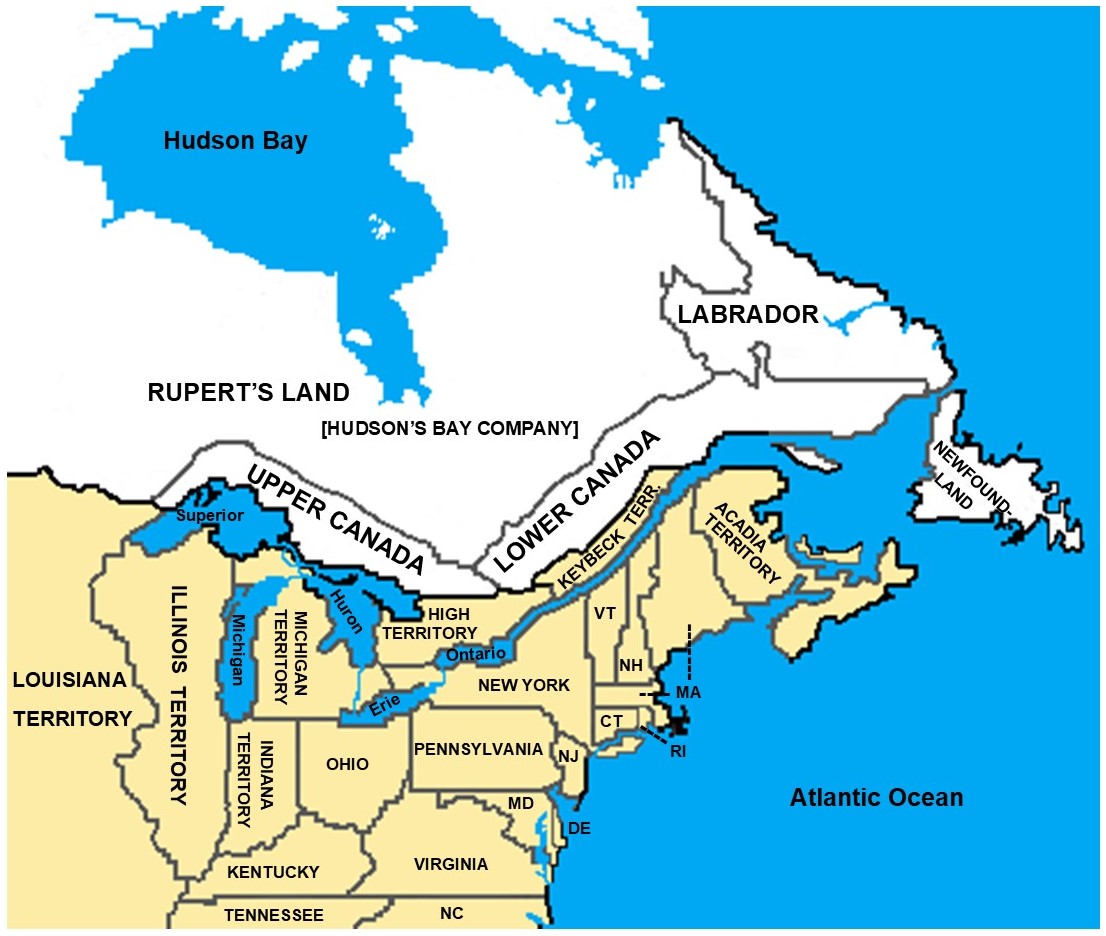
It is envisaged that the conquered areas are annexed to the USA either in the extension of existing state and territories or by the creation of the new territories, i.e. the organisation of a region before it becomes a US state. It might be argued that given the rows between states of the USA, especially around the Great Lakes, that there would not have been the extension of existing states. However, given the terrain, especially the land between the lakes, it seemed more feasible than having small fragments of new territories. In this alternative by 1815, the USA would have had greater control around the Great Lakes and along both shores of the St. Lawrence Seaway.


It is assumed that those who could not bear to live under US rule would have fled to the interior of Upper and Lower Canada making use of the trading stations that had been developed to handle the fur trade. Those most likely to have fled would have been those families of Loyalists and the black population especially if their families had found freedom in Canada fleeing the USA after the American War of Independence. It seems feasible that they would have been treated as runaway slaves and hauled back to those deemed their owners in the USA.

The pattern of laws around slavery varied quite considerably from state to state, but the recovery of escaped slaves was permitted at the time even from states which themselves did not have slavery. In addition, it is interesting to note that even as slavery was being eroded in some of the northern states, laws permitting indentured labour continued, notably for former slaves or their children up to a certain age.

Especially given that some leading individuals in the USA at the time wanted to introduce slavery to the Great Lakes region, while they were unsuccessful, I have assumed that they found it easier in the conquered territories taken from British control. Anger at the Loyalists does not seem to have declined much in the thirty years since the end of the American War of Independence so I felt it probable that Loyalists taken in the Canadas - and in New Brunswick and Nova Scotia which had actually received more Loyalist refugees than the other regions - would be punished by being put into indentured labour. I imagined they would be especially sent to aid the development of the new US states. Kentucky had become a state in 1792, Tennessee in 1796, Ohio in 1803 and Louisiana in 1812. 

I particularly became interested in Louisville as a destination for those Canadians captured in this war. In part because Kentucky was more distant from the conquered lands and because Louisville was known very much as a slave trading city and an important link in the trade between the so-called Upper South, i.e. those states south of the Mason-Dixon line but north of the northern borders of the states running east-west from Texas to South Carolina and the Lower/Deep South.

Dealing with the aftermath of the invasion and the selling into slavery and indentured labour of Canadians became the focus of this novel. I decided on using two families - Daniel and Mehitable Jarvis and their children, George and Charlotte and Cyrus and Madeleine Hartwood and their sons Lysander and Pharas. Daniel is a master cabinet maker in York (nowadays Toronto) who employs Cyrus as his journeyman. Both men are part of the York militia so are drawn into the fight against the invading Americans. I found a great resource on the York militia which really helped my story: The War of 1812 Project: https://www.wikitree.com/wiki/Project:War_of_1812 While Madeleine and the Hartwood children escape northwards into the less populated areas of Upper Canada, Cyrus and the Jarvises are captured, separated and shipped to Kentucky.

It is important to know that the Jarvises are white, Cyrus is black and Madeleine is mixed-race with one black grandparent and three white. At the time much was made of categorising races and there was a plethora of terms for different categories of mixed race people for example mulatto, quadroon and octaroon. On the 'drop of blood' principle even someone with one great-great-grandparent who was black, i.e. a  hexadecaroon, would be considered black and thus could be enslaved even if all their other relatives had been white. It seemed important to explore these aspects and note that while indentured labour was bad, slavery was worse.

Immediately this led me to worry about whether people would say I was not permitted to write black or mixed race characters especially in a story set when slavery was in force. Not to do so would have led to a very distorted story and it would almost have been as if I was ignoring that experience. In addition I reflected that while commentators might say I could not get 'inside the head' of a black person or indeed as a man write two women as main characters. I would argue that the same kind of charges could be laid against anyone in 2024 writing about anyone in 1813, not matter what their own or the characters' race. I do accept that me writing the story especially of Cyrus Hartwood is going to accept some readers and commentators, but the alternative was either to produce a very skewed novel that would have looked to be brushing certain aspects under the carpet or to have abandoned the novel entirely.

Much of the action takes place in the rural areas between the towns and especially in the Canadian sections interaction with the indigenous peoples who had settlements and had established routes that the European settlers made use of. The characters cover a great distance going through terrain from northern Kentucky to the northern shores of Lake Huron and I was keen to make sure that the plants and wildlife they encountered were authentic for each area. It did become apparent, especially for the sections in Kentucky and Ohio, how climate change has already altered this and trees, for example, that in 1813 would only have been found in more southern latitudes in the USA have now crept much further north.

This then is the background of the novel. It rotates between the perspectives of the four adults to show different elements of the conflict and its consequences. As such it is very much an adventure story as each of the characters seek to escape American control and keep their children safe. I have tried to reflect how brutal and cheap life was, and how assiduous Americans were in trying to recapture what they felt was theirs. While my alternate history novels are often adventure stories, it is unusual for me to write family dramas, but I enjoyed writing this one. I hope you will enjoy reading it and looking at your own views of how different North America might have been if this often forgotten war had gone down just a slightly different path.


https://www.amazon.com/Loyal-Pursuit-What-novel-1812-ebook/dp/B0DLJT9Z1Y/ref=sr_1_1?crid=TPTQCHWXHXU8&dib=eyJ2IjoiMSJ9.HOIwlRsPbLnrffcDzIim_A.oHox1Qr5v5WJzSJlovo7KesA1obZoBx9gP0lR_mCL70&dib_tag=se&keywords=alexander+Rooksmoor+the+loyal+pursuit&qid=1732304680&s=digital-text&sprefix=alexander+rooksmoor+the+loyal+pursuit%2Cdigital-text%2C169&sr=1-1

Thursday, 21 November 2024

Taken In Lycia: The Treaty of Sèvres Enforced Giving Fascist Italy a Zone in Anatolia


Of the peace treaties signed following the First World War, one which envisaged some of the greatest changes to the defeated Power was the Treaty of Sèvres imposed on the Ottoman Empire in 1920. While it did not entirely tear apart the empire in the way that happened to Austria-Hungary, it did treat the country more like a colonial territory than a lesser Power. The British, French and Italians had been hacking away at the Ottoman Empire throughout the 19th and early 20th Centuries, depriving it of all its North African territories as well as Cyprus and the Dodecanese Islands closer to Anatolia. Its European borders had been pushed back starting with the independence of Greece and the emergence of Romania, Bulgaria, Albania and an enlarged Serbia out of Ottoman territory. British, French and German companies had become heavily involved in exploiting the Ottoman economy.

The Treaty of Sèvres took this erosion a step further as can be seen in the map below. Britain, France, Italy and Greece received mandates - effectively colonies in all but name - and zones of influence in Anatolia. The Straits between the Mediterranean and Black Seas were internationalised. Remaining non-Turkish territories, i.e. Palestine, Transjordan and Syria largely came under the control of the British and French. Arabia, Kurdistan and Armenia were to be granted independence.


While all the defeated countries railed against the treaties imposed on them, the Turks fought back against the Treaty of Sèvres. Following the war with Greece, there was an exchange of populations. The sultanate was overthrown and the Turkish Republic established. Even the British and French, while able to hold their mandates in the Arab states could not introduce the zones in Turkish areas. Kurdistan has still not been established and Armenia only reappeared and then much farther North, following the collapse of the USSR in the 1990s. Unlike all the other defeated Central Powers, a second treaty, the Treaty of Lausanne was signed in 1923 enabling control of the Turkish Republic over Anatolia.

The leader of the founding of the Turkish Republic and the prevention of the establishment of the zones of control, was Mustafa Kemal Pasha (1881-1938) later known as Mustafa Kemal Atatürk. He served as a Colonel in the Ottoman resistance to the attempt to capture the Gallipoli Peninsula, 1915-16. He went on to lead the forces that opposed the Sultanate and the Greeks. In this novel it is envisaged that he was instead killed while at Gallipoli and consequently those trying to oppose the treaty impositions, the Sultan and the Greeks have remained disunited and as a result have been defeated. Consequently, the Treaty of Sèvres has been enforced in full. There is still a Sultan on the throne but very much as a puppet of the British.

Benito Mussolini came into office as premier in Italy in 1922 and by 1925 had established the Fascist dictatorship which was to persist across the Italy and its colonies into the Second World War. In this alternative the Italian Empire has come to include a large slice of southern Anatolia. It is named 'Lycia' the name given to part of the region during the Roman Empire, a period Mussolini liked to reference in his propaganda.

This novel is set in 1937 when the Governor of the Italian mandate of Lycia is abducted. Lieutenant Colonel Michele Tartaglia, head of the Italian detective squad is assigned to this most challenging case. Tartaglia is from the poor Molise region of Italy and coming the 'backwater' of Lycia has allowed his career to advance and for him to send money back home to his family. He is soon caught up in the internecine conflicts of the Fascist state. Since the 1970s, historians have recognised that rather than being monolithic states, the European dictatorships of the mid-20th Century were in fact more like regimes of rival 'baronies' with different individuals and bodies within the regimes competing for power. Even more than Nazi Germany, Fascist Italy had a range of centres of power, including the Fascist Party, various police and economic bodies, the Army, the King and the Church. This novel looks at the frictions inherent in such a regime as well as the tensions arising in a colony in an era of rising nationalism and sense of national identities across the world.

This book, then, is a novel both featuring a detective story but also one of political conflict within a regime and between a colonial power and its subject peoples. While Italy was never able to establish itself in its Anatolian zone, I have thoroughly researched the way it ran its empire and what groups and individuals were important in that to hopefully give a portrayal of what the running of Lycia would have been like, if it had occurred. I was very fortunate to be able to access the doctoral thesis of Dr. Dih Wang, 'The Judicial System of Fascist Italy' which was submitted at the London School of Economics in June 1939. It is clear that Wang was not only fluent in Italian as well as English, but had managed to gain deep access to the Italian judicial system of the 1930s and so provides possibly unique insight into how it functioned thus giving me a wonderfully solid basis for how it might have been translated into the Anatolian context.

It can be a challenge when writing a protagonist who is a functionary, especially a police officer in a dictatorship. However Philip Kerr with his Bernie Gunther novels, Martin Cruz Smith with Arkady Renko and Josef Škvorecký with Lieutenant Boruvka managed to do this successfully. Tartaglia is not a devoted Fascist but I wanted a protagonist who would not be unfeasible or anachronistic for the context in which he is working. He is devoutly religious and has the prejudices such as misogyny and homophobia that would be common across Europe and the wider world, in the democracies as well as the dictatorships. He is more understand of the Turkish, Greek and Armenian populations of Lycia than many of his colleagues but at best has a paternalistic attitude of a coloniser towards the subject peoples. He does have faith in due process and in a sense of justice, both of which were eroded in the Fascist state, again raising a point of tension and hopefully interest as he seeks to resolve this high profile case.

As always I hope readers will not only enjoy this novel as a detective and political conspiracy novel, but that it will provoke thought on how our history could have gone down this path rather than the one it took and what the implications would have been for the people caught up in this alternative.

Wednesday, 3 August 2022

The Blood and The Ghost: Vikings Victorious In England


Having seen the BBC television series, 'The Last Kingdom' (broadcast 2015-22), I was reminded that at the Battle of Chippenham in 878, King Alfred the Great was defeated by the Danish Army. He had to flee to the unhealthy Somerset Levels to hide out until he was able to rebuild the Anglo-Saxon Army and go on to defeat the Danes, pushing them back from recent gains in Wessex and to begin establishing what would become England under his grandson, even though it took Alfred himself another 21 years of fighting to get to that position. I had already written a short story which features in my anthology, 'Route Diverted' (2015) showing the execution of King Alfred in 879 so I had given some thought to this scenario. I was also very riled by a number of portrayals of various historical characters in the BBC series. I sought to rectify that more in the direction of how I judged those people, and indeed, I must confess, the way they were shown in the programme.

With Alfred dead, even if his supporters notably Odda, Ealdorman of Devon who in our history defeated the Danes at the Battle of Cynwit, had been able to fight on a lot would have gone from the Anglo-Saxon campaign, not just Alfred's victories after Chippenham but also his promotion of scholarship, development of a navy and particularly the development of towns around England into burghs. Burghs were better defended against Danish attack but also reinvigorated various towns that had been in decline since the departure of the Romans. Rather than following on directly from the death of King Alfred I moved forward 25 years to 903 and envisaged his real son, Edward the Elder who in our history succeeded him to be King of Wessex in 899, instead having lived in exile among the Welsh kingdoms, then as a man using Welsh backing to try to seize back his father's throne.

While Edward is defeated, his (second) wife, Ælfflæd and his children both by her and his first wife, escape. The mission to track these heirs to the throne of Wessex is at the heart of the story. I wanted two characters who while not having magic per se might have been perceived as sorcerers by the people of the time, so I created Øfura ‘The Blood’ and her brother Ræf ‘The Ghost’. They might be twins; they might be half-siblings, they do not know. However, while Øfura had brilliant red hair and is covered all over with large freckles, Ræf is an albino. Added to this, they have the ability to envisage a landscape, particularly battlefields as if seeing them from a bird's eye view. They also have very fast reactions - I was thinking of the athlete Jesse Owens and his remarkable ability to respond so fast to the sound of a starting pistol. These are skills that aid them on the battlefield and might appear as magic, but in fact we know people genuinely have these traits. They are assigned, with the help of one of Ælfflæd's servants to track down the would-be monarchs of Wessex.

The chase from Gloucester to Lewes across south-western and southern England, renamed 'Danelagen' in this alternative, presents them with many risks especially as Ælfflæd's bodyguard fight back and supporters of Ælfflæd seek to frustrate the pursuit. As well as providing action - Øfura and Ræf, plus their own band of warriors and assistants get caught up in a raid by Vikings from northern France in what is now Southampton - the journey shows how different England would be after twenty-five years under Danish rule. Towns have changed names. Towns that prospered under Alfred are still left in decline whereas others important to the Danish rulers and settlers have grown up and both locations and many residents now have Danish names and live under Danish laws. Indeed rather than the forced conversions to Christianity seen in our world, the religion of Odin and the Nordic pantheon have made Christianity into a marginal religion in Danelagen almost followed in secret. This creates a greater divide between Danelagen and the assorted Welsh kingdoms that are proud Christian heirs of the last phase of the Roman Empire. It could be argued that the coming of Christianity was inevitable, though we can note that Lithuania only stopped being a Pagan country in 1387, almost 500 years after my novel is set. Perhaps controlling all of what otherwise would have been England would have boosted the Danish adherence to Paganism.

Of course the impact of the shift in history does not all run one way. Controlling a larger kingdom, puts pressure on the Danish kings and jarls in the British Isles to become more bureaucratic; to keep records and make more use of coinage which had been well established much earlier in the British Isles than Scandinavia. Faced with countering Christian priests, rather than having the head of a family officiating as de facto priests, full-time gothi as they were known are beginning to develop. In addition now in control of what had been the Anglo-Saxon kingdoms, the rulers face attacks from other Nordic groups that had settled in Ireland, Wales and northern France, just as the Anglo-Saxons had faced Danish Viking raids. Furthermore in the 11th Century the relationship between the heirs of the Vikings would have been very different from the entangled Norman-English relationship which led to the invasion of 1066, though of course, as the rule of King Cnut, showed, it may simply have been replaced by a similar but different entanglement with Scandinavian kingdoms, though interestingly, probably sharing a more similar language.

Overall I hope I have produced an exciting adventure story which shows what I feel is a very feasible alternate route that England could have ended up going down, that would have left a significant legacy most likely down to present day.

As always I did some maps for the book. The first shows how I envisaged the kingdoms of the British Isles existing in 903 and the second what I imagined the names of various English towns would have become under the Danes.

Alternate British Isles in 903 Following Killing of King Alfred the Great in 878


Envisaged Names for an English Towns in 903 Under Danish Rule


Monday, 2 August 2021

Streseland: 1930s Germany with the Nazis Marginalised


This is my fourth novel published by Sea Lion Press: www.sealionpress.co.uk and is also available for sale via: https://www.amazon.com/gp/product/B093QHCXNH/ref=dbs_a_def_rwt_bibl_vppi_i0 

There have been a lot of alternate history novels and analysis books about the Nazi Regime in Germany being more successful than it proved to be. As early as 1937, Katharine Burdekin published 'Swastika Night' a science fiction novel envisaging a future in which the Nazis dominated the world. Other books followed while the war was on and then alternate history books appeared on this theme once the regime had fallen. What is far less common are books that look at what would have happened if Adolf Hitler had not been appointed Chancellor of Germany on 30th January 1933. While he headed the largest party in the Reichstag, the NSDAP, the Nazis had lost 35 seats at the November 1932 election and there was a sense that they had passed their peak.

We have to bear in mind that while they were elections in Germany, effectively democracy had been suspended in July 1930 with President Hindenburg effectively ruling through emergency decrees. He appointed the Chancellors which made it easy for him to simply put Hitler into the role. Hitler made great use of it, making use of the Reichstag Fire to pass the Enabling Act in March 1933 which began to dismantle the Weimar Republic as a political system. Even then, he required the support of the Z and DNVP parties in the Reichstag to get this legislation through. While he moved quickly to consolidate his position it was not until the death of the President in August 1934 that he could become a true dictator. An uprising let alone resistance by the military could have headed off that step even at this late stage.

As with so much in history, Hitler coming to power was never 'inevitable' in the way that popular accounts of the period often seem to portray it. Yes, Hitler and his party were popular. However, as the period July 1930 - January 1933 had shown, there were other options and in fact the installation of a military dictatorship might have been the more probable outcome.

My novel turns things back a few more steps to see what Germany would have needed not simply for Hitler to be left out of office in January 1933, but to dent support for the Nazi Party at an earlier stage. The party tapped into enduring complaints among the German population, especially around the Treaty of Versailles of 1919, but also the sustained support for anti-Semitism which was present right across Europe to a greater or lesser extent. However, the prime factor which had triggered rising support for the Nazis was mass unemployment. This had come about as a result of the global Depression which had begun as early as 1927 but was heightened by the Wall Street Crash of October 1929. By 1930 German unemployment was 2.8-3.2 million with figures being higher in the winter than the summer. It peaked in the winter of 1931/32 at over 6 million and was still at 5.4 million that summer. The figures for 1933 were a little better. Nazi policies such as expelling Jews and left-wingers from posts reduced the official figures for unemployment though it does appear that by 1934 there was also an improvement in the economy, one matched across Europe and elsewhere.

One example of a democratic country combating mass unemployment was the USA. Here President Roosevelt who came to power in March 1933, pursued what was termed the New Deal, a policy of state investment in numerous sectors of the economy in order to stimulate demand and increase employment. The USA had minimal official unemployment in 1929 but this rose to around 15 million by 1931, about 25% of the working age population and does not include those underemployed, e.g. put on short hours. As in Germany it began to decline by 1934, though there was a summer peak once more before continuing to decline to 9.9% by 1941. It is now argued that the New Deal did more to reduce wage inequality. However, it is clear that public works projects did create jobs and it is disingenuous now to argue that Hitler's policies such as building the autobahns reduced unemployment and yet Roosevelt's schemes run by WPA and especially the TVA dam projects somehow provided no benefit. What is clear is that not simply in the dictatorships but in democracies including the USA, UK and France there was an increasing acceptance that greater industrial planning and stimulus put into the economy by governments were an approach which can be used, though often in the face of opposition from bankers and civil servants.

So, what does this have to do with German history. Well, my novel starts from the basis of asking, what if Germany had seen New Deal and/or Keynesian style policies to reduce unemployment before the Nazis came to power? Would reducing German unemployment to 4 million in 1931/32, have taken the sting out of the Nazis' popularity? Of course, the policies would neither have eliminated unemployment, nor the Nazi Party, but it seems feasible using the policies of the style soon to be adopted in the USA, that they could have reduced both. In this situation one can envisage that while Germany would not have suddenly seen democracy reinvigorated, conversely there would not be the fall into the harshest dictatorship seen in the era outside of the USSR ultimately leading to the persecution and extermination of millions of Germans, let alone other nationalities across Europe and North Africa.

To oversee this stimulus policy, there seems to be only one man who could have successfully pulled this off, former Chancellor, Nobel Peace Prize recipient and Foreign Minister, Gustav Stresemann. Unfortunately for our world he died in October 1929, aged only 51, three weeks to the day before the Wall Street Crash. Why was Stresemann so important? His prime claim to fame was reorganising German banking in 1923/24 to counter the hyperinflation in the wake of the Franco-Belgian occupation of the Ruhr which had wrecked the economy. Stresemann pulled the country back from the scenes of worthless money with many transactions being carried out by bartering. He used innovative methods such as the Rentenmark to move to a stable position.

Stresemann was part of all the governments from August 1923 until his death so was well known and trusted in Germany and indeed in Europe and North America. Stresemann importantly was a patriotic, even nationalist liberal, so did pursue policies that were supported by the nationalist DNVP and formed part of the NSDAP's demands and was certainly anti-Communist. However, he formed a 'hard centre' around which democratic parties could coalesce. One can easily envisage that, if he had lived, he would have seen the new economic challenge triggered by the Wall Street Crash that he would have to address to save Germany.

Thus, the point of divergence in my novel is that Gustav Stresemann did not die in 1929 but lived on another 7 years. Following the Wall Street Crash he has been appointed emergency Chancellor as in 1923 and has adopted public works and stimulus schemes, notably the building of the Autostraßen motorways to create jobs and demand. This is not a radical departure as there had already been plans, stimulated by the Italian projects, to build the German motorways which feature in the book. Stresemann's schemes do not 'cure' German unemployment but reduce it notably and this adds to the decline in the Nazis' fortunes anyway. Slowly a greater degree of democracy can be established once more and naturally, on the death of President Paul Hindenburg, Stresemann, the 'saviour' of Germany once more, would be elected.

In this alternative, Stresemann is still not as enduring as the old field marshal he replaced (who had lived until aged 86) and so soon after the book opens, the stroke which killed Stresemann in our world in 1929, hits seven years later. Still, the stability he has provided for Germany and the projects he has initiated have tided the country over into a period when across the World things were improving, yet without Germany fixed on a course to war. As noted above Stresemann was patriotic and disapproved of the Treaty of Versailles and so these trends continue in his Germany, this 'Streseland', but he had learnt in the early 1920s that steady negotiation achieved much more in terms of revision than precipitate threats.

So with Germany having stepped back from the brink and still facing challenges but not falling to dictatorship, what of the Nazis? Hitler and his followers believed they were destined to come to power. Hitler had moved from his 1923 assumption that he could seize control to seeing it coming through the ballot box. In our world while he did not fully achieve this, he did enough to get him simply appointed Chancellor. With Chancellor and then President Stresemann, instead, this step would have been denied to him and indeed the Nazis' popularity may have continued to decline. Still they were a dogged political movement with a strong paramilitary wing, the SA. This enduring threat to the peace of Germany forms the core of my novel.

We follow the adventures of Gotthard Nachtigall an undercover agent employed by the RfV an internal security body, modelled on the British MI5, established by Stresemann in 1930 to combat those seeking those trying to overthrow his government. Nachtigall is sent to infiltrate the Nazis and especially their front organisation which conceals their enduring paramilitaries. While it is increasingly clear that Hitler is planning something big, it remains unclear what it is and what the authorities can do to combat it. In such a risky deception, Nachtigall has to think fast and act ruthlessly to survive in order to remain best placed to see off Hitler's threat.

Saturday, 6 February 2021

Interviewing the Alternate History Community: Alexander Rooksmoor on the Sea Lion Press Website

While I imagine anyone who regularly reads this blog will know quite a lot about me. However, if you are particularly interested in my alternate history writing and what I think about the genre, you could do worse than check out the article about me by Gary Oswald. It appears on the Sea Lion Press website: https://www.sealionpress.co.uk/  As well as being the leading publishers of alternate history books, they have regular articles including interviews with alternate history authors and other types of creators.

The article on me is based on an fascinating interview in which we ranged over how I got into the genre, the different phases that my writing has gone through, the challenges of fact in historical fiction and the potential crossovers for crime and alternate history fiction. The article can be found here: https://www.sealionpress.co.uk/post/interviewing-the-ah-community-alexander-rooksmoor

Tuesday, 10 November 2020

Byzantium Express: The Byzantine Empire Persisting until the First World War


This book, my third published by Sea Lion Press: www.sealionpress.co.uk is also available for sale via Amazon: https://www.amazon.com/gp/product/B08M8X3TCZ/ref=dbs_a_def_rwt_bibl_vppi_i0

As is often the case when I cannot sleep and need to distract myself, late in 2019, I began thinking about different scenarios of the First World War. I have published both two books of analysis on some scenarios and an anthology of short fiction. However, I had considered shorter-term changes rather than introducing a country which had been gone for about 450 years by the time the war broke out. Of course, the persistence of Byzantium has often been discussed, you can find numerous articles about it on the Sea Lion website. Alternate history author, Harry Turtledove, did not go this far, but as a Byzantine scholar he did use the empire as the basis for his Videssos fantasy stories. Another prompt for me was one of my 'what if?' book art covers from 2007: http://rooksmoor.blogspot.com/2007/08/what-if-art-3-history-book-that-never.html itself inspired a chapter in 'On Other Fields' (2012/14) about medieval alternatives.

To get to Byzantium surviving into the 20th Century, you need a lot of points of divergence. Not only do you need to prevent the steady Ottoman conquest of its territories in the 11th-15th centuries leading to the fall of Constantinople in 1453, but you need to see the empire far less damaged by the Crusades. For example, the leaders of the 1st Crusade, 1096-99, had sworn to the the Byzantine emperor to restore the cities recently lost to the Fatimids and Seljuks in Syria and Palestine. Instead they set up their own principalities, the Crusader States that shrunk over time until snuffed out in the late 13th Century. Even worse for Byzantium was the 4th Crusade of 1202-04 which smashed up the empire and replaced it with a series of Latin states which persisted until the 1260s. While this did not condemn the empire to Ottoman overthrow it severely weakened it. Removing crusader leaders, notably Bohemond of Taranto who established the Principality of Antioch in what had been Byzantine lands, is easy. The siege of Antioch was lengthy and the crusaders were almost defeated both by disease and their Muslim opponents.

A stronger Byzantium would only have endured when faced by weaker Seljuk opposition. Again, this is far from impossible. As it was the expansion and unity of the Seljuks was wrecked by the incursions of the Mongols in the 13th Century. It was out of these ashes that the Osman tribe of Seljuks rose to become the Ottomans and establish a vast empire stretching right across the Balkans and North Africa, into Arabia and Mesopotamia as well as over Anatolia and the Levant regions. In turn it was sliced up by European countries, but on the eve of the Great War, was still deemed a Power and one that Germany sought out as an ally. I have envisaged that Britain and France have seen Byzantium as a bulwark against Russian expansion in the 19th Century and so have provided funds and fought in a version of the Crimean War in the 1850s to check this.

For the Sejuks and Arabs I have envisaged that a number of smaller states would appear across eastern Syria, Transjordan, Mesopotamia and Arabia. They are quite diverse, with divisions between Sunni, Shi'ite and Wahhabi Muslims, even an Orthodox Christian state as well as between different dynasties. There is a chance that some of these would be taken over by European powers, especially via the Persian Gulf. I have envisaged that as in our world, by 1914, Britain would have taken Egypt, Italy taken Libya and France taken Morocco, Algeria and Tunisia. However, it is likely that they would have been taken from Arab or Bedouin rulers rather than Turkish ones.

I have envisaged that the enduring Byzantine Empire, by 1914, would be rather like the Chinese Empire. It would be able to hold off full-scale colonisation by European powers, but there would be economic and political penetration. I envisage a British 'treaty port', at Limassol on Cyprus and the Italians holding Rhodes on a 99-year lease. In our world, Britain effectively controlled all of Cyprus from 1878 and annexed it in 1914. Italy took Rhodes and the rest of the Dodecanese Islands in 1912. Maybe this is too few and more realistic would have been a number of treaty ports along Byzantium's various coasts, more akin to what happened in China 1840s-90s. However, my sense was that being more compact, Byzantium has been that bit stronger and largely able to resist most such demands. In addition, the independence of Bulgaria from the Byzantine Empire has been slowed up a little compared to its break from the Ottoman Empire, but again this helps the story I planned, too.

I know some fans of alternate history baulk against 'parallelism', but even with the changed situation, it seemed to make sense that as happened with the Ottoman Empire in our world, the German businesses and government would seek to penetrate the Byzantine Empire in the early 20th Century. It also provided a motive for the heroine, half-British, half-Greek to be there and provide the context for a spy story which seemed perfect for the time setting I had chosen. Too often, women are left out as main characters from alternate history novels, unless there prime focus is romance, so I always seek suitable ways to mix the genders in my novels into the action and a woman spy in 1914 seemed to fit trends of the time. Given how advanced Germany was in electricity and electrical engineering, it seemed to make sense that they would have sold such technology to Byzantium. The absence of coal in the region led me to envisage an earlier exploitation of oil from the fields in  northern Syria and northern Mesopotamia. This is not too much of a leap given the US and British navies were moving to oil power for warships at this time.

The political and economic elements of an alternate historical country are always interesting to work on. However, with this story there was another challenge that I actually found more fulfilling than I might have expected. I had to come up with a culture for Byzantium across the more than four centuries that it existed in my world compared to reality. I wanted it to be modern, especially as much of the action is in the capital, but also to show connections to the heritage that Byzantines would naturally have been proud of. I looked at a lot of Greek and Russian clothing and styles, e.g. with housing, from the late 19th/early 20th centuries and then sought to give them a distinctive twist. Thus men wear suits as they might in London, but cut higher to the neck; their bowler hats have a lower crown. Women wear kohl and more ornate jewellery day-to-day, conical rather that brimmed hats and the apomalli, a fictional counterpart of the pashmina, is an essential part of a Byzantine lady's wardrobe. With an enduring Greek culture in Anatolia, more Greek artists who in our world went to Athens or Paris have remained there. Constantinople was always a crossroads and in this novel we see foods that are typically Greek but others in our world we associate with Turkey. As a Christian rather than Muslim empire, alcohol is more widespread. The same goes for buildings in Constantinople. Much of the geography of the city would have developed on the same lines, but for example, we find the St. Eirene Chambers, gallery and theatre, where in our world the Topkapi Palace was built.

Some things did not need alteration. As it was Greece and Russia, plus other countries of the region, still used the Julian calendar in 1914, meaning I had to keep a close check on dates, especially when referring to battles that happened in our First World War and occurred just the same in this alternate world. The Metropolitan of Constantinople, the leading churchman, is portrayed unchanged from our history. I did have to extend the ruling dynasty and work out feasible names and numbers for the emperors after 1453 and their families. For other things, such as government positions and the currency, I updated what we know about the Byzantine era. Byzantium had a very complex military and civic society, perhaps highlighted by the term 'byzantine', but again it helps to give the reader a feel for what would be a distinct society and an ancient one dealing with the modern world. Given this effort, I hope that readers feel that they are stepping into an engaging alternative but also one that is feasible given centuries of divergence.

This is also the first spy story I have written. I hope that this works well for readers, how Eugeneia Cranston [reasons for the spelling are explained in the book] works as an agent and deals with sometimes very frustrating controllers in that work. I hope I have made it both seem realistic but show the characters in genuine jeopardy. I am certainly tempted to produce another alternate history spy story, given that I can find an appropriate context for one. This period when so much was still up for grabs in the early days of the war, seemed ideal and there may not be other settings that work so well. I always welcome feedback from readers and look forward to hearing your views.

Fictional Alternate History Map of the Byzantine Empire in 1914


Sunday, 8 March 2020

Thinking of Writing Alternate History?: A Guide to the Important Questions


This book is available via Amazon: https://www.amazon.com/gp/product/B085LQ6H8Q/ref=dbs_a_def_rwt_bibl_vppi_i20 

I was particularly pleased with the front cover. I had thought first to have William Shakespeare with a laptop, but apparently so have hundreds of other people, so I worked to do an Ancient Greek version which I hope both sums up the alternate history aspect and the fact that it is about writing. My only concern was that given so many people who commentate in the alternate history context are very much from the 'manosphere', seeing a woman portrayed on the front would put them off even considering this book as one they might want to rant about.

As anyone who has followed this blog down the years will know, I have long been interested in alternate history writing, whether as the basis for analysis or fiction. I had planned this book to come out in 2019. I had been aware of Grey Wolf's book, 'How to Write Alternate History' (2013): https://rooksmoor.blogspot.com/2020/02/books-i-listened-toread-in-february.html but, despite establishing a relationship with Sea Lion Press, I had been ignorant that they were releasing, 'How to Write Alternate History' (2019) in August 2019, https://www.amazon.com/gp/product/B07W44DQHG/ref=dbs_a_def_rwt_bibl_vppi_i3 so I had to postpone my book, read that one and reflect my thoughts on it in my own book which has not followed some five months later.

I have read the work of a lot of alternate history authors, though these days it can be a challenge to keep up with all the books coming out, even just on alternate outcomes of the American Civil War and the Second World War, let alone more widely. However, I felt I had learnt a great deal about the genre and so could offer advice to other authors who were considering it. In addition, I had seen the appearance of 'rules' such as 'only one point of divergence is permitted' that I felt were not only unnecessary but wrong and in fact did not take into consideration what renowned alternate history authors of the past had done.

This is a common trend in the 2010s. I know people (typically men) feel they can and should assert their 'authority' on various issues through online fora to the exclusion of any other views. I faced this with reviews of 'Stop Line' (2017) with one reviewer saying that because some online forum had decided that no German invasion of Britain in 1940 would have been possible, any author writing on that should be ridiculed forever more for even trying. Despite such scenarios being common in books written over the past decades, the Sandhurst Royal Military Academy wargame of 1974 on this very topic which suggested something very different is simply swept aside. In this era, apparently the shouting of some men in the public arena, counts for far more than analysis by senior military staff from a generation with knowledge of the war itself. In this context, this book was my shot at getting back at such indignation and indeed an attempted suppression of alternate history writing by self-appointed judges on the genre.

Drawing on loads of books and movies, this analysis looks at what kind of alternate history you might want to write. While at present fiction is the prime focus, in previous decades books of analysis have been popular and I have enjoyed writing some myself. Though not attracting so much attention now, people continue to produce sober, fascinating analysis which can actually help the alternate history fiction author. I look at podcasts on alternate history, a growth area. I also look at the role alternate history short stories can play, whether stand alone or part of a 'fix-up' anthology. I look at the principles of alternate history and without imposing any rules, highlight bases on which your book might be challenged, in terms of feasibility and even including characters. One revelation to me in recent years has been in reading historical novels, usually set in wartime, which do not feature any (female) characters. Having read so much Bernard Cornwell, I had not realised that was a sub-set of historical writing and it can be used as a way to criticise alternate history novels for 'wasting time' and 'not getting to the real alternate history' if you develop characters in your story.

I look at the mechanics of alternate history novels, such as whether the main character arrives or lives there; the use of points of divergence and how far you set your story from them. I address the challenges when featuring time periods or events that readers may be unfamiliar with, let alone may cling very strongly to popular, though actually inaccurate, views about. I look at the controversial concept of 'parallelism', i.e. using people from our history over in quite a different context. While people dismiss this as 'wrong' in alternate history, again it is in fact very common in some of the most successful alternate history novels and stories. One large section drawing on numerous books, shows how alternate history is often the context for another genre, for example spy thrillers, murder mysteries, fantasy, slice of life stories or even romance.

There are some sections advising alternate history writers on how to deal with the kind of hostility writing in the genre is liable to attract. This is especially the case, as the book explores further, when alternate history writing is so often put to contemporary political uses especially in the USA. The book ends with a select bibliography outlining a range of books, stories and movies that you may not have encountered.

Overall, I hope authors and anyone interested in alternate history writing, whether fiction, analysis or for the screen, will find this a useful and interesting book. As always, I expect that some will be indignant with what I have written and will dismiss me as an idiot. However, one of the main reasons why I came write alternate history was to stimulate discussion and debate. Maybe I am naive in this age when it seems that people are primarily motivated to enter 'discussions' simply to shut down opinions which differ from their own. However, I do cling to some optimism that this book will generate discussion about the full scope of alternate history writing and the different ways in which it can be done.

Sunday, 20 October 2019

Against the Devil's Men: 'What If?' Novel of Greater Success of the Mongols in Europe in the 13th Century


This is my first book published via Sea Lion Press: https://www.sealionpress.co.uk/ I approached them in the summer of 2017 with 'Eve of the Globe's War' (2017): https://rooksmoor.blogspot.com/2017/09/eve-of-globes-war-what-if-novel-of.html but very foolishly pulled out of the arrangement, I am not certain now why I did that. However, I was glad that Tom Black, head of Sea Lion, gave me a second chance with this book. I had always been interested in having a story about what if, in 1242, the Mongols had not simply turned back from Europe following the death of their great khan, Ögedei Khan. This had been stimulated, as had the title, by the non-fiction book, 'The Devil's Horsemen' (1979; revised 2003) by James Chambers. I had picked up a copy remaindered in the mid-1980s though it was not until many years later that I read it, as is often the case with non-fiction books I buy.

My first shot at a story along these lines had been with a novella which is now encompassed as 'Facing the Devil' within 'Déviation: What If? Stories of the French' (revised 2015): https://www.amazon.com/gp/product/B00L45ATYC/ref=dbs_a_def_rwt_bibl_vppi_i12 That story covers events later than 'Against the Devil's Men' being set in 1272 and based in northern France. The story was not well received especially by one reviewer who is an advocate of the medieval Mongol expansion and feels that any story of the time which is shown from any perspective that is non-Mongol, must be like a project for primary school children. However, I thought, for myself, it highlighted how western European states might have dealt with the Mongols if they had continued progressing farther west. I envisaged that trying to cling on to the European enclaves in Palestine and Syria would have to be abandoned, but that the various crusading orders would have turned their focus on fighting the Mongols. I also saw that the Papacy, under threat in northern Italy and with southern France at risk too, would have withdrawn to the Iberian Peninsula. Given that the threat would have involved numerous Christian states, and indeed Muslim ones too, I imagined that the Papacy would have 'weaponised' much of western European society with both religious and military orders focused on repelling the existential threat.

Thus, from these ideas, I began to decide how I could make a full novel. I settled on three characters to enable me to give different perspectives on what was happening. I wanted to emphasis just how cruel the Mongols were and how unlike other enemies European soldiers had faced, were so destructive no matter whether their victims were Christian, Muslim or Pagan. Thus, I came to include a Cuman horseman, Captain Braçayda 'Barc' Ulas. The Cumans are interesting people who were pushed westwards by the Mongols and received somewhat of a warm reception in Hungary. The Magyars themselves had been a similar nomadic people who had previously settled on the Hungarian plains and become what we know as Hungarians. I also wanted someone who could fight to give action for the story. I also wanted to show the impact of the Mongols on the people in the areas in which they settled, so this led to Sister Aurea of the Mercedarians. She is a half-Mongol, half-Italian woman born as a result of rape who fled into 'France' from Mongol held northern 'Italy'. The Mercedarians were a bold order that were willing to risk their lives for imprisoned Christians; she also provided a way in for what I saw as an undercover mission among the Mongols. Then, finally, to represent how the weaponised clergy was used, I included Brother Cataldo, a Trinitarian friar originally from Venice. The states of Venice and Genoa were known to be flexible in relations with the Mongols and I saw that as liable to grow as the invaders' power extended.

All that remained was to determine what these Papal agents would do and this led to lots of exploration of diseases among horses and how these could be spread. With all these factors in place, my trio - though the story is primarily seen through the eyes of Cataldo - were ready along with a band of soldiers and later some sickening horses to go on their mission. Their journey allowed me to show the complexity of society at the time, especially the multiple states in what is now southern France. There is room for jealousies of both secular and clerical authorities and to look at some of the stunning towns in the region though those in northern Italy, as happened elsewhere the Mongols went, have been reduced to ruins. Along the way the characters encounter people showing what impact the grim threat of people many genuinely believed to be demonic, would have, so there are heretics and millennial cults arising. The Cathars were strong in the region even in our version of the history and have continued when an even greater threat to Christendom has taken priority.

I hope readers appreciate all the details, of food, clothing, weapons, horses, towns and different groups. I was pleased with what I felt was a rich experience with numerous points of tension and scenes of action as well as reflections on the political and religious developments of the time. Some pressed me to include things like sex between Cataldo and Aurea, despite an 18 year age difference between them and both being sworn to chastity. However, I am glad I resisted this and that one reviewer has picked up on the fact that I have been careful to show characters following the views of the time rather than me including anachronistic attitudes from my own. This includes showing people, whether in religious orders or following a heresy or simply fearful of the Mongols, sincerely believing the views of the time; accepting the supernatural and the reality of the Devil and his agents. As such, I hope that while providing an interesting exercise in alternate history story-telling, readers can also enjoy exploring a rich historical context based on extensive research. Of course, if you spot some error, please let me know first before emblazoning them across Amazon reviews.

Saturday, 10 February 2018

Wars to End: What If? Stories of the First World War

Wars to End: What If? Stories of the First World War


This is the latest in my what if? short story collections.  It seemed apt, with the centenary of the end of the First World War coming this November to focus on alternatives for that conflict.  This is the first collection I have organised on a chronological basis with stories in the book stretching from June 1914 with no assassination of Archduke Franz Ferdinand to April 1940 approaching the anniversary of the success of the Gorlice-Tarlow Offensive in a world with no Second World War raging.  As is the case with my what if? collections, there is no attempt to provide an overarching history.  Instead, each of 22 stories starts from a different alternative.  Some stories see no First World War or a more restricted version breaking out; others see an even more devastating or longer version.  In this book, in contrast to other collections I have produce, the story is typically set just a short time away form the divergence from our history rather than decades or centuries later.

The changes vary in scope.  At the simplest level is a single assassin missing.  Then there are local changes, such as British mutinies spreading further and to a greater extent; an earlier German assault on the Verdun fortresses at a time when the French garrisons had been thinned greatly or the German plan to draw out British cruisers working better leading to a more conclusive Battle of Jutland.  There are changes at a strategic level, for example adherence to an earlier version of the German invasion plans which involved marching through the southern Netherlands rather than leaving it neutral and pulling back on the Lorraine Front to draw French forces further from Paris or in 1918 launching a more co-ordinated Kaiserschlacht so forcing the British back.  These were decisions that could have been made by the generals or their commanders.  Some others stem from geopolitical alterations, such as Italy remaining loyal to the Triple Alliance and invading French territory; the Japanese being an ally of the Germans rather than the British or Romania entering the war earlier and participating in the Brusilov Offensive or the Ottoman forces going into Egypt sooner than in our world.  Others have a technological alteration, such as the British developing tanks two years earlier; the appearance of biological weapons and the kinds of gas and tanks that were planned by the Entente to continue the war in 1919.

I hope that this book shakes off the attitude that tends to be so common especially in Britain, that 'it had to be that way'.  Some alternatives, such as Kaiser Friedrich III living into the 20th century are just from a twist of nature, but many could have arisen from influential people making different decisions at the time based on the information they had then so could have easily occurred.  Even if you disagree with the outcomes that I suggest in these stories, I hope this book will interest you and provoke thought and debate about how different the First World War might have been and, indeed, that it easily may not have occurred at all.
 

Sunday, 28 January 2018

Scavenged Days: A ‘What If?’ Novel of the Impact of the Assassination of President De Gaulle

Scavenged Days: A ‘What If?’ Novel of the Impact of the Assassination of President De Gaulle


Certainly since first seeing the movie 'Ascenseur Pour L'Echafaud' (1958; novel 1956) and 'Le Samouraï' (1967) I have long wanted to write a book set in France in the late 1950s or early 1960s.  In part it is because of the style of those days with suave men and sophisticated women in fashionable clothes, eating well and driving around in sleek cars.  The period was also one of great upheaval for the country, with an attempt by disaffected military officers to overthrow the government, a sustained colonial war in Algeria and terrorism both from nationalists and the state there and in France itself.  I had long toyed with writing a detective novel set in that context.  However, I settled on a 'what if?' novel, possibly the genre that I have best become known for.

There are lots of potential points of divergence in French history of the time.  One reason for this is the assassination attempts that the President of France, General Charles De Gaulle faced.  Two attempts came very close to killing him.  The attempt at Petit Clamart in August 1962 when hundreds of bullets were fired at De Gaulle's car features in the opening minutes of the movie of 'The Day of the Jackal' (1973; from novel 1971).  However, I used the September 1961 attempt close to Pont-sur-Seine in which De Gaulle's car was blasted across the road by explosives and napalm.  If it had not been for the age of the explosives and the failure of the assassins to follow up with gunfire, De Gaulle could easily have been killed.

Those targeting De Gaulle were the OAS - the Secret Army Organisation made up of disgruntled officers and their supporters.  It carried out a string of terrorist attacks with the intention of bringing down the French government and so retaining, they believed, French control of Algeria, its colony since 1830.  Initially they believed that De Gaulle would achieve this for hem, but they rapidly turned against him when it became clear he was going to grant the country independence.

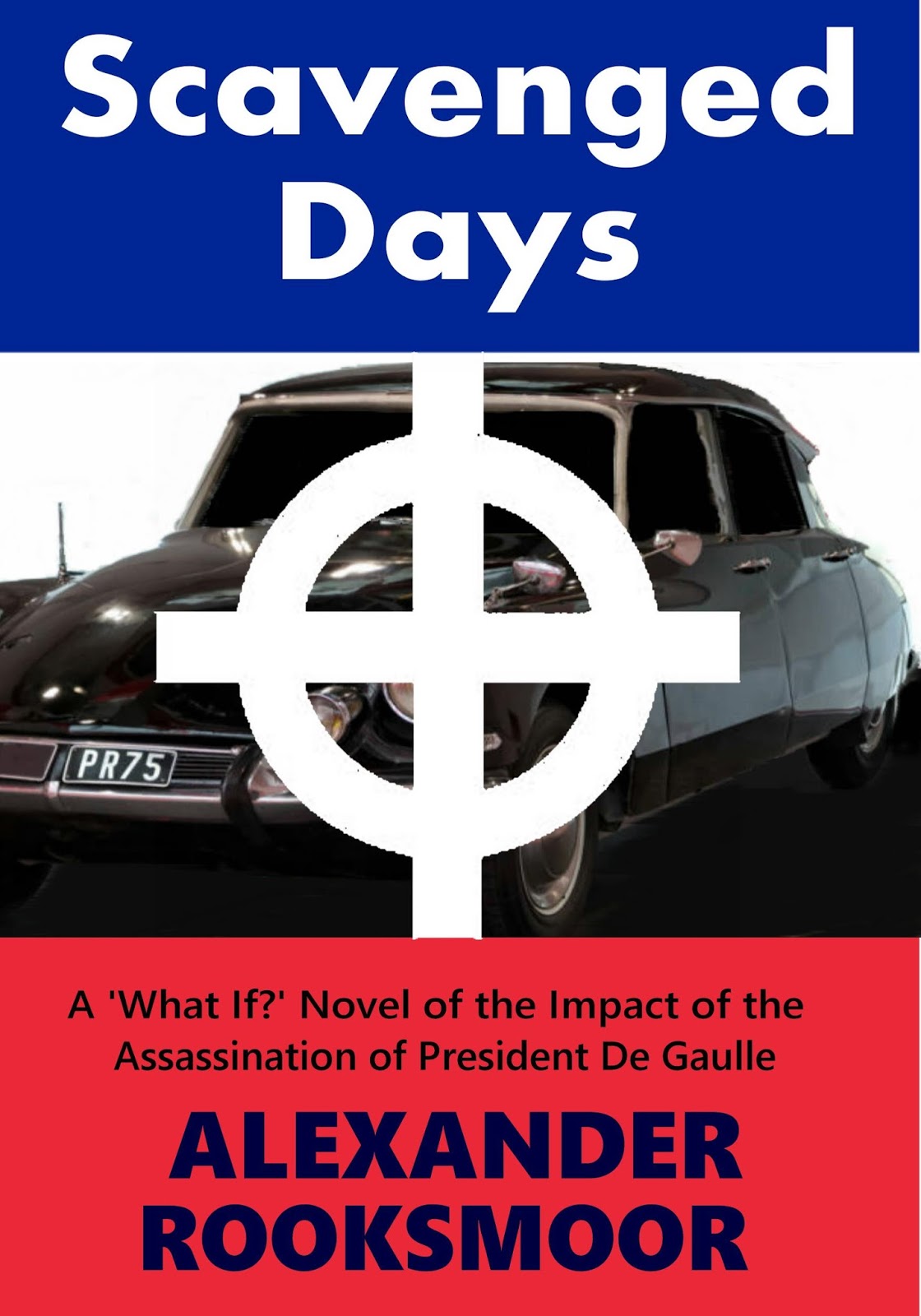
This novel focuses on the days following the successful assassination of President De Gaulle in September 1961, when the OAS - its symbol was the Celtic cross featured on the book's cover - in its triumph, aims to seize power in France.  With 'what if?' novels it is often a challenge to show different sides of the story. I am alert to criticisms of my books, that, despite extensive historical notes, I do not give sufficient context for the differences from our own history in the text. You sometimes end up with the leading characters in alternate history fiction taking a convoluted journey in order to witness different events.  Often there is lengthy expository dialogue to fill the readers in which can really deaden a novel especially if it is a thriller.  Having different characters witness different development, can also lead to a charge I have received that it makes the book 'fragmentary'.

In 'Scavenged Days' I have gone for a hybrid approach.  At the heart of the story is young magazine photo-journalist Laure Favager.  I am conscious that many alternate history books are often male dominated.  I have always included female characters and think it is essential to show the impacts on different kinds of people. Thus, police, civilians, old people, civil servants, all appear.  Laure is a modern sophisticated woman, drawing in her lover, businessman Roland Trémaux and her boyfriend, journalist Gilles Vasseur into the danger that France in this situation is facing.  However, in line with my sense of the importance of the vulnerability of lead characters, she is highly flawed and her involvement with the conspiracy to seize power challenges her.  As always, while the 'what if?' is the focus, I feel it is a weak book that does not reflect it through people and simply ends up something like a wargaming scenario.

As is the case with all my work, I have done immense research on the historical details of the setting, not simply the politics, but also the fashion, the food and the cars, to give it that finesse that I envisaged when first thinking about a book set in this era.  I am sure that there will be people queuing up to condemn the book as pure fantasy and that it could not have gone that way or to moan about the fact that there is not enough shooting.  They will complain about some pistol one of the characters is shown using, or more worryingly that too many women feature in the book, which, in their eyes should all be about men.  However, no author can choose their audience.  I hope you find this both an exciting and interesting book, taking a look at a slice of modern history which, certainly in the English-speaking world, is sorely overlooked.


https://www.amazon.co.uk/Scavenged-Days-Impact-Assassination-President-ebook/dp/B079J2FBV1/ref=asap_bc?ie=UTF8

Sunday, 3 September 2017

Eve of the Globe's War: A ‘What If?’ Novel of the Coming of the Second World War without an Industrial Revolution

Eve of the Globe's War: A ‘What If?’ Novel of the Coming of the Second World War without an Industrial Revolution

Today I self-published a new 'what if?' novel for sale on Amazon.  Rather than look at a small shift in history of one country and its implications, this one considers what would have happened if the Industrial Revolution had not been permitted to happen.  As the introduction outlines, there have been many regimes and societies throughout history that have resisted innovation; indeed passed laws against it.  The Classical societies of Egypt, Greece and Rome did advance knowledge in certain areas but as slave economies felt no need to go further and indeed many of the skills they had were lost.  In Imperial China and Shogunate Japan there was active resistance to innovation for fear of the damage it would bring to the established regimes.  Thus, looking at absolutist monarchies that were increasingly strong across Europe in the 18th century, often with monopolies over leading industries, it seemed highly feasible that innovation may have been halted; punishable by death.  Discovery of China and Japan seem to simply vindicate that this was the right approach for these restrictions.

Having set up this scenario I aimed to pick a well-known element of our history and show how different it would have been without the industrialisation of the 18th and 19th centuries.  I lit upon the Munich Crisis of 1938 when Germany demanded the Sudetenland region of Czechoslovakia.  In addition, paralleling with the German use of the Enigma ciphering system and its provision to Britain and France by Polish intelligence, I thought the idea of agents seeking such a device would form the good basis for a story.  In order to highlight the differences I used well known people from our history: Winston Churchill, Anthony Eden, Bernard Montgomery, Neville Chamberlain, Oswald Mosley and Adolf Hitler to show that the lack of industrialisation would have not simply have impacted on the technology available but also the societies of Europe.  In our world there was still limits on chances to advance, but in a democracy even a man from a mercantile background like Chamberlain could become Prime Minister of a large empire and Adolf Hitler, a failed painter, son of a customs official, could rise to be dictator of Germany.  In a world where society remains dominated by the nobility such men could not have progressed.

I have felt that the Stuarts were more liable to become an absolutist monarchy for Britain than the Georgians would have been, given the behaviour of Charles I and James II.  People might challenge that the family, especially Charles II, had an interest in science.  However, given the removal of Charles I, their Stuart descendants - stemming from children of Queen Anne surviving rather than dying in infancy - seemed more like to adopt the kind of absolutist approach favoured in France, that in our world, provoked the French Revolution.  In this alternative rumblings on both sides of the Channel have not gone any further.

The map of Europe looks very different too.  As there has been no French Revolution so no Napoleonic Wars,  the Holy Roman Empire and various Italian kingdoms have been left in place.  The slow speed of communications and relatively low level of urbanisation has meant that though things have developed from the early 18th century, it is of a fraction of the scale of what happened in our world in the same time period in so many aspect.


This is the map I produced to give an idea of what the heart of Europe is envisaged as in this book, in itself providing opportunities and challenges for the heroes and heroine as they travel by horse-drawn carriage, river-carried barge and hot-air balloon from London to Munich and back.

This book is a spy novel set in this alternate context and it has a greater romantic element than my previous novels. It is interesting as an author when a character appears and then gains a more central role than you had ever anticipated and this is what occurred with Écuyesse Servane Adélaïse Perenelle Bérénice de Grimoard who grew from an incidental to being a counterpoint to the Honourable James Manners, the rather feckless civil servant dispatched with the motley crew of notables - Churchill, Eden and Montgomery to barter for the Prussian cipher machine, of course, unlike the Enigma of our world, operated by hand; electricity not being in use in this alternative.

I hope a spy novel set in a very different 1938 to our own will appeal to readers. It provides a very different story set around the Munich Conference to that seen in Robert Harris's forthcoming novel!

Friday, 10 February 2017

The Three Eagles: A What If? Novel of the U.S.A., Mexico and the First World War

The Three Eagles: A What If? Novel of the U.S.A., Mexico and the First World War
 
 
Today I self-published a new what if? novel on Amazon called 'The Three Eagles'.  I have long wondered why, having won the 1916 election on the slogan 'he kept us out of the war', Woodrow Wilson decided to enter the First World War in April 1917.  It was 23 months after the RMS 'Lusitania' with 128 US citizens on board had been sunk by a German submarine and it is clear that, despite the popular view, it had minimal impact on US foreign policy. 
 
Wilson decided to go to war despite him proposing peace terms to both sides of the conflict.  He seems to have been put out by the fact that both the Allies and the Central Powers, made no genuine proposals and simply put forward their list of objectives.  Two factors, however, meant that the USA entered the war on the side of the Allies, though it largely kept its armed forces separate and did not become a formal ally of Britain or France.  The first was the resumption of German U-boat attacks on neutral shipping, notably US ships.  The Germans had curtailed this on two previous occasions following requests from President Wilson but at the start of 1917 reneged on this.  The second was the Zimmermann Telegram sent to the German ambassador in Mexico to encourage the country to attack the USA.  Wilson was always more concerned with Mexico than Germany and US marines had occupied locations in Mexico in 1914 and he sent the so-called Punitive Expedition in 1916 commanded by Brigadier General Pershing to try to catch Pancho Villa, a revolutionary whose men had been responsible for raids into the USA.  The Expedition achieved little and Pershing was sent to Europe to command US troops dispatched to France, the American Expeditionary Force (AEF).
 
One important fact to remember is that in 1917, the US Army was very weak; smaller than that of Serbia.  Many troops had equipment and uniforms left over from the American Civil War which had finished in 1865; on reaching France they were largely kitted out by the French Army.  As the AEF received their own portion of the Western Front they were kept apart from the seasoned British, French, Belgian and Portuguese troops, so they had to learn from scratch.  Consequently US casualties were seven times higher than other units fighting on the Western Front.  Involvement in the war even for such a short time, meant the USA paid a heavy price.  However, the presence of US troops and the food and war materiel that accompanied them, gave heart to the Allies, particularly the French.  US troops were particularly important in defending Paris in May 1918 when the German Kaiserschlacht Offensive almost went further than German troops did in 1914 when they almost won as it was.  With no US troops in France in 1917-18, it is likely that the French and probably the British troops too, would have suffered widespread mutinies and the German Army would have reached Paris in May 1918.  They had already beaten Russia into surrender in March 1918.
 
Thus, this book works from the basis that the Germans avoided upsetting Wilson for a third time and he was left to carry out further action in Mexico, where just as on the Western Front in our world, the ill-equipped small US forces struggled against battle-hardened Mexican troops and the various revolutionary armies.  Meanwhile with the Germans having won a last gasp victory in Europe, they have not gained all that the nationalists fantasised about, but have been able to secure the worldwide empire that the Kaiser had dreamt of.
 
This is the counter-factual background, which, as with all my writing, has been carefully researched.  As with my other what if? books and stories, however, it is the impact on characters that interests me rather than labouring through details of battles.  This book is in three sections, the first features a National Guardsmen sent to occupy a Mexican oilfield in 1917; the second sees a US spy investigating a new German submarine base on the Gulf coast of Mexico in 1920 and the third is set in 1923 covering a pilot sent to root out one of the remaining revolutionaries operating in northern Mexico.  If you enjoy a alternate history setting as the background for adventure stories, then I trust this novel will appeal to you.