Showing posts with label book art. Show all posts

Monday, 16 September 2013

What If? Art 7: History Books That Never Existed

It has been six years since I posted any 'what if?' book covers on this site, the last being my spate of 'lost' books back in November 2007:  http://rooksmoor.blogspot.co.uk/2007/11/what-if-art-6-books-that-existed-but.html  The use of book art as an element of 'what if?' speculation has long interested me and my engagement with it is outlined here: http://rooksmoor.blogspot.co.uk/2007/08/what-if-art-1-history-book-that-never.html

For the cover of my latest 'what if?' anthology, 'Other Lives: ‘What If?’ Outcomes for Famous People in History' (2013), I considered doing gravestones or announcements in newspapers.  However, the people feature stretch from Alexander the Great in the 4th Century BCE right up to people in the 20th century.  In addition, not all the differences about the duration of their lives but also some of them taking different decisions.  As a result I returned to the idea of creating history books that never existed in our world.  I tried to keep as close as possible to the style that you find on history book front covers, though also to bring in a bit of variety.  These appear as small images on the front of the book.  However, I thought people might enjoy seeing them separately in a larger format here, with some explanation of why I decided on the different titles and formats.

One challenge was that to emphasise the alternate history aspect often required two things.  First the date has to be included to show the precise divergence from our history.  This is notable with the book on the impeachment of George Bush.  I included '1987' in the title, as I envisaged Bush becoming President following the assassination of Ronald Reagan in 1981, rather than being impeached during the term of office 1988-92 that he had in our world.  The other challenge for those who I was looking at as living longer than in our world, was to find images that showed them as older than they ever were in our history.  Thus, I had to work on the hairline of Julius Caesar and Abraham Lincoln and spread the grey in Indira Gandhi's hair far further than was the case in our history.

'Alexander the Great's Conquest of the Iberian Peninsula'


 For this cover I used an image of Alexander's father, King Philip II of Macedonia to stand in for the older Alexander the Great.  The book envisages Alexander living into his fifties rather than dying in his early thirties.  Thus, not only completing his conquest of western Asia but then turning to conquer the remainder of the Mediterranean region with this book focusing on his final conquests in what is now Spain and Portugal. 

'The Bactrian Campaign of Julius Caesar' 


The basis of this book is Julius Caesar surviving or preventing the assassination attempt against him.  As a result he lived on into his sixties and was able to carry out the conquests in western Asia that we know he had planned.  Bactria is the region of Central Asia between the Caspian Sea and the Hindu Kush, covering the modern central Asian republics.  It was a region Alexander the Great knew and Caesar had sought to conquer.  I worked to adjust the image to make it appear as if it showed an older, more wrinkled Caesar.  He was concerned baout hair loss and in this image I have him with some male pattern baldness.
'Parliament's Lost Leader: Oliver Cromwell 1599-1643'


This is another example of a cover that needed dates on it to show that it was Cromwell's earlier death, in this case in battle in 1643, rather than peacefully in 1658 which was envisaged.  By this stage Cromwell was significant in the Parliamentarian camp but was not yet in a position to become leader of the country.  Thus this book would ask what missed opportunity the country had with him being killed at this stage.  If his death was earlier then it is unlikely he would have warranted his own historical study. 

'1777 - The End of the American Bid for Independence'


In my book, the focus is largely on George Washington dying at Valley Forge along with many of his troops in the winter of 1776/7.  However, if he had died then, his fame might not have been sufficiently significant to warrant a book of his own, so I envisage this one seeing with his death, the break up of the Continental forces and the end of the attempt of the Thirteen Colonies to break from British control.  This is a manipulated painting which actually shows Continental soldiers being trained.  However, it seemed to sum up the difficulties at Valley Forge and the three men at the front are in very submissive positions and look as if they are laying down their arms, assuming they have been captured by the British.  The background is the Continental flag of the time.
  
'Lincoln's Post-War Administrations 1865-1872'


This book like the one on Caesar envisages Abraham Lincoln surviving assassination in 1865 or that never having been attempted.  Again I needed to age him in the photo and I added in a map of the USA from the post-Civil War period to show Lincoln living on into this period.  His survival would have meant much more difference to that period of US history than I initially realised. 


'The World Economic Depression and the Demise of Capitalism'


This uses the classic Progress Publishers style for a book that never existed.  Progress Publishers were a Soviet back publishing house that made Communist literature available in cheap editions in the hope that ordinary people would buy them.  They were typically purchased by students who had to read set books.  This one would have been published in 1931 assuming that Lenin had not died in 1924 but had lived on as leader of the USSR.  The Great Depression which began with the Wall Street Crash of 1929 appeared to many Communists and Fascists to be the proof that capitalism could not work and that a different political approach was necessary.  One could imagine Lenin delighting in his emotionless way to the difficulties capitalism was facing and have hoped that the world Communist revolution was imminent.

'The Overthrow of President Franklin D. Roosevelt'


This one envisages the planned coup d'état of 1934 actually going ahead, leading ultimately to Franklin Roosevelt being pushed from power, probably forced to retire on grounds of ill-health.  I felt this picture might be his resignation speech to the nation.  This was a scenario that I had not envisaged leading to such a bleak outcome for the world as a whole.  However, it quickly became apparent that without the New Deal and certainly Roosevelt's almost one-man attempt to involve the USA in the Second World War not only would that war have dragged on longer but the US and the global economies would have struggled to return to any kind of prosperity well into the 1960s. 

'Gustav Stresemann and the Decline of National Socialism 1931-35'

  
As a bit of a contrast, for this one rather than use a photograph, I picked a commemorative stamp for Gustav Stresemann.  I manipulated the dates on it so he is shown as living to 1936 rather than dying in 1929 as was the case in reality.  The point behind this book is that probably only Stresemann had the skill and appeal across the political spectrum to undermine National Socialism, the proper name for Nazism.  He was a conservative and a nationalist but certainly never sought anything like the regime Hitler installed.
'A King of Our Times - Edward VIII, 1936-72' 

This is another one in which the date was necessary to show the change.  This is a late picture of the Duke of Windsor who in our world ruled briefly in 1936 before abdicating so he could marry the American divorcee, Wallis Simpson.  This book envisages he never met Simpson or he chose to remain on the throne.  The trouble with Edward was his willingness to interfere in politics, engage in illegal currency deals and his sympathies for Nazism.  Given he would have been influential in the run-up to the Second World War, it is likely that this would have had an impact on British foreign policy.  I have opted for the styling of a bland 1970s book on monarchy that you can see online which belies the kind of difficulties this alternative would have brought to Britain.
'The Collected Articles of Benito Mussolini' 


It was quite a challenge to find a photo of Mussolini in which he was not in military clothes, shaven headed and pontificating.  This is a surprisingly human picture of him that seemed to fit really well with the different path envisaged, i.e. rather than becoming a dictator, he remained a Socialist journalist.  As a consequence, rather than being executed in 1945, I envisaged him living into old age.  His longevity and his writing is likely to have meant that he received some attention across Europe, perhaps even becoming a kind of older statesman of Socialism, though maybe not to the scale of Antonio Gramsci.
  
'The Assassination of Charles De Gaulle'


This is an old image dating back six years, which I revived for the chapter in 'Other Lives' on the assassination of De Gaulle.  I removed the date from this one as the chapter speculates on his killing at a number of dates.  However, the picture is from the early 1960s so suggests an assassination at that time.  As I wrote the chapter, my views on when the assassination would have had greatest impact shifted back in time a little.  However, I think this is one feasible 'what if?' which tends to be overlooked by writers. 
'Nixon as President: The Second Term, 1964-68' 


As is often the case with these alternate history covers I start with an actual history book.  This ones envisages Nixon being first elected in 1960 when he was narrowly beaten by John F. Kennedy, rather than in 1968.  The picture fits with the timescale of the book.  The 'button', i.e. the badge, is a genuine image of one produced for the 1964 election when Lyndon Johnson won.


'China's Reprieve: The Fall of Chairman Mao, March 1966' 


This centres on a picture of Mao Zedong with his likely replacement if he had been overthrown in the mid-1960s, Deng Xiaoping.  While China would have remained a totalitarian dictatorship under Deng, it certainly would have been spared the madness of the Cultural Revolution 1966-76 that caused so much damage to the country.  The Cultural Revolution was primarily about Mao re-establishing his predominance in China, so with him being ousted, which seemed possible at this time a different path would have been followed.

'The Indian Dictatorship, 1984-89'


This was another book about a leader avoiding being assassinated.  The idea is that Indian Prime Minister Indira Gandhi avoided being assassinated in 1984 yet the attempt on her life and accompanying turmoil in the country led her to impose a dictatorship as she had effectively done in the 1970s.  For this picture I had again to try to age the image and I think it comes out reasonably well, with Gandhi's streak of grey having spread more widely across her hair.  This picture with the furrowed brow makes her look older too. 
'The Impeachment of President Bush'
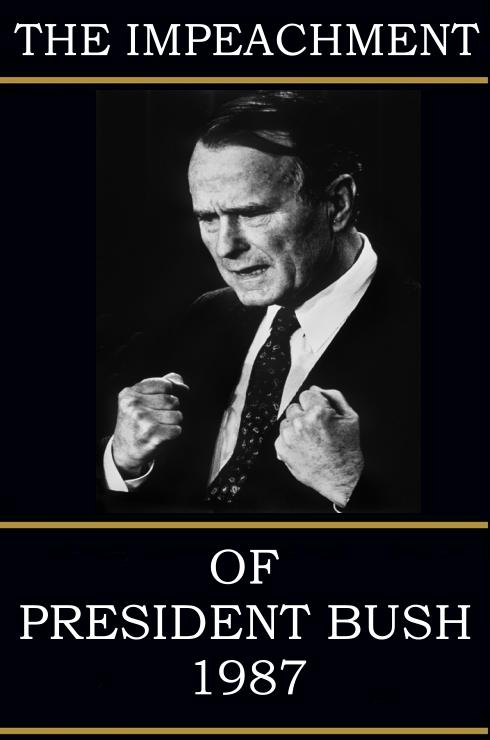


I have explained the reason for the date at the start of this posting.  This cover is to signify a chapter which is less about Bush than about the implications of the assassination of Ronald Reagan in 1981.  With the De Gaulle one in place, I did not want another title with assassination.  The chapter naturally envisages Bush as Reagan's Vice-President, as Johnson did after Kennedy's assassination, taking over at his death and serving out Reagan's term, then being elected himself.  Furthermore it seems likely that Bush would have become directly involved in the Iran-Contra scandal and this would have led to him being charged with wrongdoing and to his impeachment.  It is probable that in such a situation Bush would have resigned as Nixon did when threatened with impeachment.  However, I picked this image as it suggested Bush had the pride and arrogance to hold on and to fight against the charges.

Saturday, 17 November 2007

What If? Art 6: Books that Existed but have been Lost

This posting is slightly different. All of the books shown did actually exist at one time, it is just that for various reasons they have now been lost to us. In the past ten years a whole slew of lost books has turned up in various places, suich as 'Paris in the Twentieth Century' by Jules Verne (1863) a very accurate prediction of Paris in the 1960s which reappeared in 1997; 'Basil Howe: A Story of Young Love' by G.K. Chesterton (1894) was published in 2001; 'The Rum Diary' by Hunter S. Thompson (1950s) which resurfaced in 1998; 'Summer Crossing' by Truman Capote (1943) republished in 2004, 'The Last Cavalier' Alexandre Dumas's final novel which had been lost then refound and published again in 2005, plus Robert A. Heinlein's 'For Us, the Living' (1939) which was suppressed as it was seen as 'too racy' at the time. This year, 89-year old Dutch author, Hella Haasse found a manuscript of her own lost book 'Sterrenjacht' (Hunt for the Stars) (1950). The next one to be published imminently is 'The Children of Húrin' by J.R.R. Tolkien which is apparently set 650 years before the events featured in 'The Hobbit'. There is a great list of lost books at: http://en.wikipedia.org/wiki/Lost_work Many of them date from Classical times and it is just an issue of things being lost in history or destroyed for example in the burning of the Library at Alexandria. Even material that we know about produced by William Shakespeare is now no longer available, but we know it existed because others refer to it (the same has happened with paintings, some artists include other artists' paintings in the background of their pictures and these are often the only clues, along with things like bills of sale, that we have about these paintings which are now lost). In more modern times, books have tended to be lost because of war or repression or more often because the author themselves or their executors have destroyed incomplete or early work or work that embarrassed them. Capote thought he had done this with his early 'Summer Crossing' but one manuscript escaped destruction.

Thus, the novels and the plays featured here are books which existed at one time, but you certainly can no longer pick them up at your local bookstore. Whenever a lost novel is found there is a great rush to get it published as sales, if only based on curiosity alone, are typically strong. This is a range of some of the interesting lost books. I have worked on the covers over a few weeks and have noticed I have become rather dependent on Victorian paintings for the covers, sort of Pre-Raphelite style in most cases so I hope you forgive my lack of imagination in this respect. I will do them in chronological order.

'Achilles' by Aeschylus

Aeschylus (525-456 BCE) was an Ancient Greek playwright. He is supposed to have written 90 plays in his life of which only 6 survive with another possible one attributed to him. Fragments of his 'Achilles' were found in mummy wrappings a decade ago. His plays were tragedies and very influenced by the Persian invasion of Greece so it is likely that his played about the flawed legendary Greek hero Achilles (played reasonably well in all his arrogance and narcissism by Brad Pitt in 'Troy' (2004)) would have combined both tragedy and some Greek patriotism. Aeschylus did better than some other playwrights of Ancient Greece we have 11/40 of Aristophones's plays, 18/90 of Euripides's, 7/123 of Sophocles's and none of those by Agathon, Cratinus, Diphilus and Theodectes. Given how so many Greek stories have ended up in our modern day culture and fiction let alone being performed themselves, even if 10% of these let alone one in four or more had survived, then we would have some very different material in our culture. An interesting 'what if?'

'Studiosus' by Pliny the Elder

Pliny the Elder (23-79) was a Roman historian, natural historian and author. We have more of his natural history works than we do his other material. His 'History of the Times' and 'History of the German Wars' may have given us a different picture of Roman civilisation especially penetration into Germany as many now believe that there were Roman settlements farther into Germany than was previously thought. In addition Pliny lived through the end of the Roman Republic into the Imperial period, including the conquest of Britain. The book featured here, 'Studiosus' was his lost study of the art of rhetoric, an important skill in Roman civilisation.

'Love's Labour's Won' by William Shakespeare (1598)

As discussed in a previous posting it has been argued that a number of other writers may have been responsible for William Shakespeare's (1564-1616) work. In addition there are plays that are attributed to William Shakespeare and may or may not have been written by him and quite often were collaborations between him and another writer. Aside from these discussions there is harder evidence that shows a number of his own plays have been lost. 'Love's Labour's Won' written in 1598 was the matching play to 'Love's Labour's Lost' but there is no trace of it today. (In an episode of the British television series 'Doctor Who' the time-travelling characters meet Shakespeare and having saved him for attack by alien witches this missing play is mentioned).

'Les Journées de Florbelle' by the Marquis De Sade (1807)

The Marquis De Sade (1740-1814) was a playwright and author in the years leading up to and including the French Revolution and almost to the end of the reign of Napoleon. He is renowned for his erotic fiction and his name was given to the sexual perversion of 'sadism' in which a person gains sexual gratification from inflicting pain, though the term has now broadened to refer to straight forward brutality. De Sade spent much of his life in prison or insane asylums. He his most famous for 'Justine', 'Juliette' and '120 Days of Sodom'. The Marquis's son had all of his unpublished manuscripts burnt after his father's death including the many volumes of 'Les Journées de Florbelle' featured here. Another eight of De Sade's works have been lost.

'The Poor Man and the Lady' by Thomas Hardy (1867)

Thomas Hardy (1840-1928) is an author renowned for his sentimental dramatic stories set in the West of England, possibly his most famous book is 'Tess of the D'Urbevilles' (1891). 'The Poor Man and the Lady' was Hardy's first novel written in 1867, but not finding a publisher for it he destroyed the manuscript. His first published novel was 'Desperate Remedies' (1871) though it was published anonymously. If he had kept hold of 'The Poor Man and the Lady' manuscript it is likely he would have found a publisher for it in the early 1870s. With this cover as with Aeschylus and Pliny the Elder, I have used the wide-ranging Penguin Classics range which covers both works of the Classical World of Ancient Greece and Rome as well as 'classics' from books through the centuries.

'Pilgrim on the Hill' by Philip K. Dick (1956)


Philip K. Dick (1928-1982) has featured quite a bit on this blog so probably needs no introduction. Somewhere in the world probably exists an actual copy of this book with a different cover as there are three of Dick's earliest novels: 'A Time for George Stavros' (1956), 'Nicholas and the Higs' (1958) and this one which have subsequently become lost. Dick features religious elements in some of his novels. In 'Do Androids Dream of Electric Sheep?' (1968) via a device he and his wife grasp, the hero tunes into a constant television programme of religious leader struggling up a hill who can throw rocks at the viewer. So though I have no idea about the content of the 1956 novel 'Pilgrim on the Hill' one might speculate its plot included some elements of this.

'You and Me and the Continuum' by J.G. Ballard (1957)


This is another lost early novel of a science fiction writer, though J.G. Ballard (born 1930) never actually finished it, it was seen almost completed in 1956. Ballard has given rise to the term 'Ballardian' because of his various dystopian visions such as 'The Drowned World' (1962), 'The Burning World' (1964) and even Shepperton (in Surrey, England where he lives) becoming an overgrown jungle in 'The Unlimited Dream Company' (1979). Attention to him in the mainstream media has been around his novel 'Crash' (1973) and the movie that was made of it in 1996 about people who get sexually aroused by car accidents and his semi-autobiographical novel about his life in China during the Second World War in 'Empire of the Sun' (1984) and its movie of the same name in 1987. Maybe 'You and Me and the Continuum' would have been a more mainstream science fiction novel, maybe it would have been an early engagement with his later dystopian themes of worlds out of control. Ballard is still alive so maybe someone will ask him if he remembers and if they do (or already have done) can someone point me towards his answer.

'Double Exposure' by Sylvia Plath (1964)

Maybe our computer age is ending the 'lost' novel, now that we are no longer dependent on handtyped manuscripts that can be lost by authors (even when this appeared as a conceit in the movie 'Love Actually' (2003) it appeared very dated) or destroyed by their executors. Different versions of novels can be deleted by a touch of a button. However, so many of us create backup files (often our computer will do it without asking, this blog keeps saving as I type so even if I died while writing this my partially saved 'lost' blog posting would remain for discovery) that there may be many copies that would not be deleted. In addition, I have already encountered this, that there are stories I have saved on disk that I cannot now access because the file type has changed and I cannot open them to delete them maybe one day a data archaeologist could get in and access my early work (this happened to the University of Hull's computerisation of the Domesday book carried out in 1986, they thought they were all high-tech at the time, but a decade later no-one could access their files; funnily enough, the original Domesday Book is as easy for a user to read as the day it was written).

So, anyway, this speculation brings me to why my cut-off date for a lost book maybe the 1960s, twenty years before home computers. The manuscript of 'Double Exposure' or 'Double Take' (people are uncertain about the exact title, I picked the former, partly because of the mental illness Sylvia Plath (1932-1963) suffered and a sense of a divided personality and by including the Marilyn Monroe image in the picture it suggests double taking a celebrity) was seen in poet Sylvia Plath's possession around the time of her suicide and it is believed the manuscript was destroyed in 1970. I imagine it being taken up and published posthumously. Monroe had died in 1962.

So all of these books see counter-factuals if just simply in someone holding on to what had been written. At the minimum their survival would have expanded the body of work we discuss about these writers and their books may have fed into our contemporary culture triggering a range of cultural outputs. Of course, given that lost work seems to keep turning up in recent years, it is quite possible we will see some of these on the book shelves in the coming future.

Thursday, 1 November 2007

What If? Art 5: Books That Never Existed

These four counter-factual book covers are pretty straight forward. I took an original cover of the particular play and simply changed the name of the author on the front cover. There is a lot of speculation that some of William Shakespeare's plays and sonnets were actually written by other people, even that the name 'William Shakespeare' was a title for a series of different authors. There are four main suggested playwrights and I have produced a book cover showing one of Shakespeare's plays written by them. Shakespeare's plays were written between 1590-1612 and they received premieres between 1598-1634 there was often four or five years between him writing a play and it being performed; some plays have been lost but we have the bulk of his output. He lived 1564-1616 so through the reign of Queen Elizabeth I and well into that of King James I. Some now believe he came from Stratford in East London rather than Stratford-on-Avon in Warwickshire. Information about people in the 16th century is difficult to pin down so it has led to a range of interesting speculations.


'The Tragedy of Richard III' by Christopher Marlowe (written 1592)


Christopher Marlowe (1564-1593) was a poet and playwright in his own right as well as probably being a spy; he was probably also bisexual. He was killed in a fight in an inn in 1593. There has long been speculation that he wrote at least some of Shakespeare's plays and there is at least one reference to Marlowe's work in Shakespeare's. Some believe he faked his own death and continued writing under Shakespeare's name. Compared to Shakespeare, Marlowe appears a more glamorous figure. Here I have featured 'Richard III' which was written a year before Marlowe's assumed death.


'Love's Labour's Lost' by Francis Bacon (written 1594)
 

Francis Bacon (1561-1626), 1st Viscount of St. Alban, led a less glamorous life than Marlowe, but was a leading essayist, philosopher, statesman and scientist. Since the late 19th century there are people who believe he actually wrote Shakespeare's plays. Here I show him having turned his hand to that quite early, producing 'Love's Labour's Lost' in 1594, preceding his first collection of essays in 1597.
  
'A Midsummer Night's Dream' by William Stanley (written 1595)


William Stanley (1561-1642), 6th Earl of Derby is a possible candidate for writing 'Love's Labour's Lost' as it featured an incident similar to what he had experienced in 1578 in Navarre. However, he has a connection with 'A Midsummer Night's Dream' which is supposed to have been first performed at his wedding banquet. His older brother ran a troop of actors who later became the King's Men. There are letters reporting Stanley as acting as a playwright though there are no scripts currently known. Here I suggest that he wrote the play initially as a kind of gift for his bride, especially as it is a romantic, dreamy play in the Shakespeare collection.
 

'Hamlet' by Edward De Vere (written 1600)


Edward De Vere (1550-1604), 17th Earl of Oxford, was another Renaissance man seen as in line to have written at least some of Shakespeare's work. He was a playwright and poet and patron of two theatre companies. Despite being noted as a writer only a few of his poems survive and none of his plays. Fascinatingly many incidents in numerous Shakespeare plays reflect things that he had witnessed or had happened to the De Vere family. Those who support De Vere as the candidate point to the fact that the regular publication of Shakespeare plays ended in 1604, the year De Vere died and only resumed with the so-called first folio in 1623 which was after even William Shakespeare's death. Here I show him writing 'Hamlet' which even if he did not, had many parallels to his own life.  Amongst a whole list of parallels there are things such as his mother's early remarriage; he accidentally murdered someone with a sword as Hamlet does Polonius; De Vere had a friend called Horace like the Horatio who is friend of Hamlet; Polus was De Vere's guardian's nickname and he was given a list of principles by his father as Polonius does for Laertes and they are very similar. So, his 'Hamlet' written four years before his death might have been his most autobiographical play.
 
 
Apologies to the authors and publishers shown here with work they may have produced in one of a number alternate realities.

Sunday, 23 September 2007

What If? Art 4: A History Book That Never Existed

Seeing how few postings I have made this month I do wonder if finally I am running out of steam. However, I guess I am not too angry about things at the moment. There seems to be some progress on moving house and the landlord and the bank have backed off for the moment. I did have some half-completed what if? book covers that I have sat down today and finished. These three can be grouped together as each of them envisages a different outcome for colonial empires. I will take them in historical order.

'The Sino-Portuguese War For South-East Africa 1509-1513' by David Birmingham (1998)


This one was stimulated by thoughts about what the possible continuation of Chinese explorations which began in 1421 as outlined in Gavin Menzies's book '1421 - The Year China Discovered the World' (2004) which outlines the huge fleets captained by eunuch admirals which went exploring around Asia and probably as far as Africa and maybe even America. However, a shift in imperial policy brought such explorations to an end in the early 16th century. In the late 15th century the Portuguese began sailing around the coast of Africa and on to India and China. They established 'factories', i.e. trading posts along the East coast of Africa - Zanzibar in 1503, Sofala in 1505 and Mozambique in 1507 and contined to develop these and others inland throughout the 16th century as well as expanding in China at Macao, in India at Goa and in Indonesia in Timor. This book envisages a battle between the Portuguese and Chinese over the area which was to become Mozambique where the Chinese had established bases 60-70 years earlier. Such a conflict would have shaken both Western and Chinese perceptions of the world. Assuming China had adopted an outward rather than inward looking then they might have mobilised their forces at a time when they were stronger than any western power. Such contact may have turned the Chinese view inwards and led to an abandonment of colonial expansion. As for the Portuguese given their apparent hunger for colonies on three continents, I doubt they would have been discouraged but the approach to China may have been more hostile and led to greater penetration of that country three hundred years before the Treaty Ports. I selected David Birmingham to write this book because he is a leading historian on Portugal and its relationship with Africa.

'A History of French West Australia 1806-2006' (2007)


'This book was written around the time of the bicentenary celebrations in French West Australia. It was established formally in 1806 as part of Napoleon's plans to block the British Empire across the world which led him to become involved in Egypt, India, North America and the Caribbean. French interest in western Australia pre-dated the French Revolution. Having won sufficient mastery of the sea following the indecisive Battle of Trafalgar and with British ships kept to home waters to defend against the anticipated French invasion, Napoleon was able to put into force his plan, landing troops at what is now Cognac in South-West France Australe. With diversionary raids against British shipping around the South-East of Australia, French forces were able to secure a bridgehead and in 1806, Napoleon formally claimed up to the 133rd East parallel. This was as far West as the British had claimed in 1788. Following the defeat of Napoleon in 1815 the British permitted the new French regime as a boost to its prestige that they were keen to foster, to retain the colony which seemed to be of no great value being predominantly desert. Of course as with all borders between states, the economies of Adelaide in the South and Leclerc in the North were boosted by cross-border trade. French West Australia is noted for its wines, the first from outside Europe to rise to prominence in the mid-19th century.'

The French certainly had long had an interest in western Australia and it was really only British dominance of the seas which prevented Napoleon putting his colonial plans which also involved and invasion of India with aid from the Russians, into effect. A different outcome at the Battle of Trafalgar could have changed this, especially if it led to Nelson's death and yet no overwhelming victory. I picked Cognac as the name for what we call Perth, Australia as Perth, Scotland has it as a twin town. George Louis Leclerc was a French naturalist who I have substituted the name for Darwin. It took the British a long time to claim all of Australia, going from East to West; as late as 1825 they had only reached the 129th East parallel (the border of modern day Western Australia) and only set up Western Australia in 1829, partly to forestall French intervention in the region. Where there is a border between states you tend to get more economic development and with two colonising countries bringing people to the two halves of Australia I envisage its population would have been higher by now.

'Economic Development in Mittelafrika 1917-1957' by Walter Otto Henderson (1978)

This book envisages that Germany won the First World War probably in 1915-16 and was able to put into place the grand plans that German nationalists were developing as the war progressed. They planned to have an economic bloc called Mitteleuropa in Europe and to restructure the central African colonies into Mittelafrika. They believed that unless Germany could achieve this it would lose out to the superpowers of the time, seen as the USA, Russia and the British Empire. The core of Mittelafrika would be the Belgian Congo. If victorious the Germans would have split Belgium into vassal states and taken over its colonies. By also relieving Portugal which fought on the side of the Allies of Angola on the West coast Germany could connect its colony of South-West Africa (now Namibia) to the Congo which bordered German East Africa (now Tanzania) anyway and the German Cameroons. However, Portugal was also expected to give up Mozambique which bordered German East Africa to the South. The French would have lost Gabon to the South of the Cameroons and French Equiatorial Africa to its East. The British would have lost Northern Rhodesia (now Zambia) and Nyasaland (now Malawi) but retained Southern Rhodesia (now Zimbabwe) and Bechuanaland (now Botswana). Morocco had interested the Germans before the First World War and the British had resisted German attempts to control it in 1905 and 1911; the French had taken it as a colonial territory in 1912, so it is very likely that this would have been rectified in favour of the Germans in 1916. German Togoland between the British Gold Coast and Nigeria has expanded by taking the French strip to the East.

The Union of South Africa had only been created in 1910 after British victory over the Boer Republics eight years before. It is likely that the Kaiser Wihelm II who had been an outspoken supporter of the Boers would have forced the British to restore them, so you can see them as brown, i.e. non-colonial states bordering the German lands in the South. These would have been Transvaal, Orange Free State, New Republic, Stellaland and Goschen, though I imagine they would have formed some kind of confederation or even a federation. The other losses for the British would come in the North. In 1882 Britain had taken over running of Egypt and in 1889 had set up the Anglo-Egyptian Condominium of Sudan. At the outbreak of war in 1914 Egypt was made a British protectorate. Effectively these lands however, were supposed to belong to the steadily weakening Ottoman Empire, an ally of Germany's. So with Germany victorious these would be restored. Germany had been economically penetrating the Ottoman Empire before the war so would have had control of these areas including the vital Suez Canal link under control by proxy. I have assumed that with the war going against the Allies, Italy has remained neutral and kept its colonies.

Assuming a German victory in 1916, there is unlikely to have been any Second World War but this would not have exempted the German Empire from experiencing the pressures of nationalism that the British, French, Portuguese, Belgian, Dutch and Spanish empires were to do so in 1920s-1970s. By losing its colonies in our world in 1919, Germany was let off these challenges. In 1956, the first British African colony the Gold Coast (now Ghana) gained independence. Morocco and Tunisia had already left the French empire in the late 1940s. So it is likely that the German Mittelafrika despite all the German efforts to create an economic bloc, would have begun to fragment. How the Germans would have responded is a point of debate. Even the British and French who tried staged independence faced severe conflicts for example in Kenya in the 1950s and in Algeria in the 1960s. The Portuguese were still fighting bitter colonial wars in the mid-1970s. The German reputation for suppressing uprisings in its colonies was brutal. Suppression of unrest in German South-West Africa in 1907-11 led to the death of half of the indigenous population with thousands being forced into the desert to die. It is likely then that Mittelafrika would have seen decades of bloody conflicts and an Africa even more ravaged than it is in our world.

Walter Otto Henderson wrote 'Studies in German Colonial History' in 1962 and 'Genesis of the Common Market' in 1985, so seems a suitable author for this more detailed book.

Monday, 13 August 2007

What If? Art 3: The History Book That Never Was

Last night I was thinking that in my recent counter-factual book covers, though I am not certain what the University of West of England's definition of a 'history book' is most of mine so far had been memoirs or books written at the time of the divergence from our world's history. Then I got to thinking, why not try some history books, i.e. looking back from somewhere around 2007 in an alternate world, back in time to a period which would be different to ours. One advantage of this was it was difficult to fake up contemporary book covers from any period much before the late 19th century. So to address earlier issues a history book of the 20th and 21st centuries would work better. As before, what I have done is look for the type of book that I am seeking to replicate with an alternative history. I try to use the same fonts and colouring as they use for those books in our world. I have tended to avoid putting actual publishers on them, especially in the cases of dictator's books, but hope they are not offended that I have done a few others that clearly reference their style.

I hope that it is clear to all that as with the millions of manipulated images of celebrities that are available on the internet, these are meant in parody and not to cause offence. In fact I think they are mildly educational as, at a glance they can provoke debate about history. As I have noted before, counter-factual history is a legitimate academic tool for testing the relative importance of causes of particular events. If anyone is upset by what I produce, please let me know via a comment and I will alter the offending image.


'The Failure of the Holy Land Crusade 1095-98'
By Steven Runciman (1951; 11th edition 2004)


My views on this topic can be found in my e-book ‘On Other Fields: Alternate Outcomes of the Middle Ages’ by Alexander Rooksmoor.  It is available for purchase on Amazon: http://www.amazon.com/On-Other-Fields-Alternate-ebook/dp/B008LMT9WO/ref=sr_1_8?s=digital-text&ie=UTF8&qid=1342436531&sr=1-8


UK readers might prefer to access it through: http://www.amazon.co.uk/On-Other-Fields-Alternate-ebook/dp/B008LMT9WO/ref=sr_1_9?s=digital-text&ie=UTF8&qid=1342436579&sr=1-9

'Patterns of Byzantine Industrialization: The Eighteenth Century'
By W.A. Lewis (1958; 4th edition 2002)


My views on this topic can be found in my e-book ‘On Other Fields: Alternate Outcomes of the Middle Ages’ by Alexander Rooksmoor.  It is available for purchase on Amazon: http://www.amazon.com/On-Other-Fields-Alternate-ebook/dp/B008LMT9WO/ref=sr_1_8?s=digital-text&ie=UTF8&qid=1342436531&sr=1-8


UK readers might prefer to access it through: http://www.amazon.co.uk/On-Other-Fields-Alternate-ebook/dp/B008LMT9WO/ref=sr_1_9?s=digital-text&ie=UTF8&qid=1342436579&sr=1-9


'Selected Congressional Speeches of Senator Harold Wilson
1950-62; With Foreword by Governor Douglas Jay' (1965)


For this one I was trying to imitate Harold Wilson's actual book 'The New Britain: Labour Plan Outlined by Harold Wilson' which was published by Penguin in 1964 and in line with their current affairs books of the time had a very red cover. Unfortunately I could not find an online image of that so this was as close as I could come. In reality Harold Wilson was an MP from 1945 and in 1947 at the age of only 31 he became President of the Board of Trade, a post he held until 1951. In 1964-70 and 1974-6 he was Prime Minister. Whilst not as pro-American as contemporaries in the Labour Party, notably Hugh Gaitskell, he was not opposed to the Americans either and continued Britian's 'special relationship' with the country as prime minister. A Wilson whose political career had developed in a more US-focused Britain would no doubt have had a different, possibly even more positive outlook on relationships with the Americans.


How would this have come about that a Briton would sit in the US Senate? Well, Following the First and Second World Wars in the space of just over 30 years, the UK which had fought in both almost throughout, was financially and industrially exhausted. It also faced the burden of a huge empire that had always cost more money than it had generated. The UK was facing bankruptcy and had to take out another loan from the USA in 1946 (which was only finally paid off in 2006) with harsh terms such as to make the pound convertible in 1947, which the UK did though had to stop as it almost wrecked the economy.


In 1948, seeing how difficult Europe was finding it to recover (there was starvation in Germany) and fearing that this would drive countries like France and Italy to Communism (the Americans were even a little hesitant over the British Labour Government's views) they launched Marshall Aid which gave dollars for the Europeans to buy the necessary resources and machinery from the USA. UK alone got half of the total sum given. The UK was also plagued by harsh weather in the Winter of 1947 and 2 million people went unemployed as a result. Some Americans politicians suggested that the UK should become a full part of the USA as the 49th state (Alaska and Hawaii did not become states until 1959) and have senators sit in the Senate. The UK is only the size of Rhode Island, but with about 50 million people in 1951 it has more than even the most populous state in the USA in 2006 (California with 36 million people), but as with the senatorial system it would still get 2 senators as the largest and smallest states of the USA do. British politicians rejected the offer but the USA and UK have remained politically close ever since.

This what if? envisages that the UK could not sustain itself in the late 1940s and that by 1950 it was electing senators to Congress. There is no limit on how often a US Senator can stand. Their term of office is 6 years and a third of the Senate is re-elected every two years. So, if Wilson had won in 1950 he would have served until 1956 and could easily have won again to serve to 1962. I have also added in Douglas Jay as Governor of the State of the United Kingdom. Jay was a 'moderniser' in the Labour Party and an Atlanticist. He supported Hugh Gaitskell who, if he had not died in 1963 would have led the party towards being more like the Democrats of the USA; he was opposed to British involvement in the EEC. Jay served under Wilson as President of the Board of Trade 1964-7, so it seems that he might have been a good candidate for governor in an Americanised UK.


'The Causes and Consequences of the Assassination of Charles De Gaulle, 8th September 1961' by Serge Bernstein (1995)

I have been more cheeky with this one as Serge Bernstein is actually author of a book called 'The Republic of De Gaulle 1958-1969' (1993) which is in the Cambridge History of Modern France series. The book above of course has never existed. General Charles De Gaulle, leader of the Free French Movement 1940-5, prime minister of France 1944-46 and 1958 and president of France 1958-69 died peacefully in 1970. This was quite an outstanding achievement given there probably 31 attempts on his life from 1940-69. He came back to power in 1958 to resolve the situation of Algeria which had been owned by France from 1830 and was considered part of France rather than a colony. About 1 million out of a population of 9 million were Europeans (including Spanish and Italians as well as French) and at the time Algiers was the second largest French city after Paris. Colonists were unwilling to give up Algeria to Algerian control and received much support from sections of the Army. In May 1958 French paratroopers seized Corsica as the first step in a coup to overthrow France's government. Only De Gaulle's credibility among the military combined with his willingness to fight for democracy enable that crisis to resolved and another attempt at a coup in April 1961 called the Generals' Putsch which followed the French referendum decision of January 1961 to grant Algeria independence. De Gaulle went on to reform French politics to a more stable basis, establishing the 5th Republic in 1958 which remains in place today.

De Gaulle's opponents in the 1950s and 1960s were the CNR (Council of National Resistance) of those who supported Algeria remaining French. They had a military arm, the OAS (Secret Army Organisation). They tried repeated assassination attempts on De Gaulle. He was in an almost unique position as the only person who could keep France away from civil war or a dictatorship. Not many people have been in such a position in history that there is not someone who could have replaced them: Hitler and Stalin could easily have been substituted for by someone else in their party. The most famous attempts against De Gaulle came at Pont-sur-Seine 8th September 1961 when a bomb combined with napalm misfired as De Gaulle was driving past. It showered his car in flaming napalm but the explosion was too weak to cause damage. The other well-known attempt was at Petit Clamart 22nd August 1962 when assassins sub-machine gunned De Gaulle's car putting over a hundred bullets into it. De Gaulle's wife and son had been in the car and his retribution was swift and brutal: he acted outside the law to have the would-be assassins picked up by snatch squads and had them executed without trial. The Petit Clamart attempt (and its many blunders) is reconstructed in the first 10 minutes of the movie 'The Day of the Jackal' (1973).

So, with this book, I envisage that the assassins at Pont-sur-Seine built a better bomb with newer explosives. De Gaulle is killed in the explosion. What then for France? Well, though the coups of May 1958 and of April 1961 were seen down, I doubt there would have been anyone who could have stopped a third. I imagine troops would have seized power in Paris and you would have seen another general, probably General Jacques Massu (1908-2002) who had led the attempted coup in 1958. The referendum would have been revoked and France would probably have fought a bloody colonial war stretching on into the late 1960s. This would have meant upheaval across Europe as refugees fled the fighting. France along with Germany was the cornerstone of the EEC (European Economic Community) which had excluded dictatorships such as Spain and Portugal from joining. So the EEC which has now evolved into the EU may have dissolved. Would the Americans have intervened? They were not yet involved in Vietnam, but they also had not problem with dictatorships and may have let the French go their own way. I do envisage that the stability and thus the prosperity of Europe would have been disrupted severely and the development of its economy and the EU which now includes so many European states would have been greatly retarded: things that might be discussed in this book.

Wednesday, 8 August 2007

What If? Art 1: The History Book That Never Was

Recently I was introduced to a contemporary form of art that I had not encountered before: Book Art. This is not, as I initially thought, about illustrating books, that apparently comes under Print-Making, it is more books made by artists, sometimes, for example binding together collections of their images or bits of text and concertinaed pieces of paper or even scrolls with images on are popular too. Sometimes they just make one copy, sometimes they run off thousands. Some go much further and do not just use paper and card but things like wood or textiles or even metal. There is another strand which is taking existing books and altering them in some way such as cutting shapes in them or sticking in other images and/or text or even objects. A lot of the themes are pretty nostalgic: images, text and styles from the 1930s-1970s or drawing on the memories of the artists' grandparents. One thing about this form of art, which I accept would not appeal to everyone, is that unlike paintings and I suppose most sculpture, you can actually handle most book artists' work. I suppose 'book' defines its scale too, you could not have a book feasibly the size of the 'Black Watch' or even the 'Mona Lisa'.

Anyway, after this, in my search for 'what if?'s and counter-factual material, I came across an art project at the University of the West of England (acronym UWE). They do a lot of book art there apparently and in 2003, I think, asked artists to produce work under the title 'The History Book That Never Was'. The examples of the work can both still be seen and are freely downloadable if you go to: http://www.bookarts.uwe.ac.uk/nevergal.htm

This got me thinking and I wondered what it would be like to produce some of these for myself, with an emphasis less on art and more on counter-factual history, i.e. images of books which if they had actually existed would have implied an alternate history than the one that our world encountered. I do not have a sophisticated graphics package but found an old one I had that allowed me to do most of what I wanted (except write in gothic script which is a shame) and on my first effort I produce these three examples below.


'Mein Leben in der Kunst' by Adolfus Hitler (1967)


I hope got my German correct on this one, please let me know if I slipped up and what it should be. For this one I used a cover of a book that was actually in Hitler's library, it was a historical atlas so seemed to me the right sort of format for a book which would include 'plates' as photographic illustrations were called in books in the past even though it is shown as published in 1967. This was the one that I wanted to use gothic print for, but I guess by 1967 something like this, especially in a world where Hitler did not come to power and so reasserted the use of that script, would have been more likely.

If my German is correct, the title means 'My Life in Art' and the 'what if?' it suggests is that Adolfus Hitler (that was the name he was given when he was born, he had no middle name and always used 'Adolf') remained an artist and lived out his days in Austria (he was an Austrian, born in Linz close to the German border, if the German authorities had not granted him German nationality he would have been barred from becoming leader of Germany later). Wien is the German spelling of Vienna; I made up the publisher it means New World Art, after the initial one I thought of turned out to be an actual publishers and I thought they might sue someone suggesting that they published a book by Hitler. By 1967, Hitler would have been 78 and presumably a rather bitter, maybe mad artist of not large repute who had chafed seeing Germany deal with its problems in the 1920s and 1930s possibly through an authoritarian regime, but certainly stopping short of the Nazi regime and the Holocaust.

'Current Reforms in Seminaries of the Autonomous Russian Region of Georgia'
by I.V. Dzhugashvili (1947)


This one is similar. Josef Stalin's real name was Iosif Vissarionovich Dzhugashvili. He was born in 1879 in Georgia and attended seminary school until he was expelled in 1899. This book envisages that he stayed on and ultimately became a priest in the Orthodox Church of Georgia rather than becoming involved in the growing Russian Social Democratic Labour Party (RSDLP) which split into the Bolsheviks (who went on under Lenin to set up the USSR) and the Mensheviks (who were pushed aside in 1917-18) in 1903. Stalin did not take part in the October (November on the West European calendar) 1917 revolution which brought Lenin to power, but he was a dominant force in the Bolshevik Party and by 1928 had become leader of the USSR until his death in 1953. His rule saw millions die in engineered famines and from purges which sent them to prison camps and had them executed. This 'what if?' sees Russia having a revolution but probably going no further than that of February (March) 1917 with some kind of democracy established and increasingly autonomy for the different ethnic states of the Russian Empire such as Georgia. Valentin Andreevich Antonieff (1877-1962) in our world was a leading Russian Orthodox priest in Australia, so would have been in a position to translate a book like this if Stalin had turned out to be a reforming priest rather than a ruthless tyrant.

'Selected Speeches of Col. Gamal Abdel-Nasser'
by Professor Anthony Eden (1962)

This one is less wide-sweeping than the other two. It envisages that rather than going into politics in 1922 Anthony Eden who spoke French, German and Russian and got a First from Christ Church College, University of Oxford in Arabic and Farsi (the language of Persia/Iran) stayed on at the university rising to become a professor (for US readers, not all tutors at British universities are 'professors'; there are four ranks: lecturer, senior lecturer, reader and professor, only the highest rank is addressed as 'professor', the others are generally 'doctor' or sometimes 'Mr./Mrs./Miss./Ms.'. Professors are either promoted to being a professor usually having had an outstanding career or are 'given a chair' a special position concerning a particular area of study) and was awarded what I have called the Pococke Chair of Arabic Scholarship. Edward Pococke was a scholar of Arabic at Christ Church in the 17th century, so, though no such chair exists it would be feasible.

In our world Eden became a minister in 1931 and was Foreign Secretary in 1935-38, 1940-45 and again 1951-5; he became Sir Anthony in 1954. When Winston Churchill retired in April 1955 Eden became Prime Minister but his time in office was short-lived after the bungled attempt to re-secure control of the Suez Canal from the Egyptians in October 1956 in conjunction with the French and Israelis. This was seen as a humiliating defeat for Britain and Eden was compelled to resign in January 1957, having held the post for only 21 months. He became the Earl of Avon in 1961 and wrote successful memoirs and contributed to documentaries on the Second World War. Some feel that continued tension in the Middle East stemmed from Eden's agreement to carry out what became known as the 'Suez Crisis'; others argue it was just its failure which meant that outcome. In 1955 Eden did meet Nasser (this is where the picture comes from) who had become president of Egypt in 1952 and was to retain that position until 1967. This book envisages Eden having taken a different career path, possibly one that kept him away from large events and possibly may have led to a more peaceful Middle East in the 1950s, though maybe still turbulent later; one man or his absence could not resolve the Arab-Israeli conflict. This cover is modelled on the kind of political/current affairs books Penguin produced from the 1930s to late 1960s.