It has been six years since I posted any 'what if?' book covers on this site, the last being my spate of 'lost' books back in November 2007: http://rooksmoor.blogspot.co.uk/2007/11/what-if-art-6-books-that-existed-but.html The use of book art as an element of 'what if?' speculation has long interested me and my engagement with it is outlined here: http://rooksmoor.blogspot.co.uk/2007/08/what-if-art-1-history-book-that-never.html
For the cover of my latest 'what if?' anthology, 'Other Lives: ‘What If?’ Outcomes for Famous People in History' (2013), I considered doing gravestones or announcements in newspapers. However, the people feature stretch from Alexander the Great in the 4th Century BCE right up to people in the 20th century. In addition, not all the differences about the duration of their lives but also some of them taking different decisions. As a result I returned to the idea of creating history books that never existed in our world. I tried to keep as close as possible to the style that you find on history book front covers, though also to bring in a bit of variety. These appear as small images on the front of the book. However, I thought people might enjoy seeing them separately in a larger format here, with some explanation of why I decided on the different titles and formats.
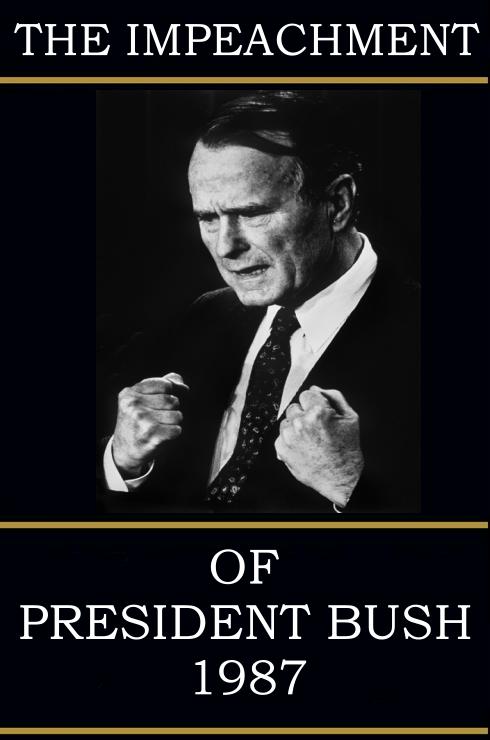
One challenge was that to emphasise the alternate history aspect often required two things. First the date has to be included to show the precise divergence from our history. This is notable with the book on the impeachment of George Bush. I included '1987' in the title, as I envisaged Bush becoming President following the assassination of Ronald Reagan in 1981, rather than being impeached during the term of office 1988-92 that he had in our world. The other challenge for those who I was looking at as living longer than in our world, was to find images that showed them as older than they ever were in our history. Thus, I had to work on the hairline of Julius Caesar and Abraham Lincoln and spread the grey in Indira Gandhi's hair far further than was the case in our history.
'Alexander the Great's Conquest of the Iberian Peninsula'
For this cover I used an image of Alexander's father, King Philip II of Macedonia to stand in for the older Alexander the Great. The book envisages Alexander living into his fifties rather than dying in his early thirties. Thus, not only completing his conquest of western Asia but then turning to conquer the remainder of the Mediterranean region with this book focusing on his final conquests in what is now Spain and Portugal.
'The Bactrian Campaign of Julius Caesar'
The basis of this book is Julius Caesar surviving or preventing the assassination attempt against him. As a result he lived on into his sixties and was able to carry out the conquests in western Asia that we know he had planned. Bactria is the region of Central Asia between the Caspian Sea and the Hindu Kush, covering the modern central Asian republics. It was a region Alexander the Great knew and Caesar had sought to conquer. I worked to adjust the image to make it appear as if it showed an older, more wrinkled Caesar. He was concerned baout hair loss and in this image I have him with some male pattern baldness.
'Parliament's Lost Leader: Oliver Cromwell 1599-1643'
This is another example of a cover that needed dates on it to show that it was Cromwell's earlier death, in this case in battle in 1643, rather than peacefully in 1658 which was envisaged. By this stage Cromwell was significant in the Parliamentarian camp but was not yet in a position to become leader of the country. Thus this book would ask what missed opportunity the country had with him being killed at this stage. If his death was earlier then it is unlikely he would have warranted his own historical study.
'1777 - The End of the American Bid for Independence'
In my book, the focus is largely on George Washington dying at Valley Forge along with many of his troops in the winter of 1776/7. However, if he had died then, his fame might not have been sufficiently significant to warrant a book of his own, so I envisage this one seeing with his death, the break up of the Continental forces and the end of the attempt of the Thirteen Colonies to break from British control. This is a manipulated painting which actually shows Continental soldiers being trained. However, it seemed to sum up the difficulties at Valley Forge and the three men at the front are in very submissive positions and look as if they are laying down their arms, assuming they have been captured by the British. The background is the Continental flag of the time.
'Lincoln's Post-War Administrations 1865-1872'
This book like the one on Caesar envisages Abraham Lincoln surviving assassination in 1865 or that never having been attempted. Again I needed to age him in the photo and I added in a map of the USA from the post-Civil War period to show Lincoln living on into this period. His survival would have meant much more difference to that period of US history than I initially realised.
'The World Economic Depression and the Demise of Capitalism'
This uses the classic Progress Publishers style for a book that never existed. Progress Publishers were a Soviet back publishing house that made Communist literature available in cheap editions in the hope that ordinary people would buy them. They were typically purchased by students who had to read set books. This one would have been published in 1931 assuming that Lenin had not died in 1924 but had lived on as leader of the USSR. The Great Depression which began with the Wall Street Crash of 1929 appeared to many Communists and Fascists to be the proof that capitalism could not work and that a different political approach was necessary. One could imagine Lenin delighting in his emotionless way to the difficulties capitalism was facing and have hoped that the world Communist revolution was imminent.
'The Overthrow of President Franklin D. Roosevelt'
This one envisages the planned coup d'état of 1934 actually going ahead, leading ultimately to Franklin Roosevelt being pushed from power, probably forced to retire on grounds of ill-health. I felt this picture might be his resignation speech to the nation. This was a scenario that I had not envisaged leading to such a bleak outcome for the world as a whole. However, it quickly became apparent that without the New Deal and certainly Roosevelt's almost one-man attempt to involve the USA in the Second World War not only would that war have dragged on longer but the US and the global economies would have struggled to return to any kind of prosperity well into the 1960s.
'Gustav Stresemann and the Decline of National Socialism 1931-35'

As a bit of a contrast, for this one rather than use a photograph, I picked a commemorative stamp for Gustav Stresemann. I manipulated the dates on it so he is shown as living to 1936 rather than dying in 1929 as was the case in reality. The point behind this book is that probably only Stresemann had the skill and appeal across the political spectrum to undermine National Socialism, the proper name for Nazism. He was a conservative and a nationalist but certainly never sought anything like the regime Hitler installed.
'A King of Our Times - Edward VIII, 1936-72'
This is another one in which the date was necessary to show the change. This is a late picture of the Duke of Windsor who in our world ruled briefly in 1936 before abdicating so he could marry the American divorcee, Wallis Simpson. This book envisages he never met Simpson or he chose to remain on the throne. The trouble with Edward was his willingness to interfere in politics, engage in illegal currency deals and his sympathies for Nazism. Given he would have been influential in the run-up to the Second World War, it is likely that this would have had an impact on British foreign policy. I have opted for the styling of a bland 1970s book on monarchy that you can see online which belies the kind of difficulties this alternative would have brought to Britain.
'The Collected Articles of Benito Mussolini'
It was quite a challenge to find a photo of Mussolini in which he was not in military clothes, shaven headed and pontificating. This is a surprisingly human picture of him that seemed to fit really well with the different path envisaged, i.e. rather than becoming a dictator, he remained a Socialist journalist. As a consequence, rather than being executed in 1945, I envisaged him living into old age. His longevity and his writing is likely to have meant that he received some attention across Europe, perhaps even becoming a kind of older statesman of Socialism, though maybe not to the scale of Antonio Gramsci.
'The Assassination of Charles De Gaulle'
This is an old image dating back six years, which I revived for the chapter in 'Other Lives' on the assassination of De Gaulle. I removed the date from this one as the chapter speculates on his killing at a number of dates. However, the picture is from the early 1960s so suggests an assassination at that time. As I wrote the chapter, my views on when the assassination would have had greatest impact shifted back in time a little. However, I think this is one feasible 'what if?' which tends to be overlooked by writers.
'Nixon as President: The Second Term, 1964-68'
As is often the case with these alternate history covers I start with an actual history book. This ones envisages Nixon being first elected in 1960 when he was narrowly beaten by John F. Kennedy, rather than in 1968. The picture fits with the timescale of the book. The 'button', i.e. the badge, is a genuine image of one produced for the 1964 election when Lyndon Johnson won.
'China's Reprieve: The Fall of Chairman Mao, March 1966'
This centres on a picture of Mao Zedong with his likely replacement if he had been overthrown in the mid-1960s, Deng Xiaoping. While China would have remained a totalitarian dictatorship under Deng, it certainly would have been spared the madness of the Cultural Revolution 1966-76 that caused so much damage to the country. The Cultural Revolution was primarily about Mao re-establishing his predominance in China, so with him being ousted, which seemed possible at this time a different path would have been followed.
'The Indian Dictatorship, 1984-89'

This was another book about a leader avoiding being assassinated. The idea is that Indian Prime Minister Indira Gandhi avoided being assassinated in 1984 yet the attempt on her life and accompanying turmoil in the country led her to impose a dictatorship as she had effectively done in the 1970s. For this picture I had again to try to age the image and I think it comes out reasonably well, with Gandhi's streak of grey having spread more widely across her hair. This picture with the furrowed brow makes her look older too.
'The Impeachment of President Bush'
I have explained the reason for the date at the start of this posting. This cover is to signify a chapter which is less about Bush than about the implications of the assassination of Ronald Reagan in 1981. With the De Gaulle one in place, I did not want another title with assassination. The chapter naturally envisages Bush as Reagan's Vice-President, as Johnson did after Kennedy's assassination, taking over at his death and serving out Reagan's term, then being elected himself. Furthermore it seems likely that Bush would have become directly involved in the Iran-Contra scandal and this would have led to him being charged with wrongdoing and to his impeachment. It is probable that in such a situation Bush would have resigned as Nixon did when threatened with impeachment. However, I picked this image as it suggested Bush had the pride and arrogance to hold on and to fight against the charges.