Showing posts with label George Bush. Show all posts

Monday, 16 September 2013

What If? Art 7: History Books That Never Existed

It has been six years since I posted any 'what if?' book covers on this site, the last being my spate of 'lost' books back in November 2007:  http://rooksmoor.blogspot.co.uk/2007/11/what-if-art-6-books-that-existed-but.html  The use of book art as an element of 'what if?' speculation has long interested me and my engagement with it is outlined here: http://rooksmoor.blogspot.co.uk/2007/08/what-if-art-1-history-book-that-never.html

For the cover of my latest 'what if?' anthology, 'Other Lives: ‘What If?’ Outcomes for Famous People in History' (2013), I considered doing gravestones or announcements in newspapers.  However, the people feature stretch from Alexander the Great in the 4th Century BCE right up to people in the 20th century.  In addition, not all the differences about the duration of their lives but also some of them taking different decisions.  As a result I returned to the idea of creating history books that never existed in our world.  I tried to keep as close as possible to the style that you find on history book front covers, though also to bring in a bit of variety.  These appear as small images on the front of the book.  However, I thought people might enjoy seeing them separately in a larger format here, with some explanation of why I decided on the different titles and formats.

One challenge was that to emphasise the alternate history aspect often required two things.  First the date has to be included to show the precise divergence from our history.  This is notable with the book on the impeachment of George Bush.  I included '1987' in the title, as I envisaged Bush becoming President following the assassination of Ronald Reagan in 1981, rather than being impeached during the term of office 1988-92 that he had in our world.  The other challenge for those who I was looking at as living longer than in our world, was to find images that showed them as older than they ever were in our history.  Thus, I had to work on the hairline of Julius Caesar and Abraham Lincoln and spread the grey in Indira Gandhi's hair far further than was the case in our history.

'Alexander the Great's Conquest of the Iberian Peninsula'


 For this cover I used an image of Alexander's father, King Philip II of Macedonia to stand in for the older Alexander the Great.  The book envisages Alexander living into his fifties rather than dying in his early thirties.  Thus, not only completing his conquest of western Asia but then turning to conquer the remainder of the Mediterranean region with this book focusing on his final conquests in what is now Spain and Portugal. 

'The Bactrian Campaign of Julius Caesar' 


The basis of this book is Julius Caesar surviving or preventing the assassination attempt against him.  As a result he lived on into his sixties and was able to carry out the conquests in western Asia that we know he had planned.  Bactria is the region of Central Asia between the Caspian Sea and the Hindu Kush, covering the modern central Asian republics.  It was a region Alexander the Great knew and Caesar had sought to conquer.  I worked to adjust the image to make it appear as if it showed an older, more wrinkled Caesar.  He was concerned baout hair loss and in this image I have him with some male pattern baldness.
'Parliament's Lost Leader: Oliver Cromwell 1599-1643'


This is another example of a cover that needed dates on it to show that it was Cromwell's earlier death, in this case in battle in 1643, rather than peacefully in 1658 which was envisaged.  By this stage Cromwell was significant in the Parliamentarian camp but was not yet in a position to become leader of the country.  Thus this book would ask what missed opportunity the country had with him being killed at this stage.  If his death was earlier then it is unlikely he would have warranted his own historical study. 

'1777 - The End of the American Bid for Independence'


In my book, the focus is largely on George Washington dying at Valley Forge along with many of his troops in the winter of 1776/7.  However, if he had died then, his fame might not have been sufficiently significant to warrant a book of his own, so I envisage this one seeing with his death, the break up of the Continental forces and the end of the attempt of the Thirteen Colonies to break from British control.  This is a manipulated painting which actually shows Continental soldiers being trained.  However, it seemed to sum up the difficulties at Valley Forge and the three men at the front are in very submissive positions and look as if they are laying down their arms, assuming they have been captured by the British.  The background is the Continental flag of the time.
  
'Lincoln's Post-War Administrations 1865-1872'


This book like the one on Caesar envisages Abraham Lincoln surviving assassination in 1865 or that never having been attempted.  Again I needed to age him in the photo and I added in a map of the USA from the post-Civil War period to show Lincoln living on into this period.  His survival would have meant much more difference to that period of US history than I initially realised. 


'The World Economic Depression and the Demise of Capitalism'


This uses the classic Progress Publishers style for a book that never existed.  Progress Publishers were a Soviet back publishing house that made Communist literature available in cheap editions in the hope that ordinary people would buy them.  They were typically purchased by students who had to read set books.  This one would have been published in 1931 assuming that Lenin had not died in 1924 but had lived on as leader of the USSR.  The Great Depression which began with the Wall Street Crash of 1929 appeared to many Communists and Fascists to be the proof that capitalism could not work and that a different political approach was necessary.  One could imagine Lenin delighting in his emotionless way to the difficulties capitalism was facing and have hoped that the world Communist revolution was imminent.

'The Overthrow of President Franklin D. Roosevelt'


This one envisages the planned coup d'état of 1934 actually going ahead, leading ultimately to Franklin Roosevelt being pushed from power, probably forced to retire on grounds of ill-health.  I felt this picture might be his resignation speech to the nation.  This was a scenario that I had not envisaged leading to such a bleak outcome for the world as a whole.  However, it quickly became apparent that without the New Deal and certainly Roosevelt's almost one-man attempt to involve the USA in the Second World War not only would that war have dragged on longer but the US and the global economies would have struggled to return to any kind of prosperity well into the 1960s. 

'Gustav Stresemann and the Decline of National Socialism 1931-35'

  
As a bit of a contrast, for this one rather than use a photograph, I picked a commemorative stamp for Gustav Stresemann.  I manipulated the dates on it so he is shown as living to 1936 rather than dying in 1929 as was the case in reality.  The point behind this book is that probably only Stresemann had the skill and appeal across the political spectrum to undermine National Socialism, the proper name for Nazism.  He was a conservative and a nationalist but certainly never sought anything like the regime Hitler installed.
'A King of Our Times - Edward VIII, 1936-72' 

This is another one in which the date was necessary to show the change.  This is a late picture of the Duke of Windsor who in our world ruled briefly in 1936 before abdicating so he could marry the American divorcee, Wallis Simpson.  This book envisages he never met Simpson or he chose to remain on the throne.  The trouble with Edward was his willingness to interfere in politics, engage in illegal currency deals and his sympathies for Nazism.  Given he would have been influential in the run-up to the Second World War, it is likely that this would have had an impact on British foreign policy.  I have opted for the styling of a bland 1970s book on monarchy that you can see online which belies the kind of difficulties this alternative would have brought to Britain.
'The Collected Articles of Benito Mussolini' 


It was quite a challenge to find a photo of Mussolini in which he was not in military clothes, shaven headed and pontificating.  This is a surprisingly human picture of him that seemed to fit really well with the different path envisaged, i.e. rather than becoming a dictator, he remained a Socialist journalist.  As a consequence, rather than being executed in 1945, I envisaged him living into old age.  His longevity and his writing is likely to have meant that he received some attention across Europe, perhaps even becoming a kind of older statesman of Socialism, though maybe not to the scale of Antonio Gramsci.
  
'The Assassination of Charles De Gaulle'


This is an old image dating back six years, which I revived for the chapter in 'Other Lives' on the assassination of De Gaulle.  I removed the date from this one as the chapter speculates on his killing at a number of dates.  However, the picture is from the early 1960s so suggests an assassination at that time.  As I wrote the chapter, my views on when the assassination would have had greatest impact shifted back in time a little.  However, I think this is one feasible 'what if?' which tends to be overlooked by writers. 
'Nixon as President: The Second Term, 1964-68' 


As is often the case with these alternate history covers I start with an actual history book.  This ones envisages Nixon being first elected in 1960 when he was narrowly beaten by John F. Kennedy, rather than in 1968.  The picture fits with the timescale of the book.  The 'button', i.e. the badge, is a genuine image of one produced for the 1964 election when Lyndon Johnson won.


'China's Reprieve: The Fall of Chairman Mao, March 1966' 


This centres on a picture of Mao Zedong with his likely replacement if he had been overthrown in the mid-1960s, Deng Xiaoping.  While China would have remained a totalitarian dictatorship under Deng, it certainly would have been spared the madness of the Cultural Revolution 1966-76 that caused so much damage to the country.  The Cultural Revolution was primarily about Mao re-establishing his predominance in China, so with him being ousted, which seemed possible at this time a different path would have been followed.

'The Indian Dictatorship, 1984-89'


This was another book about a leader avoiding being assassinated.  The idea is that Indian Prime Minister Indira Gandhi avoided being assassinated in 1984 yet the attempt on her life and accompanying turmoil in the country led her to impose a dictatorship as she had effectively done in the 1970s.  For this picture I had again to try to age the image and I think it comes out reasonably well, with Gandhi's streak of grey having spread more widely across her hair.  This picture with the furrowed brow makes her look older too. 
'The Impeachment of President Bush'
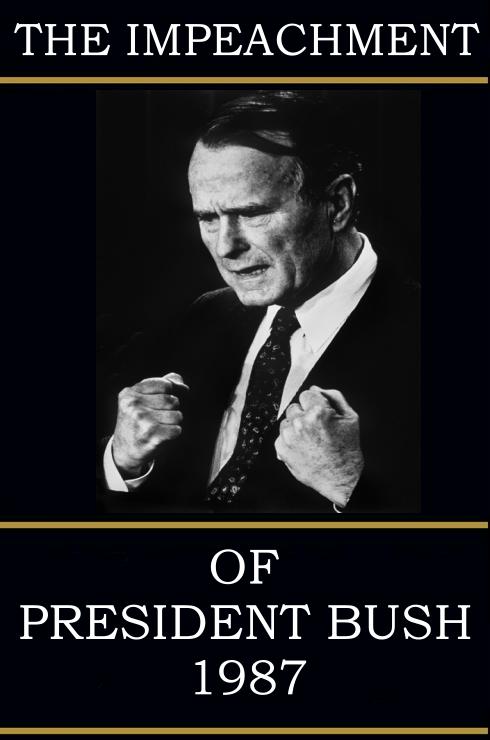


I have explained the reason for the date at the start of this posting.  This cover is to signify a chapter which is less about Bush than about the implications of the assassination of Ronald Reagan in 1981.  With the De Gaulle one in place, I did not want another title with assassination.  The chapter naturally envisages Bush as Reagan's Vice-President, as Johnson did after Kennedy's assassination, taking over at his death and serving out Reagan's term, then being elected himself.  Furthermore it seems likely that Bush would have become directly involved in the Iran-Contra scandal and this would have led to him being charged with wrongdoing and to his impeachment.  It is probable that in such a situation Bush would have resigned as Nixon did when threatened with impeachment.  However, I picked this image as it suggested Bush had the pride and arrogance to hold on and to fight against the charges.

Wednesday, 22 December 2010

The Tedium of 'Twilight: Eclipse' (2010)

I made a mistake a couple of weeks back of buying a friend the DVD of 'Twilight: Eclipse' (2010).  She had enjoyed the previous two movies and watched them more than once on DVD.  As the gift-giver, on the day of her birthday I was invited to come and watch the movie, which I had not seen, with her.  I like contemporary vampire movies and have seen 'Blade' (1998) and 'Underworld' (2003) on numerous occasions.  I had reasonably enjoyed the first two instalments of the 'Twilight' movie series: 'Twilight' (2008) and 'Twilight: New Moon' (2009).  I found the setting in the North-West of the USA a suitable one, and the tension between the werewolves and vampires seemed interesting.  Of course, the sexual/relationship tension of the late-teenaged heroine Bella choosing cerebral vampire Edward but still feeling affection for more muscular werewolf Jacob was sufficiently engaging.  Both of these earlier movies tempered the teenage romance angst with genuine action first against renegade vampires and then interacting with the Volturi, a powerful organisation of vampires based in Italy.  Interestingly, Martin Sheen who plays a werewolf fighting vampires in 'Underworld' and 'Underworld: Rise of the Lycans' (2008) appears as an elder vampire in 'Twilight: New Moon' of the same year.

Having seen 'Twilight: Eclipse' billed as 'the best Twilight movie yet', I had high hopes that it would build on the strengths of the previous two movies and provide new step.  However, I give nothing away if I reveal that it adds nothing to what had been explored in the previous movies of the series.  I know that the novels by Stephenie Meyer (published 2005-8) stretch the story of the romance between Bella and Edward over four novels, but that is probably far too long for a movie.  In 'Twilight: Eclipse' all you have is continuing prevarication from Bella about turning into a vampire and ire from Jacob who believes she should be with him rather than with Edward.  The tension between Jacob and Edward and Bella wanting to remain with Edward and yet not wanting to harm Jacob's feelings simply rehashes what happened in 'Twilight: New Moon'.  The main opponent Victoria, who appeared in 'Twilight' assembles a powerful army of new vampires but this element is neglected in favour of repetitive sullen behaviour from the three main protagonists. 

References to other incidents such as the rise of a powerful vampire army at the time of the American Civil War are skirted over.  I know Bella is the heroine, but with these apparently large threats to humanity and the vampire community going on, you would think she could lift her gaze from her own angst over fancying two young men, for even just a short time, to look at something else.  Sympathy for Bella is beginning to wear thin.  Even the woman I bought the DVD for, who is not a teenager, but certainly is very much a Jane Austen fan so into stretched out romance punctuated with minor 'crises', was tiring of it all by the end of the movie which runs for 2 hours 4 minutes meaning you see far too much of drippy teenagers moping around a rainy landscape.  There was enough of this in the second movie; cutting this one to 93 minutes would have improved it immensely and restored much of the tension felt in the first movie.

I know Meyer is a devout Mormon who is married and has three children; her husband who she married when they were both 21, has given up work to look after the children since his wife's career took off.  Meyer wrote the novels at a time when George W. Bush was in power and not only advocating abstinence as the only form of contraception for unmarried couples, but also pouring federal funds into the teaching of this approach in schools.  Unsurprisingly teenage pregnancies are the highest in the USA of all industrial states.  I can only find figures for 1996 when the rate was 55.6 births per 1000 women under the age of 20 compared to 29.6 in the UK, 13 in Germany, 9.4 in France and 6.6 in Italy.  In the USA 80% of teenage pregnancies were unintended and of these 50% were from women not using contraceptives.  I have no problem with people having religious messages in their movies.  I have watched many of the movies of Christ's life and others with explicit or implicit religious themes from 'The Nun's Story' (1959) to 'Minority Report' (2002).  However, perhaps it was because I found 'Twilight: Eclipse' so dull that these elements jarred most strongly with me when watching it. 

I accept that Edward Cullen is supposed to be 104 years old and brought up during the Victorian period, or in fact an idealised version of the Victorian period.  As Ian Hislop's very engaging series 'The Age of the Do-Gooders' currently running on UK television has demonstrated, one reason why so many Victorians had to be active in combating vice was because so much of it was happening.  Cullen reflects a 20th century view of the Victorian era rather than the context in which Sherlock Holmes was operating, which though fictional, shows us a great deal of Victorian society.  Consequently, when Bella proposes to have sex with Edward he refuses insisting they would only do it after they were married.  He proposes to the 18-year old Bella, who rightly, even in the movie, feels she is rather being blackmailed into it.  Edward wants to turn her into a vampire before they are married and only have sex after they are.  I know the USA has movements like the Silver Ring Thing which gets young people to make a commitment to abstinence until married, but even their website claims only 465,000 people have attended their events and 161,400 have made the commitment.  This is compared to around 74 million people under the age of 18 living in the USA.  The other thing is, Bella agrees to marry and even back in Shakespeare's 'Much Ado About Nothing' (1598) the priest marrying a couple acknowledges that they are likely to have already had sex.  This was at a time far more religious than our own. 

I would not be surprised if Bella would not be suspicious of Edward.  She has accepted that he is a vampire, but certainly in many stories, vampires are infertile and in some are unable to even have erections, being, in theory, 'dead'.  If the Bella and Edward are engaged, they need to discuss their future together and one thing they definitely do not talk about is sex and children.  Any couple needs to have such conversations before their relationship develops certainly to the stage of marriage.  However, in the movie reflecting the novels, this is indefinitely postponed.  In the fourth novel, Bella finally marries Edward and gets pregnant by him while still a human.  This, again, reflects Bushite views of sex; i.e. that a married woman's role is to produce children.  One minute before the marriage ceremony she must not have sex, one minute after she must be getting pregnant.  Viewers of the movie certainly can feel that Bella has been locked into a kind of production line, with no reference to her own pleasure, just simply to what is 'right'.  Free will, certainly from the woman's perspective seems to have gone out of the window.  This is ironic given Meyer's own history.  I accept that she was a young wife and mother, but now her husband is the main child-rearer and her wealth has allowed her choices in her own life she seems to deny her heroine.

The other thing that is missing is the fact that teenagers get incredibly aroused and a lot of sex just happens in the heat of the moment.  Letting your passions run away with you is frowned upon in the movie with reference both in 'Twilight: New Moon' and 'Twilight: Eclipse' to a werewolf who turned and injured his human partner, scarring her for life.  This is why Bella could never be with the werewolves as they are the analogy for unbridled human passion and the vampires, are, in fact there to represent humans in clinical control of their emotions and consequently lacking in passion and if not quite 'dead' then at least 'cold fish'.  I know this is a movie series which features fantastical creatures, werewolves and vampires, but its credibility breaks down, when Bella begins to undress for sex and simply because Edward says, not overly forcefully, that they must wait until marriage, she stops and accepts it.  This suggests she feels no passion for Edward at all and the sex would have simply have been going through the emotions.  This presents a very artificial view of sex to the audience and seems to suggest that love and passion are divorced from each other, and, in fact, implies that true love is only true when passion is absent from it.  It is ironic to compare such an attitude with movies of an era people like Meyer might look back to.  Compare this to 'Casablanca' (1942) which with no explicit reference to sex, shows how loyalty, love and passion are all vital ingredients for relationships which can endure the harshest environments.  Whilst Ilsa goes off with Victor, Rick and Ilsa still have the passion of Paris to warm their lives.

Overall, not only does 'Twilight: Eclipse' provide nothing new for the series, it presents a very cold portrayal of love and relationships, not really driven by feelings, rather following very stringent regulations that fixes the woman into a lifestyle that has very little to do with her own happiness and is shaped purely by the men in her life.  It shows an unrealistic portrayal of the passion in an intimate relationship and the challenges there in handling that.  Meyer said she wanted to keep sex out of her novels, but in fact, by showing it in this distorted way, which does not reflect how real teenagers even in the past behaved, let alone today, distorts the expectations and behaviour of her core audience.  Many teenager will find it immensely harder to behave like Edward and Bella and simply switch off arousal because they have been told to do so.  That will damage relationships not only in the teenage years but beyond and the USA does not need any more damage to relationships than it already has.

Sunday, 31 January 2010

Invading Iraq: Unwavering Politicians Are Dangerous

Strangely, seeing coverage of Tony Blair's testament to the Chilcot Inquiry into the UK's involvement in the war in Iraq, the one which is still going on, I found myself believing in divine vengeance.  I have noted in the past that many elements of the Bible as they have been filtered and interpreted by those in authority in the Middle Ages encourage a stable society.  The emphasis that vengeance is God's is a good way to stop vendettas and people taking the law into their own hands, but this week I recognised that it can also be a bit of a consolation to people who feel wronged.  The sense that 'well, I can do nothing to get back at him for what he has done, but he still has to face God's judgement'.

I suppose what brought me to this kind of last resort when seeking justice is how unwavering Blair was.  I had always expected the politicians wheeled in front to the enquiry to say what they had done was right, and have actually been heartened by the legal officials and even Lord Goldsmith showing the confusing and uncertainty around the legality of the war.  What cut most deeply with Blair, however, was his total lack of regret for anything he did.  We always knew that he was arrogant, but this emphasised that now, even out of office and earning millions of pounds, he will not concede he has ever made a mistake.  I once attended a speech by former prime minister (1970-4) Edward Heath in which he reflected on his term in office, a very troubled period in British society and wryly he argued that it might have been bad but was nothing compared to what came later under Callaghan (1976-9) and Thatcher (1979-90).  Blair seems to believe that he ruled over a golden period in British history in which we, the public might have got things wrong but he was perfect in every way, and our problem was that we did not listen to him enough.  Blair is supposed to be a Christian.  He is now a Catholic, so I suppose he has been able to confess his sins and get absolution for them.  However, surely to be a Christian of any sort you must be able to reflect on what you have done and see your errors in order to repent and seek absolution.

Blair can argue that invading Iraq to overthrow Saddam Hussain was the 'right' thing to do.  No-one would argue that Hussain was not evil and was killing many of his own people and using torture.  However, so are many other leaders around the world and we seem to be taking no efforts to depose them.  Robert Mugabe of Zimbabwe would seem a good place to start as we know he does not even have the suggestion of weapons of mass destruction.  Yet, Blair does not take this line, so we end up with fudged explanations around misunderstandings about nuclear or chemical or biological weapons, some partial legal approval from the United Nations and the UK's connection to the USA.  Perhaps the motivations were this confused mish-mash.  However, if they were, this seems to suggest a weak, confused prime minister, that Blair certainly does not portray himself as.

Saying this, the concessions that Blair has allowed are that he never expected Al-Qaeda to become involved in Iraq after the USA had conquered it and neither did he expect Iran to destabilise the state either.  A student of GCSE level International Relations, could have told you to expect these things.  First of all, one of the reasons why George W. Bush emphasised the need to invade Iraq was because he felt it was a base of Al-Qaeda activity.  Of course, Hussain, was in fact an opponent of the movement, whereas Saudi Arabia, the USA's ally in the region has always been a place where Islamist terrorists have thrived.  The second point is that there was the example of Afghanistan.  When that had been destabilised by the Soviet invasion and occupation (1979-89) it opened the door to the Taleban to take power and created a regime in which Al-Qaeda was able to operate, probably not as this supposed international terrorist structure somehow resembling the fictional SPECTRE, but as an association of small radical groups connected by a desire for promoting Islamist regimes through terrorism.  In Afghanistan they were labelled the 'foreign fighters' and in many cases would be simply volunteers looking to fight to defend what they saw as the correct form of Islamist state that the Taleban had established.  So, there was a clear example of what was liable to happen in a primarily Muslim country once a superpower had invaded; it encourages religious fundamentalists rather than weakens them.

As for Iranian intervention in Iraq after the US invasion, again, a teenager who had read 20th century history, could have predicted this.  Even if this had not been a correct prediction, it was something the USA and its supporters should have prepared for.  Iran and Iraq were at war 1980-8 and have continued to have border tensions since.  Iran, itself a dictatorship, would never pass up the chance to keep Iraq weak and then to create a regime sympathetic to Iran if not a puppet state.  Knowing the Iranian regime as well as the USA does due to its bitter relations with the country since 1979, surely it could have been foreseen that the Iranians would not have stood by passively.  Their pursuit of nuclear technology suggests that the regime is not currently adopting a passive stance.  From the Iranian perspective, look at a map and see that Iran has Afghanistan to its North-East and Iraq to its West, two places that by 2003, the USA was militarily involved with.  Iraq under Hussain had been supported militarily by the USA, so is it no surprise that when the Americans are running it the Iranians would feel that they might be next on the list for invasion.  If Barack Obama had not won the US presidential election, perhaps they might have been.
 
What has not come out in the Chilcot Inquiry are the real motives for the war, rather than the mixed up approaches that were supposed to win public support.  This comes back to US concern about oil resources especially in the light of China's aggressive search for control of raw materials and a regime in Venezuela, the USA's prime short haul supplier of oil, that was unfriendly to US imperialism.  I think George W. Bush probably believed, as he was told that Al-Qaeda, the imagined organisation that gave so many of his authoritarian policies some form of perceive legitimacy, was in Iraq.  However foolish Bush was, as a former oil man, I imagine he must have seen the value of the USA holding Iraq.  Of course, this explanation for the war is the least palatable to the public of all of the excuses put forward and this is why it will not be heard at the Chilcot Inquiry or anywhere else public.

This then brings us back to Blair and his mish-mash explanation. for going to war.  He said there was no plot or conspiracy to bring about war, but the problem with the approach that was adopted was that it was a shabby collection of reasons.  At least, to some extent, admitting that neither the USA and especially not the UK was ready to go to war in terms of forces and equipment, he said a military build-up could not have begun without alerting Hussain to the potential of invasion.  I think Hussain probably had already seen the UN resolution and the weapons inspectors.  His country had been invaded by the USA and UK back in 1990-1 and it was clear they had been disappointed that he had not fallen at the time once they had expelled him from Kuwait.  So, Hussain was as ready as he could have been to face the invasion. This issue about trying to keep preparations low key, is something that Blair can be blamed for directly as it meant the UK forces were ill-equipped and this has meant far higher casualties than needed to be the case.  If you are going to be a militarist state in the way the UK has been in the 2000s you need a strong military and not to be involved in two wars on the cheap.  Skimping on equipment means paying a higher price in casualties.  For the British public this is on charge that Blair really needs to be held accountable for, because unlike with US global political approaches, he had direct control over it.  The excuse that decent preparation could have given the game a way is pathetic.

In fact, a strong, visible military build up would have helped remove Hussain.  By making him feel under threat and so keeping his military expenditure at a maximum, the West could have brought down the regime through economic chaos the way the USSR dissolved after years of sustaining its side of the arms race.  However, that would not have served the USA as there was no knowing who might have got control of the oil, possibly the country with the greatest foreign currency reserves in the world, China, though effectively supporting Hussain's regime financially as they are backing those regimes in Sudan and Zimbabwe.  All superpowers, including the USA, prefers to deal with dictatorships than democracies; China, however, has fewer qualms over human rights records.  Of course, ironically the USA's invasion of Iraq moved it into an era in which it adopted torture as an approach it was happy to use.

So, what we got from Blair, was probably what we expected, though, I, like many headline writers was stunned by how unwavering Blair was in seeing himself as having done precisely nothing wrong.  I suppose unrepentance is the luxury of retirement.  The fact that he has gone on to be a Middle Eastern envoy on the basis of his career is sickening.  Blair's attitude is very like that of the politician he most resembles in policies and attitude, Margaret Thatcher.  She famously said 'this lady's not for turning' and saw any critics of her sledgehammer policies as 'moaning minnies'.  The UK likes politicians of this ilk and they serve long in office, whereas their more human successors, John Major and Gordon Brown are portrayed as weak and vacilliating.  However, for one, I would rather have a politician aware of his flaws because that means s/he is aware of their humanity.  Humanity is what connects them with not only the entire electorate, but more broadly people across the world.  It is fine to admit you have made mistake, but for some reason we want politicians who will never do this.  As a consequence we end up with policies, which may appear needful and strong at the start but usually end up leading to years of suffering for ordinary people.  To anyone who favours unwavering politicians, with no regrets at all, just like Tony Blair, I would point to the politician who took this to the extreme, who continued to blame everyone else for what ruin he had brought to his country and the world, right until his death: Adolf Hitler.

P.P. 01/02/2010: An interesting twist in this story comes from former minister Clare Short who is apparently going to claim at the Chilcot Inquiry that Gordon Brown, long Tony Blair's rival in government, was kept out of the inner circle that decided on the UK's involvement in the invasion of Iraq in 2003.  Short believes that on the back of the glory of the expected quick victory Blair would have moved to remove Brown from his position as Chancellor of the Exchequer effectively marking a coup against his rival and ultimately his successor.  We know that Blair postponed stepping down as prime minister as long as he could and went much later than Brown had been led to expect.  Brown did become prime minister, in 2007, as Blair had promised him back in 1994, but in harder circumstances and with the troubles in Iraq dragging on after the war and the UK still suffering casualties.

For Blair it seems the invasion of Iraq had the potential for a 'Flucht nach vorn', in the style of Fritz Fischer's explanation of the domestic reasons for the German triggering of the First World War, i.e. using overseas success to resolve domestic political pressures.  I was very suspicious when in his testament to the Chilcot Inquiry last month, Blair's henchman Alastair Campbell emphasised that Brown had played a full part in the discussions about war.  I did not see why Campbell made this emphasis and assumed he saw it as a chance to get a bit of revenge on Brown.  This may explain why Brown is happy to testify to the Inquiry before the election. 

Even if Short's accusation is exaggerated, it seems that Blair's arrogance was straying into a whole other field, and he saw domestic political gain to be had from the war, no matter what else he got from backing the USA's approach.  Perhaps it anticipated receiving the large popularity boost of the kind his heroine, Margaret Thatcher had received after the Falklands Conflict of 1982.  It shows that not only was he willing to play with Iraqi lives for personal political gain but British ones too.

Monday, 19 October 2009

The Block Warden Arrives

None of this is original research, it is something which I read in 'The Guardian' newspaper, but seems to mesh with the developments I have been reading about from different sources ever since Tony Blair came to power in 1997 and particularly since 2001. As we all know, the terrorist attacks by Islamist extremists against the USA in September 2001, unlike previous such attacks, allowed the government of George W. Bush to adopt a policy they termed the 'War on Terror'. Elements of this included supposed justification for the invasion of Afghanistan and of Iraq by US-led alliances and the introduction of authoritarian domestic legislation in the USA and many of its allied states which have severely reduced the civil liberties of citizens of those countries as well as foreigners. Consequently in the 2000s we have seen a ramping up in the use of torture and detainment without charge or trial particularly by the USA and the UK, notably in collaboration with Pakistan. I have written before about how house arrest and 28 days' detention without charge, which in the past would have been totally unacceptable in the UK have become to be seen as the norm, and in fact, by some, as mild measures. Fortunately, the change in government in the USA and the work of the independent judiciary reviewing such steps in the UK has begun rolling back such policies, at least a little.

What is interesting is another element that has come to light in the UK about steps to target those people who are seen as being 'at risk' of becoming extremists, notably males with origins in South Asia. These are seen as the easy representation of Islamist terrorism and such attitudes have helped fuel racist groups and attitudes in the UK. Back in October 2006 and again in November 2008, university lecturers were encouraged to monitor Muslim students and report to the security services if they saw behaviour that was felt to indicate these students were becoming extremist: http://www.guardian.co.uk/uk/2006/oct/16/highereducation.topstories3 and
http://www.journal-online.co.uk/article/5087-lecturers-asked-to-spy-on-foreign-students-again Unsurprisingly, given that universities pride themselves on their autonomy and welcoming people from across the world, notably from countries where they face oppression, they were not happy to be told to adopt this spying role: http://news.bbc.co.uk/1/hi/education/7774949.stm

Parallel to these high profile developments in universities it seems less apparent has been the development of such monitoring at community level. The 'Prevent Violent Extremism' programme, termed 'Prevent' launched in 2006, has received £140 million (€152 million; US$228 million) has aimed at targeting these 'at risk' Muslims, and using language borrowed from the Communist Chinese dictatorship, 'deprogrammed'. As with the university lecturers, the government has set out to recruit community group leaders and workers to being their surveillance force. Those who have expressed a reluctance to do the government's spying have been terrified that they will lose their jobs or face threats from the police and security services themselves. It is becoming apparent that some college teachers are collaborating with the authorities in reporting 'suspects'. However, others are being pressured such as a mental health project in the Midlands and various youth projects across the country. The project is run by the Office for Security and Counter Terrorism and its head, Charles Farr and local leaders of the scheme, are former intelligence officers. The youngest suspect was aged 9 and he was sent for deprogramming.

'Deprogramming' is a term, which in English, is usually associated with helping people who have been rescued from cults to allow them to have a more normal perspective on society and people around them. It is a common way of translating what used to be termed 're-education' in China under Chairman Mao, punishing those, usually with imprisonment and hard labour, who were seen to hold views different from the state or came from a social class that was deemed to be a threat to the state. 'Re-education camps', which still exist in China, most of us would see as being identical to concentration camps (as opposed to extermination camps) of the Nazi German design. 'Deprogramming' is probably a correct term to use, but if this is being imposed on a 9-year old, one has to see it as being very severe. In the UK children do not even have criminal responsibility until the age of 10, one of the lowest ages in the world. So, can a 9-year old even be an 'extremist'? I was speaking to a 7-year old recently who was talking about chopping up girls and eating them, should he simply see a child psychologist or is he a genuine threat to the security of the country? If a child espouses fundamental Christian views and wants people struck down for stealing or coveting their neighbour's wife is he a potential terrorist? If he espouses the Five Pillars of Islam it seems he is much more likely to be seen as one.

Of course, a lot of this, trying to predict future crime, sounds very like something out of a science fiction novel or movie, in particular 'Nineteen Eighty-Four' (1948) in which dissidents are tortured and terrified into accepting without question, the totalitarian regime they are living under. The science fiction nature of this scary policy continues when you read quotations from Ed Husain, head of the Quilliam Foundation (which has received £700,000 from the Prevent fund), believes it is morally right to stop people committing terrorist offences before they occur. This is naturally the role of security services. However, there is a difference between stopping some conspirators who are sitting around assembling bomb making equipment and stopping someone, a child even, who perhaps might some many years into the future think about carrying out terrorist activity. No-one has used the term 'thought police' (from thinkpol in 'Nineteen Eight-Four') in the popular media for many years, but it is effectively what we are now moving towards. Other science fiction that we seem to be basing policing policies on includes 'Minority Report' (novel 1956; movie 2002) in which people with psychic powers are used by the police to predict crimes before they happen and in 'A Philosophical Investigation' (1992) by Philip Kerr in which scientists try to predict which men are going to commit violent crime by studying the lay out of their brains.

The key issue is that the principle of 'innocent until proven guilty' has gone. The principle of 'innocent until plans/commits a crime' has gone. In its place is 'innocent until someone believes that sometime in the future you may commit a crime'. There seems to be no monitoring of the quality of the assumptions about these 'potential' extremists, not even some pseudo-scientific explanation that people with a particular physiology or in specific circumstances are far more certain to commit a crime in the future. It is just a case of someone reporting someone else. As someone who has worked in different parts of the civil service, I know people are being reported on a daily basis. Every mail sack arriving at every job centre or tax office, every working day, has letters reporting people in it. The bulk of these are simply the disgruntled taking it out on the people they do not like the look of, or simply just a random person so they can make themselves appear more important.

Most of the public forgets that the authorities generally have a good idea on what people to target based on a mix of their own experience and own prejudices, generally they do not need help from the public. What involving the public is about, is developing an air of paranoia which helps foster compliance among them, so they do not complain when they have to undress, have their luggage opened in their absence or are searched repeatedly at an airport or when public transport is closed or the road blocks are put up. Paranoia in the UK tends to fade quicker than it does in the USA. I think because the British have faced far more real threats in their recent history than the Americans ever have. We have develop an awareness of genuine and falsified threat and have a natural scepticism which seems less common among Americans, but perhaps, more common among, say, the French, Germans, Spanish and Italians.

Simply thinking about a crime let alone having some vague resentment towards the government, should not be a crime, otherwise they will have to ban all crime novels and series and prevent anyone complaining about the service they receive from the government. Of course, that might be on the cards. What Prevent has helped do, is divide the very communities that policies following the Bradford and Oldham riots of 2001 were supposed to be assisting. It is pressurising more and more public servants in an insidious way to spy for the state.

The Prevent approach also blinkers people. The assumption that young Asian males from particular districts (Prevent currently only works with 82 councils; rising to 94 next year) are the only threat leads lots of 'blind spots' neglecting other threats and terrorism from different groups like the far right and Irish terror groups. That is if you believe, as the government seems to, that extremism leading to terrorism is so pervasive in our society. In the UK, partly due to public apathy, extremist views have never been popular. Even in states like Libya, Syria or Saudi Arabia, Islamist extremists are a small minority.

Of course, security services like to be well funded, so if to get more cash they have to adopt an approach of trying to be pre-emptive and in someone's view stop scores of young people coming terrorists, they are going to go with it, even if they have little faith in the approach. The UK government has got so wrapped up in the Bush myths that it cannot see straight. If terrorism is so widespread why did the UK never face a war over Ireland with the large Irish (869,000 of the UK population were born in Ireland; 6 million have Irish ancestry compared to 1.6 million Muslims) population here? Why was there not extreme left-wing terrorism in the UK in the 1970s when there was in Italy and West Germany? Why was there no neo-Nazi terrorism in the late 1970s? I suppose they would argue that somehow South Asian and/or Muslim young people have different 'mental wiring' to Irish or other white people, but that is not based on any scientific fact at all or the fact that many Muslim states, though facing incidents as the UK has faced, have also not had massive terrorist activity in the way the Prevent method envisages it coming.

I titled this section 'The Block Warden Arrives'. This refers to the role in Germany during the Nazi period (1933-45) though similar positions were used in the Portuguese Colonial War (1961-74) and in Argentina (1976-83). A block warden is a representative of the dominant party/state regime who in Germany oversaw around 40-60 houses and not only spreads propaganda in favour of the regime but monitors that his/her neighbours are complying with the regime's wishes, not simply passively but in an active way. Anyone, in the individual's judgement, who is not complying or without insufficient vigour or that the block warden simply dislikes, is arrested by the secret police and imprisoned/tortured/killed. The example from Argentina which brought the term 'the disappeared' to the world, is probably the model most likely to be adopted in the UK. Most simply people would disappear usually for long-term imprisonment or execution without their families ever knowing what happened to them.

What we are seeing in the UK at present with people reporting Asian neighbours plus the government trying to compel community workers to spy for them is a back door introduction of the block warden approach. Once in a while they may catch someone who is a real threat, but recent evidence shows that even the security services with their high tech equipment have arrested innocent people. Such powers are quickly abused especially by small-minded people who see their personal quirks as issues of national security, so people will be put under suspicion, not because they have any genuine terrorist sympathies but because some neighbour simply dislikes them or they parked in 'their' slot or their children were noisy or something. Such an approach actually wastes the time of the police and security services and creates so much 'traffic' of denunciation and counter-denunciation that it provides good cover for genuine criminals and even terrorists, though of course, their numbers are in fact tiny.

It is clear that more and more British people, often those very individuals who have been working hard to keep their communities in a fit state, are being compelled to work for what is increasingly a state machine aiming to police people's thinking. These people are often reluctant but history has always shown us there are always the 'little Hitlers' who relish such roles and you can imagine the bullyboys of the English Defence League queuing up to become these monitors in their neighbourhoods. I have noted before how local authorities have been abusing anti-terrorist laws to carry out their own agendas often in punishing people for violating (or for being suspected, however wrongly, of trying to violate) local regulations. The Prevent approach is simply giving them yet more abilities for them and even simple members of the public with which to beat the people they do not like in their neighbourhood.

Tuesday, 21 April 2009

The Need for Nuremberg-style Trials for the USA

We all knew that the US forces and officials under the George W. Bush regime were torturing people not only at Guantanamo Bay but at other secret camps across the World. We knew that torture was used at the US-run Abu Ghraib in Iraq. We know now that the British Security Service, MI5 and even the Greater Manchester Constabulary were involved in driving torture in Pakistan. In recent days confirmation of what we believed and has been corroborated by released prisoners, has come in the form of high-level memos about torture techniques used by the US security services, notably the CIA. I have discussed before how the 11th September 2001 attacks on the USA gave its government the feeling that it had a free hand to carry out any activity it deemed as necessary, going far beyond the acceptable bounds of behaviour for any government let alone that of a democracy and self-vaunted 'Land of the Free'. It led the US government to criticise those countries it felt was not going far enough in violating civil liberties and so has damaged them not just in the USA but more widely across the World. In looking at George W. Bush's regime we must see that his the policy which has had most impact in the World has been to make abduction and torture acceptable. Did Bush never realise that he had lost the War on Terror the moment he made the USA a terror state? What is the point of fighting to defend liberty if you have already killed it in your own country?

It is good that the new US President Barack Obama has had the courage to make public the memos which expose how far the previous regime, and no doubt so many of the agents and officials still in power, went in adopting totalitarian, terrorist techniques. One important thing is that it vindicates those people who have been released and have spoken of torture. Many people remained sceptical, feeling these former detainees (they were not convicts as they were never convicted of a crime) had reasons to condemn the US and perhaps exaggerate their treatment. We now know that they had no need to exaggerate anything; the USA was constantly torturing people. I was stunned by a radio report today that said it had been revealed one detainee had been 'water boarded' effectively brought to the edge of drowning (the detainee is tied down and has cloth placed over their mouth and nose which is then soaked making it almost impossible to breath), far more times than had so far been revealed and in fact it had happened 186 times in one month. On my calculations that is 6-7 times every day. Try and imagine almost being killed repeatedly, many times per day, every day. In addition, this was just one among a wide repertoire of psychological and physical torture inflicted on the detainees. This is factory torture, it is a process that goes beyond what we know of many totalitarian regimes and a world that has had the Soviet system, Idi Amin's regime, the Nazis, China today, Pol Pot's regime, that is a difficult league to get into let alone to reach the top.

It is clear the torture was not being done to gain information, it was simply for Americans to exercise their fury at those they saw as responsible for daring to violate US society by terrorist activity. The rest of the World was rather sickened by the Americans whining on about how the 11th September 2001 attacks were so horrific and so exceptional. Many people across the World, including here in the UK, have been living with terrorism for over 30 years, what made the Americans so special? The constant torturing of detainees stems from the delusion that the Bush administration suffered from that across the World was this vast organisation called Al-Qaeda, with Osama bin-Laden sitting at the centre like Ernst Stavro Blofeld of SPECTRE in the James Bond novels. We know George W. Bush is not intelligent and it is clear that he was easily led to believe that fiction had become reality. There are Al-Qaeda operatives out there, but more than that the word 'Al-Qaeda' is a banner which lots of local Islamist terror groups use to scare people. These are at best cells and more likely, just disparate groups adhering to a title which they know will make them appear bigger than they actually are. You can torture detainees as much as you like but they are going to be unable to tell you details of Al-Qaeda because it has never existed in the form the US administration persists in believing. Al-Qaeda followers (and I use that word to distinguish from 'members') did have connections with the Taliban but certainly none with Saddam Hussain's regime in Iraq.

Now, unsurprisingly, Barack Obama has done the right thing in bringing all of this to light. He knows that the USA can never be safe if it is not seen to be a state that does not engage in terrorist activity itself. It will take many years to restore people's faith in the USA, and Obama is right to start by coming clean as early as possible. Of course it puts him in a difficult position as it has generated hostility from his own intelligence/security bodies. I hope Obama checked who was loyal to him among these bodies as it would be to the entire World's detriment if he happens to be assassinated by a 'rogue' US agent, probably an Arabic one in order to scare the US public back into fearing the 'threat' to their country. The officials are unrepentant, Obama was advised not to reveal the memos and former head of the CIA General Michael Hayden and Michael Mukasey, Attorney General 2007-9 said it would undermine the moral of the intelligence services, invite scorn of the USA's enemies (whereas they have invited the scorn of the USA's friends) and certainly stimulate a 'faux outrage' about what had happened. This insults the World, there is nothing 'faux' i.e. forced or false about our outrage, believe me it is genuine, so much so it is painful. It is painful to see a country which lauds liberty and democracy not only pursuing terrorist tactics but also having shifted the sense of what is 'normal', let alone what is right, to the extent that they cannot understand why people are offended by such horrific behaviour.

Obama was told by Leon Panetta, Director of the CIA not to release the memos because they would give away techniques that the CIA might want to use again in the future. This echoes statements by Hayden and Mukasey. That in itself is scary, that the CIA is not only willing to draw a line at using torture but will not rule out using it again in the future. It also betrays an ignorance of the public. Anyone who wants to know torture techniques, as I have noted before, only has to watch popular television programmes. If you want to know more Amnesty International has been producing information on what governments have been doing for decades now. Panetta's concern is that the memos end the speculation, they show high-level approval for things we only suspected before were being used. Despite the popular perception that intelligence services have all the highest level high-tech equipment, they are very attached to old fashioned methods. I remember MI5 being unwilling in the late 1990s to allow documents produced in 1895 to come into the public domain because they said that the techniques mentioned were still relevant over 100 years later. How do they expect to apprehend anyone if they are using methods developed before aeroplanes and when the car and telephone were novelties and a mobile phone that that fitted your palm was a video camera and could send information to the whole world in seconds. The historian M.R.D. Foot pointed out that during the late 1980s he had been able to go to a small regional museum in the USSR and find many of the documents MI5 was unwilling to reveal to its own population.

The US administration under Bush under went that shift of perceptions that we see in all dictatorships. What is acceptable is altered. For example, in Nazi Germany, it became accepted that Jews were not people but vermin and so needed to be exterminated. In Stalin's USSR it became accepted that anyone could be suspect and deserved to be killed or sent to a gulag. In modern day China it became accepted that anyone who was deemed to be a landowner or an intellectual should be abused and nowadays that anyone from particular religious groups or asking for independence for Tibet or East Turkistan or for some freedom of speech should be suppressed and tortured. In these countries under those regimes, 'normal' shifted to what the bulk of the World sees as abnormal and horrific. The fact that the officials believe Obama only acted in order to garner media plaudits shows how far away they have got from normality. Obama did it because the memos revealed how evil agents of his own country had been and he felt that had to cease and not be done again.

With Abu Gharib, there was the excuse that low-level troops got out of hand and that though there was a permissive atmosphere from senior officers, there was no clear direction to use torture. With these memos we see that John Yoo and Jay Bybee were writing torture policy for Bush. Bybee, a Mormon, was Assistant Attorney General 2001-03; John Yoo was an assistant to the Attorney General and a law professor. Quotations from him about the legality of torture make you sick. On 1st December 2005 at a debate at Notre Dame University, Chicago, he even condoned the theoretical crushing of the testicles of the child of a detainee if that was felt necessary by the President to secure the information desired. Yoo wanted to have US forces exempt for war crimes prosecutions. Quite rightly given that he provided the so-called legal 'golden shield' for US officials carrying out torture the Spanish government is looking into trying him for war crimes. Yoo, of course, all along has believed that the USA is exempt from things like the Geneva Convention on the treatment of prisoners. He also believes that the US government is exempt from its own constitution for example in regard to the 4th Amendment preventing surveillance of US citizens in the USA. With such people at the top of the administration actively embracing torture it is unsurprising that it was used vigorously by lower level officers/officials. Yoo is one of the 'Bush Six' which includes Bybee, former Attorney General, Alberto Gonzalez; Douglas J. Feith, former Under Secretary of Defense for Policy; William J. Haynes II, former General Counsel to the Department of Defense and David S. Addington, former chief of staff and legal counsel to former Vice-President Dick Cheney and the man seen as co-ordinating the clear policy of adopting torture. Cheney has asked the CIA to declassify material showing the 'success' of torturing as if this will justify and excuse it. As Obama has noted this shows how far the US administration had lost its 'moral bearings'.

Since the 1984 United Nations Convention against Torture and Other Cruel, Inhuman or Degrading Treatment or Punishment (the USA and China are among the signatories), it has been possible for any state to try someone for torture even if the activity has been carried out in another country. This is why Spain was looking to prosecute the Bush Six. These men have warned that if they travel outside the USA they are likely to be arrested on war crimes charges. Of course unlike the Guantanamo Bay detainees they will not find themselves abducted and turn up in a camp in Canada or Mexico or Spain to be tortured something of course their victims were not spared. I just hope they are extradited to the The Hague as happened to the war crimes perpetrators from the Yugoslav War. This will be an important step for the World to show the USA that it cannot simply behave how it wishes. Obama has said that the officers who actually carried out the torture will not be prosecuted, but Spain challenged this on the basis of the principle of 'just obeying orders' which was thrown out at the Nuremberg War Crimes Trials 1945-6. Obama will find it very difficult to fight off criticism within the USA and so has sought to minimise the impact, tackling the men who drove the action rather than the men who carried it out.

The Nuremberg Trials were an international court which tried leading members of the Nazi regime who had not escaped or committed suicide before hand, including Albert Speer and Herman Göring who did kill himself subsequently. The trials gave body to the concepts of war crimes and crimes against humanity and so established the basis on which these things are still judged sixty years later. In addition, they removed the excuse 'just obeying orders' which many German officers had felt was a stronger imperative than being humane. These principles not just in the West but across the world have remained basically unchallenged, though some dictatorships such as Soviet USSR argued many of these issues are internal affairs and not an international concern and China has argued that the principles are embedded in a Western perception of ethics which is inappropriate to societies from outside that tradition. Interestingly, though it is argued that the Bush Six could find refuge in Israel (or Saudia Arabia), in the 1960s, the Israelis were most vigorous in applying the international nature of war crimes charges, most famously abducting Adolf Eichmann a leading SS officer and so called 'architect of the Holocaust' from Argentina in 1960 and putting him on trial for war crimes and executing him in 1962. On one hand this shows Israel's vigorous application of such indictments, but also that their methodology was similar to that used by the USA against suspects in Afghanistan. Of course Israel had the correct information about their suspect whereas in many (not all) cases the USA has abducted people with little or no connection to terrorism.

I am sceptical that we will ever see the trial of anyone over the US torture programme. However, in my idea world, we would see the Bush Six brought to a war crimes trial in The Hague. As the Nazi leaders, Saddam Hussain and Slobodan Milosevic all said, they will claim it has no jurisdiction over them and that somehow they are exempt from justice because of how important they once were. I think a minimum of 25 years imprisonment for creating a regime that promoted abduction and torture just in the way Nazi Germany did, is the starting point. It is ironic that anyone entering the USA has to declare that they were never a member of the Nazi regime or its agencies and yet you were entering a country where the attitudes of many of the government's leading lawyers were based on the same assumptions as those of Nazi Germany.

As for the frontline officers who carried out the torture, again we can draw on the pattern from the late 1940s. Between 1945-8 there was the process of Denazification. The Nuremberg Trials were part of this, but the process was also aimed at lower-ranking Nazis. They were graded after being investigated and received a range of penalties from terms of imprisonment to fines to being restricted to holding only manual labouring jobs and all were barred from holding any public office, most usually for 20 years. Certainly any officer who has been involved in torture needs to be expelled immediately from any of the intelligence or security services or the military and be barred from working in private security companies and from holding public office. There needs to be a root and branch exorcising of this evil which has penetrated right to the heart of the US government. If not it will infect US society for decades to come and give succour to those that the USA professes to be opposing.

The USA has severely lost credibility in the free world, because it has removed itself from that company by its actions and yet expects the world to back it actively or suffer its wrath. There needs to be a real understanding in the USA that 'freedom', 'liberty' and 'democracy' are not just terms that you define for yourself, they are objective standards that you must strive to attain. Civil liberties are not luxuries that only some nationalities are permitted to have.

I have been stunned by the number of online discussion groups in the USA dismissing the 'faux outrage' especially from abroad and also seeking to define what is torture. They have very strict discussions of what is torture and keep ruling certain practices as insufficiently horrific to be called torture. Even being locked in the boot (trunk for Americans) of a car is something most of us cannot bear and yet that is seen as one of the mildest forms of treatment being meted out to detainees. I suggest if they claim that then they should experience these practices for themselves, even for just an hour, let alone a month or months, then I know their definitions would change immediately. We have to admire the strength of spirit of those detainees to have withstood such horrific treatment. Henri Alleg was tortured by water boarding in 1957 by French forces and in his book 'The Question' (in English 2008) gives a graphic account of it. Malcolm Nance, advisor to the Department of Homeland Security has also been exposed to it and terms it torture. I do not advise anyone to try it, but simply believe from these men who know that it is torture and that the USA has been carrying out an extensive torture programme, only some of which has come to light so far.The USA has certainly lost its moral bearings and in so doing has made the World a far worse place. It cannot stand and criticise the other torturing regimes of this planet when it simply uses many of the same techniques, many of which originate from the Middle Ages not the 21st century. The hypocrisy is stunning. The inability of millions of US citizens to accept even that their government has behaved in an immoral, cruel manner is shocking. In these circumstances it does seem we are blighted with a new Dark Age. The only hope of washing away this evil is to have thorough trials. This has been done before and needs to be done again as quickly as possible.

Sunday, 9 November 2008

Obstacles to Obama's Change

I am already hearing strange things coming from the USA in the wake of Barack Obama's victory in the presidential election. The odd rumours that he was going to plunge the USA into some kind of race war and that black people will be favoured over any others. Bizarrely people did not say when George W. Bush was elected that they feared a class war or that the super-rich would be favoured over everyone else. I was fearful up to the last that this election would resemble the UK election of 1992 at which it was assumed that the Labour Party would win and end 13 years of bleak Conservative rule. However, at the last, the 'grey man', John Major pulled off a surprise victory which led to a further 5 years of Conservative rule, whilst not as proactively nasty as the period under Thatcher, still a period of economic troubles and social division. Major was held by the eccentricities of the British electoral system just as Bush had been aided by the eccentricities of the US system in 2000. Thus, it is heartening that Obama won with such a majority, 364 of the college votes to McCain's 162, which was 94 more than the 270 Obama needed to win. The fact that he took all the Great Lake states shows the advantage for the Democrats of selecting him over Clinton. Also vitally important is the fact that the Democrats have majorities in both houses of Congress and Obama will not face the opposition to policies from that quarter that previous Democrat politicians have faced.

In 1997 when Tony Blair won the election in the UK for New Labour with the largest majority in living memory people expected radical change in British society of the kind they are expecting from Obama. Of course many people had been deluded and they had elected not a Labour government but a Blairite government, which effectively was simply an invigorated version of the Major Conservative government which had just led office. Naturally the reason why Blair attracted support was that he was not radical and presented no threat to the majority of the British public who are conservative and want the status quo maintained in so many aspects of British life, even if that leads to a weaker economy and wide social division. They always see the reason in scapegoats rather than realising that the UK needed substantial change.


I feel, and I hope I am right, that Obama represents a government that actually does want true change rather than simply using the rhetoric of it. To some degree there would have been change whoever had been elected President in the USA or if there had been no outcome and the Speaker of the House of Representatives had stepped in to fill the gap. This is because Bush was utterly incompetent. He lacked the intelligence to run a company let alone a country. He did not really even effectively carry out the Republican agenda. It was embarrassing to see him speak because he simply showed up his ignorance and inability to address the office he held. Even Ronald Reagan, despite his substantial flaws, came across as slightly more in control, and that is a shocking comparison to have to make. In fact John F. Kennedy dead, would have made a better president that Bush alive, because even though his image has been augmented beyond the truth, his legend presents a better guide to how the USA should be run than Bush ever could.


Though I am not doubtful of Obama's sincere wish to change the USA, I think still faces major challenges in bringing about genuine reform. The first problem is that people are so willing to believe the lies. Hearing white Americans from states that elected Obama, commenting that he will be running the USA like an African state, shows the level of racism still prevalent in the USA. All the rumours around Barack Obama being a Kenyan were also silly. Anyone who knows the US constitution would know if that had been the case he never would have been able to stand for the position (this is why Arnold Schwarznegger can never be US President under current laws) and the Democratic Party would have never made such a blunder. Such a level of ignorance opens people up to believe whatever lies are levelled at the new president and Obama is constantly going to have to fight such ridiculous stories even before he can explain his policies. What these people do not realise is that Obama represents so many aspects of the 'American dream'. All people in the USA are immigrants. Even the ancestors of the native Americans, immigrate into the continent from Asia. Many people in the USA have ancestors of different races, Barack Obama has a white mother and a black father. Obama, his parents and his wife all benefited from the US attitude to education which sees it as a way to get on and improve yourself. So, attempts to portray Obama as somehow alien to US culture fails immediately.

The other key obstacles to Obama will come from vested interests. The US$ did go from US$1.67 to £1 to US$1.58, but we have not seen the stock exchange 'bounce' that you usually witness following a US election no matter who has won. This is partly due to the ongoing financial crisis, but also shows that the super-rich know that their man, Bush, is going and they will not receive such preferential treatment as they have seen since 2000. Bush said these people were his core constituency and his policies have been mainly to help them. He secured Iraqi oil to keep it out of the hands of the Chinese and he baled out the banks who had brought themselves down by their greed. Such policies will not be pursued by Obama. In fact quite likely they would not have been pursued by McCain. However, I will anticipate a capital flight from the USA as the big investors seek to salt away funds so that they will not be asked to contribute to social reform programmes in the USA. Bush did do one thing in Obama's favour by nationalising AIG in September. This could provide a useful basis for a reformed social insurance scheme for the USA and the stigma of 'creeping Socialism' which has long been used against real social reform in the USA can be diverted to Bush's lap rather than Obama's.

In introducing reforms especially in economic and the social sectors, Obama will face the might of US big business. Brown has seen how tough this can be in the UK when he tried to introduce a windfall tax on the very wealthy power companies here, and Obama will face similar opposition, effectively blackmailing the president by holding consumers to ransom. Both Brown and Obama need to gain state control of the real levers of the economy whilst facing condemnation that this is 'wrong', 'dictatorial' or 'unhealthy' in a 'free' market economy. Of course there is no 'free' market it is just the way those who actually control it portray it. Markets have always been manipulated, since the 1980s almost exclusively in favour of those who already have money and power so they can protect and augment that money and power and reduce the gains of the rest of society made in the 1940s-1970s. Obama will not be able to overturn such ingrained power, especially as the 'norm' now says that state intervention is evil, when in fact it can really benefit far more people than any effect of the market could ever do. It would take at least a decade to shift away from this terrible 'free' market attitude that shackles so many people to life without opportunity. If Obama was becoming president after 8 years of the Gore administration, well then, things might be different, but unfortunately this is real history not a 'what if?'. Divisive, super-rich friendly policies are so fixed into Western societies that it is going to require more than one or two terms of office to alter them.

Obama will not only face harsh opposition from those who have power but also often from the ordinary people who will actually benefit from his reforms. It is fascinating how hostile the ordinary American is to policies which would actually help them (many Britons are the same though). They have been so misled by politicians like Bush to think that anything which makes the USA a more socially equal place or at least one where the people at the bottom (the majority) do not suffer so much, is somehow unpatriotic. Too many Americans believe that they will gain through force. This is why there is so much adherence to the use of guns. People feel they buy them a place in society whereas in fact they just contribute further to the deterioration of that society. The post-apocalyptic myths are still too strong in the USA. Too many Americans believe that in a 'simpler' society they would be better off, whereas in fact, those with the power currently would be the barons of such a landscape. More Americans, whites particularly, need to see how their ancestors were exploited and had short, bleak lives. They were not successful or powerful, they were ground down in the way current working class is by the US system. Despite this somehow many white Americans in that category today see such a society as being better. Blacks look back to slavery and can see how things have improved, but whites need to learn much more how far they have come in the past century in the USA but also how much further they could go if they did not think a gun buys them a good life. Of course one great fear is that someone will assassinate Obama. Of course it will win him yet more profile in history but it will deny the ordinary American the reform they need and the rest of the World the peace they require.

For the sake of the World I wish Barack Obama all the best in trying to bring about change. However, I am not going to be among the critics in 2012 complaining that he has not changed much at all, because I am already aware of how many people with so much power and wealth, aided by the entrenched attitudes of so many others, will be out to stop him.