Showing posts with label Muenchen. Show all posts

Friday, 15 May 2009

20 Years On: Part 5 of Account of Hitch-hiking through southern West Germany

When I had been inter-railing in August/September 1988 I had been conscious of getting too far from the UK so that I could not get back if there was any problem. However, I found that with a base in West Germany I was happier at being in the South of the country than I had been the previous year and wondered if I should always rent a property as a kind of 'bolt hole' when away. Of course I never had the money for such a strange approach, but it is interesting how I had a mental limit to how far I would travel alone without beginning to feel uneasy. At this stage, with the local authorities still holding my passport I was unable to leave West Germany; Becky had had to apply to them specifically to get hers back in order to enter Austria. We followed suit, making up all kinds of excuses for why we needed our passports back. The local authorities were incompetent, because unless I had been able to find a bureau de change which would change money for me without showing my passport as most asked for, I would have run out of money too. In fact they certainly showed the lie of the assumptions about German efficiency. I remember the Post Office being reluctant to give me post with my name on it because my driving licence (like all UK driving licences of the time) did not have my photograph on it and they could not believe that. They found out I was correct and had to accept it. I suppose this was a result of being in a suburb, even a well-off one, rather than in the city more used to foreign visitors.


I remember the health authorities were bad in a different way. You used to get a form called an E111 which allowed you free health care across the European Community. In the UK by this stage you got one for life but in West Germany they had a limited duration. I had to stand and make a scene in the health office for them to return it to me. They said it had expired and I said, if that was the case, then why did they need to keep it. They said they had to, but as a consolation offered me a photocopy of my supposedly 'expired' E111. This showed that they had over-stamped it with so many local stamps that many of the details were now illegible so it would have been useless anywhere else. At that stage I gave up and applied for another E111 when I got back to the UK. I wonder if my E111 is still lodged in that local office and whether I can go and view it in 2020 when the thirty-year secrecy limit has expired.


The man who drove me back to Köln took advantage of the unlimited speeds on the German autobahns (in those days most of which were still only two lanes) and was regularly doing in excess of 190 Kph. We passed a BMW which had hit the central reservation at such a speed that its engine had been gouged out and was left separate from the rest of the car which was turned to face the wrong way into the traffic some metres further on. The driver (I was in the passenger seat, another hitch-hiker, a woman was in the rear) thought I was tired as I kept my eyes closed most of the way, but that was from fear. He covered two-thirds of the length of West Germany in five hours. I have never got farther North in Germany than Essen in the Ruhr. This was the last hitch-hiking I ever did.

Rather embarrassingly despite having visited Munich three times and having written two novels set there, I cannot identify many of the locations featured in the photos I include here. If anyone can let me know where they are I would be very grateful.


Monday 15th May 1989
Today I woke promptly but dozed after breakfast and then walked to the station from where I caught the 09.59 to München. Becky is leaving Augsburg to travel to Innsbruck to see Ashley. On arriving in München around 10.40 I went to the Mitfahr centre just to the South-East of the city centre. I had just missed one lift to Köln but there was another at 15.00 so I went by U-Bahn back to the center of the town and walked through the back streets to the Englisches Garten where I had a lunch of sausages and chips, and, of course the compulsory litre of beer. I then walked through the city taking photos and then caught the car, with a woman as well, to Köln. The weather was much better [by now]. We arrived at 20.30, the driver having gone very fast. The total cost was DM45,- each. Dad said I should travel on a bit but I only have DM170,- left in cash and I have done most of the South of West Germany. I think I will use the Mitfahr to go to the North. I had a MacDonalds then came back. I chatted with Carol then unpacked and talked with Paul, Joss, Fiona and Gabrielle. Then I began reading "The Champion of Garathorn", then letters from "Wirral" Paul and Nick & Julie.

Weather: Sunny and warm, some dull periods.
Opera House [?] in Munich, West Germany in May 1989

Square in Munich, May 1989

Entrance to Weinstraße in Munich, May 1989

Pedestrianised Street in Munich, May 1989

Pagoda in Englisches Garten, Munich, May 1989

Archway Dedicated to the Bavarian Army, Munich, May 1989

Political Posters on Official Noticeboard, Munich, May 1989

I have cropped these two pictures as the background, with numerous men standing around selling cars to each other seemed less interesting than the political posters.

The parties advertised, clockwise, starting at the top left are: CSU [Christian Social Union - the Bavarian branch of the CDU Christian Democratic Union, a conservative party]; SPD [Socialist Party]; No idea, possibly the Grüne Partei [Green Party]; FDP [Free Democratic Party - centrist liberals]; Christliche Mitte [literally Christian Middle presumably a Catholic Party as opposed to the cross-denominational CSU; despite the name it is listed as being right-wing]; Christliche Liga [literally Christian League]; ODP [the Ecological Democratic Party, a green party]; Bayernpartei [The Bavaria Party].

The back of the noticeboard had the more extreme parties advertised, left to right are: DVU [German People's Union - Nationalist]; Die Republikaner [The Republicans - an extreme right-wing party who were gaining strength at the time], FAP [Free Workers' Party - I can find no details about this party, but I assume given the name it was another far right party], MLPD [Marxist-Leninist Party of Germany - a Communist Party; many of the other extreme left parties are missing probably certain of gaining few votes in conservative Bavaria].

Monday, 1 September 2008

20 Years On - Part 11 of Account of Travelling by Train Around West Germany and Austria

The thing that stunned me re-reading this entry is my admission of guilt as I have never fare-dodged at any other occasion in my life and knowing me in the late 1980s and how longer the guilt for wrongdoing lasted, I must have blanked this out. I could only imagine that it stemmed from not wanting to spend on a travel pass to go a couple of stops. There were no barriers to getting on the underground system though I heard subsequently that they introduced the so-called 'Black sheriffs' to catch fare dodgers so I was lucky to get away with it.


My memories of Vienna are of an even greater amount of simply walking around the streets and because of the cost of the place eating from sausage vans frequented by Hungarians. If I had realised it (and given that I had been studying East European history, I should have done) I was witnessing a symptom of the break down of the Eastern Bloc. Of the Eastern Bloc states, Hungary opened its borders earliest and allowed its citizens, who were comparatively wealthy compared to their neighbours in the bloc to travel into Austria to buy consumer goods, particularly electrical goods. I witnessed scores of Hungarians hurrying to their coaches with box after box of electrical items.
Austria was not in the European Community (as the EU was called at the time) hence the customs check when I left West Germany. I remember the train coming to a halt and having to get off and show my passport and then get on another train the other side of the barrier, far more stringent checks than I had faced crossing the Belgian-West German border.

The youth hostel I went to was not listed in the official guide but I had read about it in a guide book I had borrowed from a Canadian woman on the train. Two young women had sat down opposite me, the first, a German asked me in German to help put her rucksack up on the luggage rack. Then the Canadian came along and asked me the same in English and then we engaged in conversation, which visibly startled the German woman who seemed to have mistaken me for a German or an Austrian. At that time it seemed unusual, but since I have often been mistaken for something other than British, despite my poor ability with languages. Of course I always hoping for a kind of romantic encounter of the kind later shown in 'Before Sunrise' (1995) but of course was so inept at relations with the opposite sex that I would have not known how to handle it even if Julie Delpy in person had thrown herself at me. At the youth hostel I managed to get through a conversation in German with the woman at the reception and it was only when I spoke to myself in English when I forgot a word that she realised I was not German, probably because she was herself American. We switched to English which we both knew much better.

Running into eight people from my university course just about to leave where they had been sitting outside the gallery was typical of the unlikely things that used to go on in my life at the time. In Munich they had been compelled to sleep in a huge public tent on the edge of the city, constantly noisy with people coming and going. After Vienna and with no concern about damaging any potential career in the civil service they went on to Hungary and then Romania whilst I turned back to West Germany.

I must say that the crown jewels on show in Vienna far exceed the British ones and are a real 'must see' if you are in the city. I was annoyed that in trying to see the River Danube I missed the chance to see 'The Third Man' (1948) actually in Vienna where it is set as I only came across it as I was walking back having wandered far across the city. The ferris wheel is the one which features in that movie.

„“ is how the Germans put words in inverted commas and as you can see from these accounts, I was keen to affect as many German characteristics as possible in a way that now seems incredibly pathetic.

The building with the three round windows and a style which reminded me of Venice was the basis of the Merchants' Guild building in my novel 'The Karskoe Assassin' which I was just completing at this time. If you can tell the name of the building pictured or of the Italianate church close to it, I would be grateful .

Thursday 1st September 1988
Today I woke early and fare-dodged on the underground to the station. I then caught an almost empty (East German) train to Salzburg where I went straight through customs and then caught a train to Wien where I arrived at 14.00 and quickly got to the youth hostel by following two Finns. It is a small one, only 77 beds. Aachen had 170 beds, München, 510, and it is very friendly; cleaner and nicer than München, no curfew, 10.00 check out. There are four other hostels in town. Oh yes, I got my Austrian Schillings but I am having trouble calculating what they are worth. Nice views from the train.

I walked back into town and to the historical art museum outside which I met Richard from my History of Eastern Europe group and others from my university. The museum had excellent Egyptian and Classical items and I saw Rembrandts and Breugels. Then I walked onto the Imperial Palace - the Burghof and looked at the crown jewels and costumes. I then walked to the Prater Park, looked at the Ferris Wheel and walked along the very long Hauptallee. Then I walked back to the hostel and watched some chess. Everything here is so expensive - £0.75 for a can of Coca Cola, the museums are £2 per time. Whistle-stop tour tomorrow. There was "The Third Man" („Der Dritte Mann”) on at a cinema but I was too late and today is the last day.

Weather: Sunny and hot.


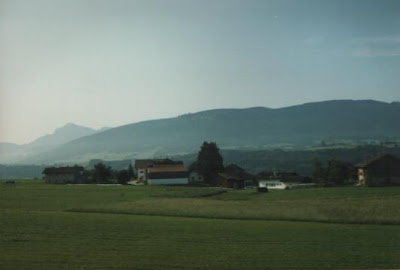
View of Austrian Countryside from Train Travelling Salzburg-Vienna, September 1988
Roof of St. Stefan's Cathedral in Vienna, September 1988

Entrance of Art Gallery in Vienna, September 1988

Entrance to the Residenz in Vienna, September 1988


Italianate Church Close to Karlsplatz in Vienna, September 1988

Entrance to Karlsplatz Underground Station in Vienna, September 1988


Building Close to Karlsplatz in Vienna, September 1988


Prater Ferris Wheel in Vienna, September 1988

Sunday, 31 August 2008

20 Years On - Part 10 of Account of Travelling by Train Around West Germany and Austria

I think one reason for getting up so early was to miss the crowd trying to get breakfast. While I seemed to get on well with many people I met others were far more of a challenge. In particular I remember an Israeli woman who nagged me because I was not going to the Dachau concentration camp. I told her that having studied the Holocaust at 'O' Level, 'A' Level and as part of my degree programme, I wanted a break from it. She said that I had to have some sourness with all the sweetness of my holiday. I said that I did not come on holiday to be depressed and refused to speak with her any more. In general I came away from this holiday both irritated by Germans and Israelis, people from both nationalities seem to keep telling me I was doing things wrong and had no hope of ever getting them right. By the end of the holiday, I felt that not only did travelling reinforce prejudices but also created new ones and I swore off travelling again for fear I would end up a real bigot. Perhaps it is the difference of the British character to that of other nations that we try to be diplomatic and understanding but that does not shield us from people being very assertive about what we 'should' be doing.

I am glad that I did not go to Dachau despite the bullying. Given how churned up I get by discussion of any genocide, even individual stories from these events, I think I would have found it difficult to cope with seeing its presence for real. Sometimes you need the fuse in your system of being able to keep things a little at arm's length otherwise you freak out. Given my dalliance with suicide as it was, I doubt I could have coped. Going to a location like Dachau is something you need to think about a great deal and make the decision which is not going to do you harm. One can understand and oppose genocide without having to rub one's face in its traces.


I remember going to a strange art exhibition in the gallery at the Hofgarten which simply consisted of black and white photographs of different types of water towers. I actually came across a book of the photos for sale in a gallery in Köln the following year. You can see the photo I sneaked while inside the gallery in the collection below; I took it as I was amusedly incredulous that a gallery could show such things.


Wednesday 31st August 1988
Today I woke up early, showered and walked to the Nymphenburg Palace where I arrived at 08.00, an hour early. When they did open I walked around the house interior and then the very pleasant gardens and the four lodges - Amalienburg, Badenburg, Pagodenburg and Magdalenklause, having already seen the carriage/porcelain museum. I then walked back towards town taking the underground to the centre where I looked around the Frauernkirche and the München Stadt museum. I stopped for lunch before moving onto the Residenz and the Hof Garden and ending up in English Garden which was full of locals, many naked and also had a [traditional style Bavarian] band in a the pagoda. I had dinner and a litre of beer, then I walked back across town which took half-an-hour. I checked up on the train times for tomorrow, it looks likely that I will have to change at Salzburg. As the bureau de change is open from 06.00 (to 23.30) I will easily be able to get Austrian Schillings before I go. So far the plan is Wien, Nürnberg, Würzburg, Marburg, Kassel, Köln, Oostende, home or earlier if I run out of money.

Weather: Sunny and hot.
Roads and Ornamental Canal Leading to Nymphenburg Palace in München, August 1988

Front and One Wing of the Nymphenburg Palace, August 1988

View of Nymphenburg Palace Gardens, August 1988

View of Interior of One of the Lodges of the Nymphenburg Palace, August 1988

View of Ornamental Canal in Grounds of Nymphenburg Palace, August 1988

View of Another Lodge in the Grounds of the Nymphenburg Palace, August 1988

Doorway in the Residenz in München, August 1988

Folly in the Hofgarten in München, August 1988

Inside Art Gallery Close to Hofgarten in München, August 1988

Saturday, 30 August 2008

20 Years On - Part 9 of Account of Travelling by Train Around West Germany and Austria

Before re-reading this I had forgotten how much competition there was to get a youth hostel place in Munich. The rules in the Land (province) of Bavaria were stricter than in the other parts of West Germany. In most areas people of any age could stay in a youth hostel, in Bavaria you had to be under 26. In most areas you could bring your own bedding; in Munich you were compelled to hire it. The youth hostel was well used and the dormitories were huge compared to the rooms I had stayed in up until now, leading many visitors, unfairly to a prison camp. I think this was partly because most German youth hostels were luxurious compared to the bulk in the UK. I had no complaint.


I travelled from Freiburg-am-Breisgau to München on a train which was run by the East German Railway service (ironically still labelled 'Deutsches Reichsbahn' on the carriages, literally 'German Imperial Way', the pre-war name for the German railways) and all the instructions were in German, Russian, French and Italian, not English. The attendant who turned the beds (three on each side of a carriage up the wall) back to seats and wall panels, wore a very naval looking uniform, she appeared like a rating from the 19th century. Unsurprisingly for East German staff they were very surly and had no interest in speaking to a non-German. Another thing new to a young British man was sitting opposite women in sleeveless or short-sleeved tops who had not shaved under their armpits. When the German singer Nina had appeared on television in the UK with her Number 1 hit, '99 Red Balloons' (1983) her unshaved armpits had raised much discussion but to be exposed to it across a train carriage left me uncertain where to look. It is funny these social mores, I probably would have been less embarrassed if these women had been topless.


I remember being impressed by Steve the American who was from, I think, Kentucky, and had studying engineering had come to West Germany to practice his German as he felt it would assist him in his engineering career. I remember Mark the Australian walked around the streets of the city barefoot.


Tuesday 30th August 1988
Today I woke up early and walked to the station along the quicker footpath route this time. I caught the train to Karlsruhe where I changed for a train to München. I stopped off in Karlsruhe where I bought some food. I arrived in München by 15.00. Then I walked to the youth hostel, already quite full. Within two hours, that one and the others, one affiliated and two non-affiliated were also full.


I met an Australian, Mark and we walked into the centre of town where we looked around some bookshops and at street-performers. Then we came back and I dried my washing at an excellent 24 hour laundrette. Then I cam back to have a beer. The youth hostel is rather rough. I am in a dormitory rooom which is rather smelly - forty people. There is quite a lot of complaint, but the town is decent. I went out again with Mark and an American, Steve, for some more drinks.


Weather: Sunny and warm.


View of the Schwarzwald Close to the Freiburg-am-Breisgau Youth Hostel, August 1988

Mural on Block of Flats in München, close to the Youth Hostel, August 1988

Friday, 29 August 2008

20 Years On - Part 8 of Account of Travelling by Train Around West Germany and Austria

When in my first year at university I had met a fourth year German language student (a British woman studying German as a subject; language degrees are four years rather than three as the students spend their third year in abroad) called Melissa and we had an ambivalent relationship. She used me at a party as a kind of shield against a very smarmy man called Tony and as a result I had my first real passionate kiss. However, as discussed before, I had no confidence in my abilities with women and did not know how to handle the situation. Melissa and her group of friends lived on the corridor in halls next to the one I lived on so they would often socialise with my friends as a group. I had not gone to university until I was almost 20, whereas most of my friends in my year were closer to 18, so in age I was not much younger than Melissa. She was a confusing character anyway, very flirtatious but then when you talked with her you realised she was very naive too and did not really realise what men expected from her given her flirtatious manner. Anyway, she had spent her year abroad in Freiburg-am-Breisgau in the South-West of West Germany and had mentioned she might be there in the Summer of 1988 and so I wandered around the town hoping that I would run into her and have some romantic encounter. It was wasted pining as when I met her at a party at her house in Herfordshire on the Saturday after I returned to the UK, it turned out she had never got to West Germany that year and instead had been in California. Anyway, she must be in her mid-40s now but I have not seen her for just under twenty years.

On the way to Freiburg-am-Breisgau in the Schwarzwald (Black Forest) I also remember meeting a strange young German man on the train who was obsessed with cows. He had a book of photographs of different breeds and travelled the country to see them. He spoke about slaughterhouses as one might concentration camps and he constantly extolled how beautiful cows were. The photograph with the bicycle by the tree was my attempt to replicate a similar arty poster I had of Oxford, but the light levels were really too low with all the rain to allow it to be successful.

Fabrikstraße means 'factory street'. The term 'yuppie' was very much in fad at the time and stemmed from the phrase 'young upwardly-mobile professionals' who seemed to be at the forefront of Thatcherite society. In Britain, München is better known as Munich, Wien as Vienna and Nürnberg as Nuremberg. In the end I did not get to Augsburg until the following Summer. At that time I returned to Freiburg-am-Breisgau too and found out that the rain on this visit had spared me the key problem of the youth hostel there, which is that it sits right next to a broad, shallow, fast moving stream and throughout the night (if the windows are open) you are kept awake by its noisy bubbling.

Monday 29th August 1988
Today I work early and caught the bus to the station. Then I caught the train to Freiburg. I looked around the cathedral and the old town, then wandered around a park in the foothills of the Schwarzwald. I walked through the rain to the youth hostel, through real yuppie areas of new houses and fancy schools, ironically called Fabrikstraße. At the youth hostel they did have [clothes] washing facilities but the dryer was out of order. I did the washing which was smelling terribly and also read "Newsweek" and "Time" lent to me by an American. I ate in the youth hostel for DM6,- and with no lunch saved me some cash. Tomorrow I think I will got to München probably via Karlsruhe. If there is no room I will go to Augsburg, and onto Wien and then back to Nürnberg.

Weather: Heavy rain, sunny and warm later.
Market Hall in Freiburg-am-Breisgau, August 1988

Decorated Doors in Freiburg-am-Breisgau, August 1988

Cobbled Street in Freiburg-am-Breisgau, August 1988

Note channels along road side to allow stream to flow through the city

Bicycle Leaning on Tree in Freiburg-am-Breisgau, August 1988

View across Freiburg-am-Breisgau from the Schwarzwald, August 1988