Showing posts with label France. Show all posts

Tuesday, 2 October 2018

Death in Amiens: Contemporary Mystery set in Northern France

Death in Amiens


This book was in part a new departure for me, as it is a crime novel, but set in 2018.  I have visited Amiens on a couple of occasions and while there I began thinking about the contrast between how different people see life.  Thus, was born the concept of a novel in which you have an apparently unhappy man and one, despite the pressures he faces, finds life worthwhile and fulfilling.  In my crime novels, this is the nineteenth of those, I like to look at aspects of the characters that go beyond the crime itself, to provide rounded individuals which you can believe in as genuine, even if they are fictional.

Amiens is a pleasant city in northern France which possesses one unique aspect - the hortillonages.  These are floating gardens that were developed in the Middle Ages and are very much in use today.  A market selling produce from the gardens has had a revival in recent years.  You can walk alongside these or even pay to have a boat tour through them.  I thought this tranquil setting would be an interesting place for a body to turn up.  A few other things came into play.  One of these was finding out that French policemen retire at 52; until recently it was 50, so they are comparatively young when they stop work.

I was keen to include places I have visited in Amiens and indeed in Arras and Dunkirk which feature in part in the book.  If I had written this 5 years ago, perhaps only 3, it seems many more of them would still be open; there has been a spate of closures in recent years.  However, given the wonders of the internet I was able to replace them with real places still open (as well as a few fictional ones) and even find out what would be on the menu if you decided to visit one of them.

I hope that readers find the book engaging, not simply for unravelling the mystery but also for the portrayal of life in contemporary France and for looking at the different ways in which men cope or do not cope with ageing.  We are currently being told so often what we are assumed to be and how we should behave, it makes it harder than ever to know where we should be going next and if there is actually anything in our lives we can legitimately enjoy.

The book is available on various Amazon websites:
UK @ £2.64:
https://www.amazon.co.uk/Evening-Amiens-Mystery-Alexander-Rooksmoor-ebook/dp/B07HTWY4JM/ref=sr_1_1?s=digital-text&ie=UTF8&qid=1538400245&sr=1-1
USA @ US$3.46:
https://www.amazon.com/Evening-Amiens-Mystery-Alexander-Rooksmoor-ebook/dp/B07HTWY4JM/ref=sr_1_1?s=digital-text&ie=UTF8&qid=1538400344&sr=1-1
Canada @ CAN$3.50
https://www.amazon.ca/Evening-Amiens-Mystery-Alexander-Rooksmoor-ebook/dp/B07HTWY4JM/ref=sr_1_1?s=digital-text&ie=UTF8&qid=1538400427&sr=1-1
Australia @ AUS$4.79
https://www.amazon.com.au/Evening-Amiens-Mystery-Alexander-Rooksmoor-ebook/dp/B07HTWY4JM/ref=sr_1_1?s=digital-text&ie=UTF8&qid=1538400530&sr=1-1
Germany and I imagine other parts of Europe @ €2.99:
https://www.amazon.de/Evening-Amiens-Mystery-Alexander-Rooksmoor-ebook/dp/B07HTWY4JM/ref=sr_1_1?s=digital-text&ie=UTF8&qid=1538400676&sr=1-1

Sunday, 14 June 2015

Returning To Sables D'Or

Six years ago, I produced a posting about my childhood memories of holidaying at Sables D'Or Les Pins in Brittany in northern France: http://rooksmoor.blogspot.co.uk/2009/03/memories-of-sables-dor.html  Conscious that I do not have a great deal of holidays left and seeking something that would not end in the kind of disaster my holidays usually do, e.g.:

http://rooksmoor.blogspot.co.uk/2008/03/when-holiday-is-worse-than-no-holiday.html
http://rooksmoor.blogspot.co.uk/2010/09/camping-in-me-first-era.html
http://rooksmoor.blogspot.co.uk/2014/07/canal-boating-running-gauntlet-of.html

I decided to go back to Hotel De Diane in Sables D'Or and sit there for a week.

The holiday was largely a success.  I aimed to go with Condor Ferries which use catamaran ferries that should shave three hours off the travel time across the English Channel.  However, being relatively small vessels they are affected by the weather much more than traditional ferries.  On both the outward and return crossings the sailings were cancelled.  In the end I had to return by Brittany Ferries, taking nine hours in total, but a very reliable service.  As it was, the Condor Ferries service saved no time.  In the last couple of years they have ended their sailings from Weymouth and from 2014 ended direct sailings from Britain to France.  Instead you are taken to the Channel Islands where you have to wait at least 2 hours, sometimes overnight, until a shuttle ferry from France arrives to take you the final stage.  Thus, the time saving is lost and often you will have to pay for accommodation on Jersey or Guernsey.  This rigmarole is repeated on the return journey.

Anyway, the ferry difficulties shifted my holiday by a day and meant me paying for another night in the hotel in France.  I also was very sick on the outward crossing.  It has become apparent that in contrast to my youth I now cannot sail on board a ferry even in calm seas without becoming ill.  I put it down to the inner ear infection I caught in Berlin some nine years ago.  It has affected the woman I was travelling with then in a different way but she has still had to abandon motorcycling.


In many ways the resort is similar to that portrayed above.  It was opened in 1924 and despite modern technology retains old world charm.  The houses shown in the picture are still there and it seems many French have holiday homes in the area as do some British.  Rambling, horse riding and golf, despite being things I did not engage with, remain important in the area.  The casino is still there, but did not seem open while I was in town.  Sitting between St Brieuc to the West and St Malo to the East, the hinterland is traditional rural France with quiet roads and pleasant villages with locations for horse riding and fishing.  The coast is a mixture of rocky headlands and large beaches from which the tide goes out a long way.  In June most of the visitors were the elderly there for the walking.  There were quite a few Germans in camper vans too.  I am sure it gets much busier once the school holidays start.

My parents stayed at the resort in 1965, 1966 and 1972; family friends also stayed there in that era.  I am not sure now if the Hotel De Diane was the hotel they visited, because it is run by the Rolland family, who have held it for four generations and that is not the name of the proprietors that my parents knew.  I think in fact they stayed at the much larger hotel less than a metre away next door.  It, however, has now closed down.  The Hotel De Diane, named after a valley rising from the town, is compact and has an award-winning restaurant which has good food though a small menu.  Everywhere seems to have been affected by nouvelle cuisine and it is very difficult to get anything traditional.  I suppose this is a result of catering schools and inspectors in France.

The hotel is modern inside and nicely appointed; the staff are very friendly - many seem to be from the Rolland family.  There is a waitress from northern England in the restaurant who shows off how people can have different characters when speaking different languages.  She squawks at British guests in English and speaks softly to the French guests in French.  A good place if you want somewhere quiet to stay.

Hotel De Diane, Sables D'Or-Les Pins, eastern Brittany, France


At this time of the year the beach which is immense at low tide, as can be seen below, is largely deserted.  There is an onshore breeze and some people sail or windsurf.

The Beach at Sables D'Or at Low Tide


The tiny chapel, seen in the picture at the top can still only be reached at low tide.  It is a real mission to reach it across the rocky causeway.

Chapel on the Islet of St Michael at Sables D'Or


The small town of Sables D'Or-Les Pins has a few restaurants of different standards, a couple of pizzerias and creperies.  Erquy down the road remains a functional town still with a fishing fleet.  Like many towns in the region it has a very large, very clean beach.  In fact how clean the beaches was stunning to me though I am familiar with award-winning ones on the South coast of England.

There are some sights to see.  I returned to Fort La Latte which I mentioned in my previous posting.  The battering ram from the movie 'The Vikings' is now properly displayed.

Fort La Latte


Prop Battering Ram used in the Movie, 'The Vikings' (1958)


I enjoyed visiting the historic town of Dinan and for some reason found Lamballe a town which houses France's national stud, very pleasant too.  St Malo old town is a tourist attraction but did not seem overwhelmed by it.  This maybe because I was early in the season.

Dinan


Lamballe


St Malo


Even St Malo which has a commercial port has a long, attractive beach, it seems compulsory for towns in the region.  Being an adult rather than a child, I had freedom to go where I chose.  Unlike many members of my family,   My car did great service getting me around the countryside.  Drivers in rural France seem more patient than their equivalent in the British countryside who always seem offended that you are simply there.  My sat nav despite containing maps of France pleaded that it lacked the memory to cope, so I ended up map reading which did me well.  I only had difficulty entering and leaving St Brieuc where the drivers were impatient at me looping the roundabouts and where, anyway, the roads were disrupted by road works and diversions.

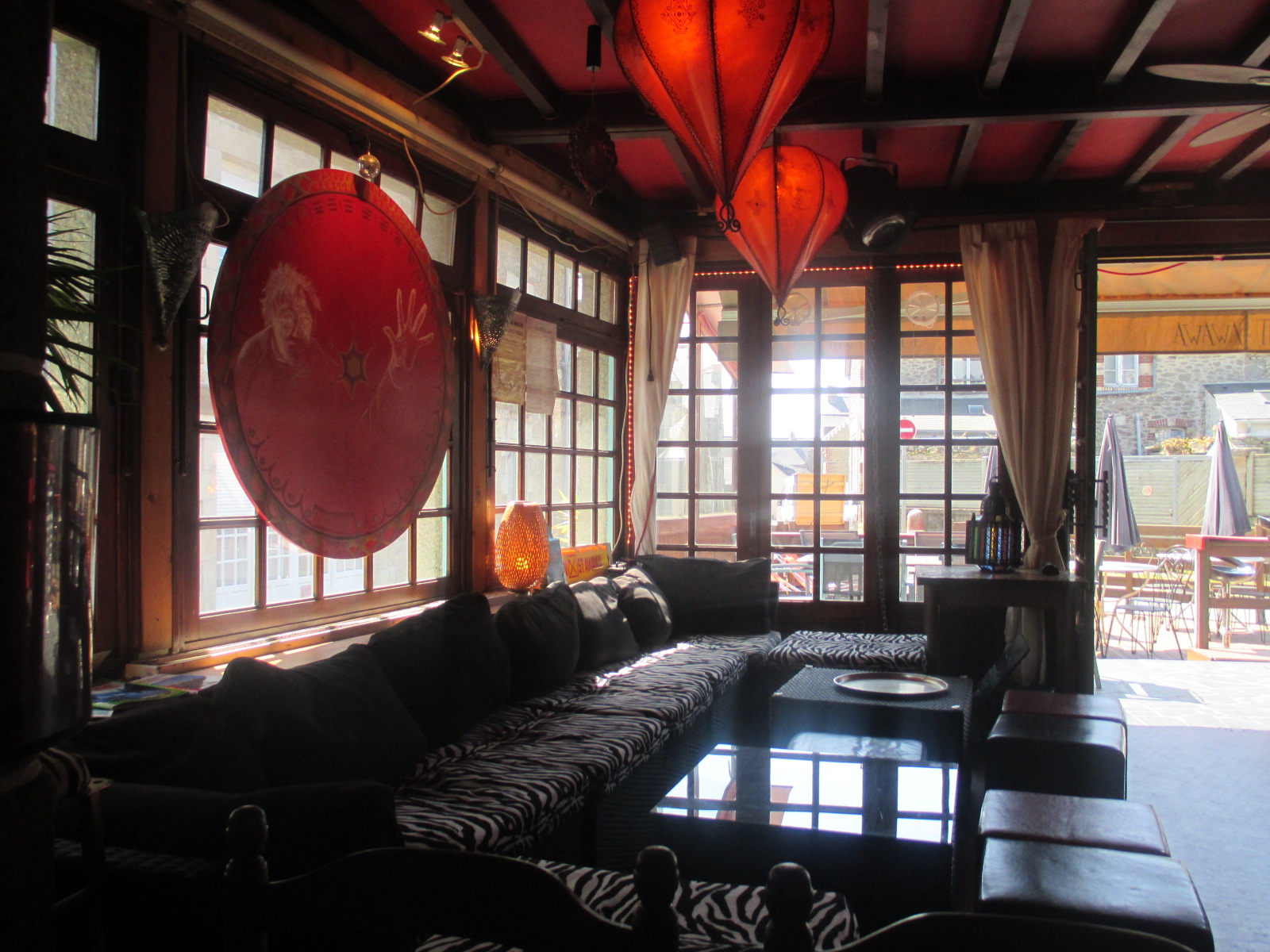
I found some other interesting places, St Jacut de la Mer is a town with very little bar a modern looking abbey.  However, being a narrow peninsula it is lovely and quiet and I can recommend the 'Awawa' restaurant run by a young couple.  The food there is delicious.  I did not have a bad meal anywhere I ate but this one really stood out.  Jugon-les-Lacs almost due South inland from there, is also very pleasant.  The lakes are artificial but you could not really tell.  As with a lot of the region, I saw loads of wild flowers everywhere and many more bird species than I even see North across the Channel in Dorset and Devon.  It must be a great area if you enjoy walking or cycling.  There was a cycle race open to teams and individuals of all levels while I was in Sables D'Or and a cycle rally in St Malo too.

One thing that struck me was how difficult it was to pick up radio stations that did not play old fashioned French music.  It was as if I was in an American's imagination of France.  I even ended up with a Breton folk channel at one time.  The rocky outcrops of the area seem to play havoc with reception.  I found no petrol station with any staff.  You generally have to pay by debit card and this can get complicated.

The main street of St Jacut de la Mer


Interior of 'Awawa' restaurant


Wild flowers in St Jacut de la Mer


Street in Jugon-les-Lacs


Jugon Lake seen from Surrounding Hills


As you can see from the shot of Jugon-les-Lacs there is a flaw in my camera, a chip in the glass right in the middle of the lens.  I had to replace it.  However, on the balance of what has happened on holidays, this one turned out to be better than the large majority.  I was able to both indulge in nostalgia for my youth and discover new places.  I also found a region, which certainly outside St Brieuc, is very quiet and relaxing to travel around and visit places.  It may be that going early in the Summer helped with this and it would be a different story in August.  No holiday in the area is going to be a staggering experience but it can be restful and that is what I really needed.  Last year's experience meaning I came back even more stressed then when at work, needed to be avoided and returning to Sables D'Or provided that.

On one hand, given this success I began thinking about possibly venturing further afield.  However, I fear now that one success has bred complacency.  Furthermore, there are few places I have been where things have not gone wrong, so I have little idea where I would go next.  I do, fortunately, appear to have broken a 7-year bad run of holidays.  Perhaps I need to go back to the pattern of the 1990s when I only had a holiday every 5 years so as to reduce the risk.  That would mean, however, I have only 1-2 holidays left.  I suppose I should be grateful this one went well.

P.P. 18/07/2015
I came across another postcard of the next beach East along from Sables D'Or and show it here with a picture I took this year to show how little has changed.


I was stood among the pines shown on the postcard, but zoomed in from there to focus on the beach, but you get the feel for it.

Thursday, 17 April 2014

Tuesday, 15 April 2014

Tuesday, 8 April 2014

What If the Gallipoli Offensive Had Succeeded?

My views on this topic can be found in my e-book ‘In Other Trenches: Alternate Outcomes of the First World War’ It is available for purchase on Amazon.  Please note that the 2nd Edition is now on sale which has been thoroughly revised and rewritten in response to feedback about the 1st Edition that you will see online:

UK readers might prefer to access it through:


Wednesday, 2 April 2014

Monday, 27 August 2012

What If The French Government Had Relocated To Algeria In 1940?

My views on this topic can be found in my e-book ‘Other Roads: Alternate Outcomes of the Second World War’ It is available for purchase on Amazon:

UK readers might prefer to access it through:


What If The British Expeditionary Force Had Been Eliminated At Dunkirk?

My views on this topic can be found in my e-book ‘Other Roads: Alternate Outcomes of the Second World War’ It is available for purchase on Amazon:

UK readers might prefer to access it through:


Monday, 16 July 2012

What If the English Won the Hundred Years’ War (1337-1453)?

My views on this topic can be found in my e-book ‘On Other Fields: Alternate Outcomes of the Middle Ages’ by Alexander Rooksmoor.  It is available for purchase on Amazon: http://www.amazon.com/On-Other-Fields-Alternate-ebook/dp/B008LMT9WO/ref=sr_1_8?s=digital-text&ie=UTF8&qid=1342436531&sr=1-8

UK readers might prefer to access it through: http://www.amazon.co.uk/On-Other-Fields-Alternate-ebook/dp/B008LMT9WO/ref=sr_1_9?s=digital-text&ie=UTF8&qid=1342436579&sr=1-9

What If Burgundy Had Persisted?

My views on this topic can be found in my e-book ‘On Other Fields: Alternate Outcomes of the Middle Ages’ by Alexander Rooksmoor.  It is available for purchase on Amazon: http://www.amazon.com/On-Other-Fields-Alternate-ebook/dp/B008LMT9WO/ref=sr_1_8?s=digital-text&ie=UTF8&qid=1342436531&sr=1-8

UK readers might prefer to access it through: http://www.amazon.co.uk/On-Other-Fields-Alternate-ebook/dp/B008LMT9WO/ref=sr_1_9?s=digital-text&ie=UTF8&qid=1342436579&sr=1-9

Tuesday, 3 April 2012

Walking On - Short Story

Back in March I joined a writers' group in the town where I work during the week.  Partly it was because aside from the unpleasant situation at work and trying to remain happy and yet deal with problems at home, I realised I was not talking to anyone.  To some degree that got me into a situation of simply bouncing between the demands of home and work with no let out.  Even after the first meeting I realised I should have come to the group much sooner as I thoroughly enjoyed the evening and the people, a real mixture, were friendly.  Having a common interest in writing, which can be very much influenced by yourself and the challenges you are facing is a good outlet when under stress.  The sessions are split into two parts with us doing an activity in one part and reading our own work in the other.  This has led me to write very short pieces of fiction in response to the stimuli we are given and I have decided to post them here.  In length, this one is 380 words, they are more like what is now fashionably termed 'flash fiction'; the Bridport Prize competition defines flash fiction as being under 250 words, so maybe I do not fit with that precisely.

This story was inspired by listening, at the writers' group, to the Clair de Lune movement of the Suite Bergamasque written by Claude Debussy in 1890 and published in 1905.  Not knowing the background of the piece I was inspired by the music itself to think of sunny fields.  Whilst the latter parts of the piece seem to have a 'darkness' I translated that into grief rather than actual night-time.  The sense I had was that this story is set in the 1920s and features a woman returning to the battlefields of northern France where her brother was killed in the First World War.  However, as it is written it could easily be applied to the post-Second World War period or to other conflicts, probably in Europe given the landscape described.


Walking On
The wind swept across the wheat as they walked along the track.  The clouds skittered across the sky sending bands of light and dark over the land.  Anne looked to the horizon.  Beyond the woods lay the shore, but from where they walked now, it was concealed.  She looked across the fields to either side not really knowing what she was seeking.  She both wanted and did not want to catch sight of some scar, some ruin from what happened here barely four years ago.  There was a derelict farm building but that could have been seen many decades back, nothing showed her that it was shells that had wrecked it. 

David walked a little ahead of her and she stepped to draw level with him: to gather from more than simply his stance how her felt.  His hand clasped Charles’s; the boy’s entirely encompassed by his father’s.  That gesture should have been something signalling hope and yet, like so many shards of things; things that would come to any of her senses it thrust into her.  It thrust painfully as she remembered holding her first Charles’s hand much the same way: the hand of her brother, not so much smaller than her own, not as much as the difference between that of her husband and her son. 

Was it a mistake to be here?  Not for the first time did her brother’s form watch her from the shadows at the edge of the woodland.  She banished it once more with the shake of her head and looked up the road, beyond the trees to where the painfully light, shard-infested blue of the sea beneath the smooth paste blue of the sky came into sight.  Anne stared hard, trying to catch as many glints as she could in her eyes to burn out the hanging weight of grief.  She took her son’s other hand in her own to make a structure, a fence of life, of young and mature skin, of energy.  She felt that she could draw strength from it and whilst David could not see her she gazed at his red-touched skin that she knew by every pore and down to the hair of her son, swept like the wheat by the breeze.  She walked on.

Sunday, 2 January 2011

Books I Read In 2010

This is the latest in my annual series of reviews of books I have read.  See:
http://rooksmoor.blogspot.com/2010/01/books-i-read-in-2009.html
http://rooksmoor.blogspot.com/2009/01/books-i-read-in-2008.html
http://rooksmoor.blogspot.com/2008/01/books-i-read-in-2007.html
for previous postings in this series.

The number of books I am reading seems to be steadily falling from between 30-40 per year back in the 1990s to much lower figures now.  Interestingly there is a direct correlation between how much I am unemployed in a year and how little I read.  You might think that being out of work would leave me lots of time for reading, but it is also about being inspired to read and when I am without a job, the debilitating lethargy quickly creeps over me.  I guess this is why I know I could never be self-employed.  Like the huge majority of the population from the moment I started play school I have been conditioned to having my day structured for me whether directly or indirectly through people making timed demands.  As a result, being out of work so much in 2010 I have read less than even in the previous years.

Some people say that the book is dead and young people in particular tend not to read books.  Pre-secondary school children do still seem to engage well with books, as sales of things like the Beast Quest series show.  Reading is in fact at a height.  The internet, though providing lots of video content, is actually full of text.  A lot of that text is very badly spelt, but it is text all the same.  Blogging is a very text based art and develops writing skills, though I accept to a limited extent in some cases, and reading too.  The book as a medium rather than reading as an activity may be in decline but it is not that apparent.  I remember when supermarkets did not sell novels or any books in fact, and yet, these days even comparatively small branches have a row of books.  I find them in 99p shops too.  Some of this I imagine is about the digital divide; 30% of people in the UK have no internet access and many others have poor, low band access.  I am a well educated person who cannot afford a Kindle, whereas I can fill my house with books from charity shops and actually have a backlog of a few hundred books to read; I have not bought a new book in the past two years trying to keep the stack down.  People give me books too.  I think the tactile element of reading, the robustness of books, their ease of reading in a variety of light situations, the fact no-one is liable to steal your book, means that they will be around for a lot longer.  The recession means they will be more appealing to those with few funds and a lot of time.

Anyway, for me, not having travel on public transport, no longer having a lunch break and having a lover who is often averse to me reading in bed, my chances for reading for pleasure rather than for information or trying to find a job have declined severely, and last year's very short list of book titles shows that.  Expecting to have to move house at any time last year I focused on the heaviest books in my collection.  Many removal companies refuse to move books (certainly three companies out of the last four I have used) and so I was concerned that if I could not reduce the weight I would have to abandon large quantities of my collection if I could not fit them in my car.

Fiction
'The Daffodil Affair' by Michael Innes.
This was the third in a three-book collection of terribly over-rated novels by Michael Innes. I commented on 'Death at the President's Lodging' and 'Hamlet, Revenge!' last year.  This third book was even worse than them.  It is a weird fantasy of a police detective sent during the Second World War to South America to investigate a man interested in psychic phenonmena who has abducted various people, a horse and even haunted buildings and brought them to a settlement he was creating.  How anyone could do that during wartime seems odd.  Of course, many of the people simply have mental health issues.  The whole novel is very peculiar, totally unbelievable and a real waste of time.  In nothing I have read by Innes does he seem to warrant the acclaim he was given.

'Chimera' by John Barth.
I really seem to have had a bad run of novels.  This one was an utter shambles.  It received an award in the mid-1970s and I can only imagine the award jury were on drugs at the time.  It is supposedly a three-part novel that draws on Greek myths and stories from the Arabian Nights.  It starts rationally enough re-interpreting the stories from a 1970s perspective though set in the ancient world.  However, quickly the text becomes almost incomprehensible with the plot running out of steam and even if you know great details of the original myths, the writing is soon a mish-mash of phrases and snippets that seem to think they are so clever but in fact are pathetic.  I certainly would warn you away from this novel, though I imagine there cannot be many left in circulation.

'The Deadly Percheron' by John Franklin Bardin.
I immediately worried that this was a kind of re-run of 'The Daffodil Affair' being a story set during the Second World War and involving a disappearing horse.  In fact it is far better being about a plot to divert, even brain wash as leading psychologist so that he cannot reveal the identity of a murderer.  It is written from the psychologist's perspective and is especially well done when he wakes up after having been almost murdered by being pushed in front of a train and begins to try to recapture his identity.  As a European reader, seeing New York portrayed in the early 1940s, so apparently untouched by the war is interesting.  The novel has elements of film noir stories, but with a greater psychological element than even those.  Not a cheerful novel, but well written and engaging all the same.

'The World at Night' by Alan Furst.
Furst is renowned for his spy/intrigue/murder novels set in 1930s and 1940s Europe.  This one was a real disappointment.  It features a Parisian movie producer who is drawn into being a double agent working for SOE and the SD in wartime France and Spain.  In the meantime he tries to make movies during the period of occupation and has lots of affairs before falling in love with an actress living in Lyons, which unlike Paris, lay in the Vichy region of the country.  The whole novel feels like Furst is simply going through the motions.  There is a real lack of tension throughout even in scenes as when the protagonist is escaping from a Gestapo prison.  There is a lack of passion in the numerous sex scenes too.  Furst is pretty good at conjuring up the context and details of the period, but in this case it makes the book as dreary as living in wartime Paris must have been.  Something to engage the reader is really lacking from this book.


'The Astounding Science Fiction Anthology' ed. by John W. Campbell, Jr.
I have no idea where I got this book from but it is one of the best I have read in a long time.  It is a collection of stories from the US science fiction magazine, Astounding Stories, which became Astounding Science Fiction in 1938.  It is still being published, since 1992 under the title Analog Science Fiction and Fact.  The magazine started in 1930 and Campbell was its editor 1937-71.  This anthology published in 1952 includes short stories appearing in the magazine 1940-51, a period that Campbell feels was when science fiction was moving from being just the substance of 'pulp' magazines to becoming a more serious genre.  I will list the short stories below because you will see many familiar names.  I have included one of the stories from the anthology in a posting before: http://rooksmoor.blogspot.com/2010/09/making-english-language-more-logical.html

I certainly think that a lot of contemporary science fiction writers especially those of the overblown, door-stop kind of writing should go back to these stories and see good writing in the genre.  These were clearly the cream of the stories over an 11-year period, but despite their age they stand up well today and I thoroughly enjoyed reading them.  Of course, in 1940 the nuclear bomb was guessed at but had not been created, but already writers were analysing the likely impacts on humans and the struggles of dealing with such power.  Interestingly only in a couple of the stories do you see Cold War sensibilities, and this is really only apparent in the later end of the collection.  Knowledge of the solar system seems a little naive today, with primitive life on the Moon and bases established beneath seas on Venus, but to some extent show writing at that cusp before all the fantasies of Jules Verne and H.G. Wells about our neighbouring bodies were finally dismissed by space travel.  Certainly 'Clash by Night' by Lawrence O'Donnell (1943) portraying battling companies of mercenaries on Venus could stand up beside the 'Dune' series even today. 

As you would expect from science fiction there are stories questioning assured mutual destruction, first contact with aliens, brilliant children and creating immortality through manipulating cells.  Though the language [for example people say 'good-by' rather than 'goodbye'], the clothing and some of the ordinary technology seems very dated now, it added to the charm for me as it gave a window into not only science fiction ideas but those of a mid-20th century US context.  As with all best short stories, these pack stimulating ideas into a small package and often have an excellent pay off, sometimes in the final phrase.

'Blowups Happen' by Robert Heinlein, 1940
About the psychological pressures on men overseeing nuclear weapons.

'Hindsight' by Jack Williamson, 1940
About personal and inter-planetary rivalry in a colonised solar system, involving weaponry firing through time.

'Vault of the Beast' by A.E. van Vogt, 1940
About unleashing a sleeping alien entity.

'The Exalted' by L. Sprague de Camp, 1940
 Rather comic tale of an intelligent bear investigating mischief at a US university.

'Nightfall' by Isaac Asimov, 1941
Great story about how, on a planet which suffers periodic eclipses, myths and cults arise explaining what is happening, with particular consequences.

'When the Bough Breaks' by Lewis Padgett, 1941
Parents' view of raising a genius child desired by a future civilisation, a kind of antidote to 'Terminator' (1984) and its sequels (1991; 2003).

'Clash by Night' by Lawrence O'Donnell, 1943
City-states on Venus use mercenary companies to fight their battles; tactical nuclear weapons are banned.

'Invariant' by John Pierce, 1944
A man has found a way for him and his dog to become immortal, with unexpected consequences.

'First Contact' by Murray Leinster, 1945
A really good exploration of the challenges of encountering new intelligent life on the edge of human space.

'Meihem In Ce Klasrum' by Dolton Edwards, 1946
Clever essay on the ridiculous aspects of English spelling.

'Hobbyist' by Eric Frank Russell, 1947
Lone human space explorer cannot determine why there is only one of each species on a planet.

'E for Effort' by T.L. Sherred, 1947
Really fascinating story of the careers of two men who develop a device which can show images from any time or place in history. A little reminiscent of 'Deja Vu' (2006) though on a far larger scale.

'Child's Play' by William Tenn, 1947
A very 'Twilight Zone' like story in which a man receives a child's kit from the future enabling him to create life.

'Thunder and Roses' by Theodore Sturgeon, 1947
Quite a sentimental story with a real 1940s feel about a female singer touring the USA in the wake of a nuclear war begging for the counter-attacks to cease for the sake of the world.

'Late Night Final' by Eric Frank Russell, 1948
Uptight commander of alien invasion fleet tries to prevent his crews fraternising with the humans.  The character reminds me of Arnold Rimmer in the 'Red Dwarf' comedy science fiction television series (1988-99; 2009).

'Cold War' by Kris Neville, 1949
Very similar to 'Blowups Happen' looking at the psychological pressures on men manning nuclear weapon armed space stations circling the Earth.

'Eternity Lost' by Clifford D. Simak, 1949
About a man who has already had his life extended centuries seeking to have one, last, vital extension.

'The Witches of Karres' by James H. Schmitz, 1949
A playful story, a kind of 'Dances with Wolves' (1990) on the borderlands of a vast space empire with mischievous inhabitants of Karres.

'Over the Top' by Lester del Rey, 1949
An explorer is stranded on the Moon while Earth is on the verge of a nuclear war; reminiscent of parts of 'The Martian Chronicles' by Ray Bradbury (1950).

'Meteor' by William T. Powers, 1950
Nice twist on the usual meteor-threatening-to-crash-into-Earth story; the oldest story I know featuring mining within asteroids.

'Last Enemy' by H. Beam Piper, 1950
About staff who monitor different parallel universes being drawn into exploration of reincarnation on one version of Earth; one of the two stories in the collection with apparent US-side Cold War sensibilities but an interesting portrayal of behaviour in a society in which reincarnation is an established fact.

'Historical Note' by Murray Leinster, 1951
Very much a Cold War spoof exploring the consequences of developing personal flying devices in the USSR.

'Protected Species' by H.B. Fyfe, 1951
Nice consideration of colonial attitudes in space exploration, with excellent final line pay-off.

Non-Fiction
'French Revolutions' by Tim Moore.
An entertaining account of the author cycling around the 2000 route of the Tour de France, which I should have read long ago.  Entertaining as all the best travel books are and especially good if you have enjoyed cycle touring and/or know France.  For the impact had on my perception of myself see the posting: http://rooksmoor.blogspot.com/2010/04/not-as-pathetic-as-i-thought-i-was.html

'The Collapse of the Third Republic' by William L. Shirer
A very good exploration of the fall of France in 1940 and the reasons behind it dating back decades.  Shirer is renowned for his work on Nazi Germany.  As a US journalist he was in France and Germany during the 1930s and into the war period.  The USA being neutral until December 1941 he was pretty free to move around even during the war.  He is excellent on the political aspects in the 1930s and early 1940s.  He tends to get overwhelmed when describing the complexities of the fighting in 1940 and the book could have benefited from more maps at that stage.  His journalistic style makes the book very readable and it is very informative on the period.