Fiction
'The Angel of Pain' by Brian Stableford
I had no memory of buying this book but guess I scooped it up from a charity shop when looking for some fantasy fiction. Stableford writes a mature kind of fantasy. I had read 'The Empire of Fear' (1988) and while I did not like the directions it went in, I recognised that he had succeeded in creating an interesting take on vampire stories in a 17th century alternate Earth. It is much the same with 'The Angel of Pain'. It is in effect a sequel to his 'The Werewolves of London' (1990), featuring the same characters but is set 21 years later, in 1893. I think my key issue with Stableford's books is that not a lot happens. He spends much time writing about the characters rather than having them do anything. He creates an interesting context of Victorian Britain in which various powerful beings with limitations are compelled to use various humans to observe and compete against their opponents. I was not surprised to find that Stableford has published a book featuring Cthullu stories. The story focuses on the impact on the individuals, one is enslaved by the Angel of Pain and for much of the book is wracked by discomfort as part of his service to her; others come off worse. The setting and the creatures within it are interesting. There are werewolves of the kind seen later in the 'Twilight' series. There is an immortal man perhaps created by an angel and these powerful beings of differing kinds. What is Stableford does well is have all of the main characters as unreliable witnesses: their viewpoints are never perfect and often contaminated by the individual's prejudices.
The book succeeds on its own terms in creating a number of complex characters and having them interact with each other sometimes in mundane ways, sometimes in very exotic ways. The lead characters ultimately end up in another realm appearing as a manifestation of Eden, but even here they do not do a great deal. Perhaps this is to emphasise that they are little more than pawns. I was interested by this book but did not enjoy it, there was insufficient action. I also read it at entirely the wrong time as I was suffering pain daily and further injured myself bringing on more pain during the period while I was reading it. I certainly disagree with Stableford's view that with time pain loses its sharpness and as a consequence felt the fact that characters did not reflect on how pain comes again and again and again as fresh as the first time as making their perspective illegitimate. I commend Stableford's imagination, I just more happened in his books. For me, reading this book was like wading through an encyclopaedia of imaginary country.
'Ashes and Diamonds' by George [Jerzy] Andreyevski
I came to this book from seeing the movie of the same name released in 1958. The book was written in 1948 but the edition I have must, published in 1957, must have been done to coincide with the movie's release as the front cover has a drawing replicating an iconic images of the young nationalist resistance assassin played by Zbigniew Cybulski (1927-67). I heartily recommend the movie which has some stunning photography that you will remember and successfully conjures up a time and place.
This book is almost the reverse of 'The Angel of Pain' featuring almost frenzied activity over the course of three days at the very end of the Second World War. For the movie it was tightened even further to a day and a night and the following morning. The setting is a medium-sized industrial town in Poland which had been liberated some months before. Nationalist resistance forces are still operating in the area, turning their attention to the Communists busily establishing a new regime, backed by the Soviet Red Army. It looks from many different points of view and the reader is shown a string of characters coming to terms with the situation which remains fluid. Interestingly, and this may stem from the time when it was written, despite the extremes of the time many characters come over as surprisingly soft. Another factor is already the legacy of the war years weighs heavily on them. Thus, this is very much a 'slice of life' novel, bracketed by two shootings and covering violence but also more down-to-Earth activity such as having meals, ambition and betrayal. For the bulk of the characters there is no conclusion contained in the book and it is very much as you have glimpsed their world in passing. I imagine this was in part Andreyevski's intention, to record a very particular time. Yet, though 1945 Poland may seem very alien to us now, you are drawn into the characters very well.
I would not say I was as impressed with the book as much as I was with the movie. However, given the poor quality of so much I have been reading recently, this did stand out and I really admire the writer's craft. However, the brevity of it is liable to leave many modern readers unsatisfied.
Monday, 30 September 2013


Monday, 16 September 2013
What If? Art 7: History Books That Never Existed
It has been six years since I posted any 'what if?' book covers on this site, the last being my spate of 'lost' books back in November 2007: http://rooksmoor.blogspot.co.uk/2007/11/what-if-art-6-books-that-existed-but.html The use of book art as an element of 'what if?' speculation has long interested me and my engagement with it is outlined here: http://rooksmoor.blogspot.co.uk/2007/08/what-if-art-1-history-book-that-never.html
For the cover of my latest 'what if?' anthology, 'Other Lives: ‘What If?’ Outcomes for Famous People in History' (2013), I considered doing gravestones or announcements in newspapers. However, the people feature stretch from Alexander the Great in the 4th Century BCE right up to people in the 20th century. In addition, not all the differences about the duration of their lives but also some of them taking different decisions. As a result I returned to the idea of creating history books that never existed in our world. I tried to keep as close as possible to the style that you find on history book front covers, though also to bring in a bit of variety. These appear as small images on the front of the book. However, I thought people might enjoy seeing them separately in a larger format here, with some explanation of why I decided on the different titles and formats.
One challenge was that to emphasise the alternate history aspect often required two things. First the date has to be included to show the precise divergence from our history. This is notable with the book on the impeachment of George Bush. I included '1987' in the title, as I envisaged Bush becoming President following the assassination of Ronald Reagan in 1981, rather than being impeached during the term of office 1988-92 that he had in our world. The other challenge for those who I was looking at as living longer than in our world, was to find images that showed them as older than they ever were in our history. Thus, I had to work on the hairline of Julius Caesar and Abraham Lincoln and spread the grey in Indira Gandhi's hair far further than was the case in our history.


The basis of this book is Julius Caesar surviving or preventing the assassination attempt against him. As a result he lived on into his sixties and was able to carry out the conquests in western Asia that we know he had planned. Bactria is the region of Central Asia between the Caspian Sea and the Hindu Kush, covering the modern central Asian republics. It was a region Alexander the Great knew and Caesar had sought to conquer. I worked to adjust the image to make it appear as if it showed an older, more wrinkled Caesar. He was concerned baout hair loss and in this image I have him with some male pattern baldness.


For the cover of my latest 'what if?' anthology, 'Other Lives: ‘What If?’ Outcomes for Famous People in History' (2013), I considered doing gravestones or announcements in newspapers. However, the people feature stretch from Alexander the Great in the 4th Century BCE right up to people in the 20th century. In addition, not all the differences about the duration of their lives but also some of them taking different decisions. As a result I returned to the idea of creating history books that never existed in our world. I tried to keep as close as possible to the style that you find on history book front covers, though also to bring in a bit of variety. These appear as small images on the front of the book. However, I thought people might enjoy seeing them separately in a larger format here, with some explanation of why I decided on the different titles and formats.
One challenge was that to emphasise the alternate history aspect often required two things. First the date has to be included to show the precise divergence from our history. This is notable with the book on the impeachment of George Bush. I included '1987' in the title, as I envisaged Bush becoming President following the assassination of Ronald Reagan in 1981, rather than being impeached during the term of office 1988-92 that he had in our world. The other challenge for those who I was looking at as living longer than in our world, was to find images that showed them as older than they ever were in our history. Thus, I had to work on the hairline of Julius Caesar and Abraham Lincoln and spread the grey in Indira Gandhi's hair far further than was the case in our history.
'Alexander the Great's Conquest of the Iberian Peninsula'

For this cover I used an image of Alexander's father, King Philip II of Macedonia to stand in for the older Alexander the Great. The book envisages Alexander living into his fifties rather than dying in his early thirties. Thus, not only completing his conquest of western Asia but then turning to conquer the remainder of the Mediterranean region with this book focusing on his final conquests in what is now Spain and Portugal.
'The Bactrian Campaign of Julius Caesar'

The basis of this book is Julius Caesar surviving or preventing the assassination attempt against him. As a result he lived on into his sixties and was able to carry out the conquests in western Asia that we know he had planned. Bactria is the region of Central Asia between the Caspian Sea and the Hindu Kush, covering the modern central Asian republics. It was a region Alexander the Great knew and Caesar had sought to conquer. I worked to adjust the image to make it appear as if it showed an older, more wrinkled Caesar. He was concerned baout hair loss and in this image I have him with some male pattern baldness.
'Parliament's Lost Leader: Oliver Cromwell 1599-1643'
This is another example of a cover that needed dates on it to show that it was Cromwell's earlier death, in this case in battle in 1643, rather than peacefully in 1658 which was envisaged. By this stage Cromwell was significant in the Parliamentarian camp but was not yet in a position to become leader of the country. Thus this book would ask what missed opportunity the country had with him being killed at this stage. If his death was earlier then it is unlikely he would have warranted his own historical study.
'1777 - The End of the American Bid for Independence'
In my book, the focus is largely on George Washington dying at Valley Forge along with many of his troops in the winter of 1776/7. However, if he had died then, his fame might not have been sufficiently significant to warrant a book of his own, so I envisage this one seeing with his death, the break up of the Continental forces and the end of the attempt of the Thirteen Colonies to break from British control. This is a manipulated painting which actually shows Continental soldiers being trained. However, it seemed to sum up the difficulties at Valley Forge and the three men at the front are in very submissive positions and look as if they are laying down their arms, assuming they have been captured by the British. The background is the Continental flag of the time.
'Lincoln's Post-War Administrations 1865-1872'

This book like the one on Caesar envisages Abraham Lincoln surviving assassination in 1865 or that never having been attempted. Again I needed to age him in the photo and I added in a map of the USA from the post-Civil War period to show Lincoln living on into this period. His survival would have meant much more difference to that period of US history than I initially realised.
'The World Economic Depression and the Demise of Capitalism'
This uses the classic Progress Publishers style for a book that never existed. Progress Publishers were a Soviet back publishing house that made Communist literature available in cheap editions in the hope that ordinary people would buy them. They were typically purchased by students who had to read set books. This one would have been published in 1931 assuming that Lenin had not died in 1924 but had lived on as leader of the USSR. The Great Depression which began with the Wall Street Crash of 1929 appeared to many Communists and Fascists to be the proof that capitalism could not work and that a different political approach was necessary. One could imagine Lenin delighting in his emotionless way to the difficulties capitalism was facing and have hoped that the world Communist revolution was imminent.
'The Overthrow of President Franklin D. Roosevelt'
This one envisages the planned coup d'état of 1934 actually going ahead, leading ultimately to Franklin Roosevelt being pushed from power, probably forced to retire on grounds of ill-health. I felt this picture might be his resignation speech to the nation. This was a scenario that I had not envisaged leading to such a bleak outcome for the world as a whole. However, it quickly became apparent that without the New Deal and certainly Roosevelt's almost one-man attempt to involve the USA in the Second World War not only would that war have dragged on longer but the US and the global economies would have struggled to return to any kind of prosperity well into the 1960s.
'Gustav Stresemann and the Decline of National Socialism 1931-35'

As a bit of a contrast, for this one rather than use a photograph, I picked a commemorative stamp for Gustav Stresemann. I manipulated the dates on it so he is shown as living to 1936 rather than dying in 1929 as was the case in reality. The point behind this book is that probably only Stresemann had the skill and appeal across the political spectrum to undermine National Socialism, the proper name for Nazism. He was a conservative and a nationalist but certainly never sought anything like the regime Hitler installed.
'A King of Our Times - Edward VIII, 1936-72'
This is another one in which the date was necessary to show the change. This is a late picture of the Duke of Windsor who in our world ruled briefly in 1936 before abdicating so he could marry the American divorcee, Wallis Simpson. This book envisages he never met Simpson or he chose to remain on the throne. The trouble with Edward was his willingness to interfere in politics, engage in illegal currency deals and his sympathies for Nazism. Given he would have been influential in the run-up to the Second World War, it is likely that this would have had an impact on British foreign policy. I have opted for the styling of a bland 1970s book on monarchy that you can see online which belies the kind of difficulties this alternative would have brought to Britain.
'The Collected Articles of Benito Mussolini'

It was quite a challenge to find a photo of Mussolini in which he was not in military clothes, shaven headed and pontificating. This is a surprisingly human picture of him that seemed to fit really well with the different path envisaged, i.e. rather than becoming a dictator, he remained a Socialist journalist. As a consequence, rather than being executed in 1945, I envisaged him living into old age. His longevity and his writing is likely to have meant that he received some attention across Europe, perhaps even becoming a kind of older statesman of Socialism, though maybe not to the scale of Antonio Gramsci.
'The Assassination of Charles De Gaulle'

This is an old image dating back six years, which I revived for the chapter in 'Other Lives' on the assassination of De Gaulle. I removed the date from this one as the chapter speculates on his killing at a number of dates. However, the picture is from the early 1960s so suggests an assassination at that time. As I wrote the chapter, my views on when the assassination would have had greatest impact shifted back in time a little. However, I think this is one feasible 'what if?' which tends to be overlooked by writers.
'Nixon as President: The Second Term, 1964-68'

As is often the case with these alternate history covers I start with an actual history book. This ones envisages Nixon being first elected in 1960 when he was narrowly beaten by John F. Kennedy, rather than in 1968. The picture fits with the timescale of the book. The 'button', i.e. the badge, is a genuine image of one produced for the 1964 election when Lyndon Johnson won.
'China's Reprieve: The Fall of Chairman Mao, March 1966'
This centres on a picture of Mao Zedong with his likely replacement if he had been overthrown in the mid-1960s, Deng Xiaoping. While China would have remained a totalitarian dictatorship under Deng, it certainly would have been spared the madness of the Cultural Revolution 1966-76 that caused so much damage to the country. The Cultural Revolution was primarily about Mao re-establishing his predominance in China, so with him being ousted, which seemed possible at this time a different path would have been followed.
'The Indian Dictatorship, 1984-89'

This was another book about a leader avoiding being assassinated. The idea is that Indian Prime Minister Indira Gandhi avoided being assassinated in 1984 yet the attempt on her life and accompanying turmoil in the country led her to impose a dictatorship as she had effectively done in the 1970s. For this picture I had again to try to age the image and I think it comes out reasonably well, with Gandhi's streak of grey having spread more widely across her hair. This picture with the furrowed brow makes her look older too.
'The Impeachment of President Bush'
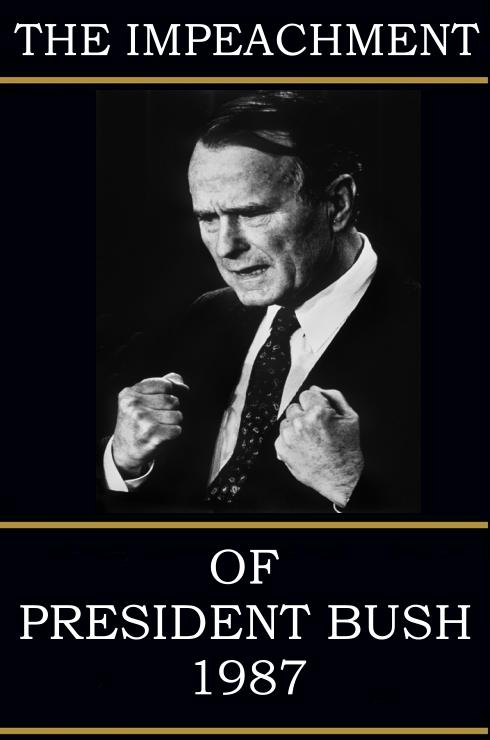
I have explained the reason for the date at the start of this posting. This cover is to signify a chapter which is less about Bush than about the implications of the assassination of Ronald Reagan in 1981. With the De Gaulle one in place, I did not want another title with assassination. The chapter naturally envisages Bush as Reagan's Vice-President, as Johnson did after Kennedy's assassination, taking over at his death and serving out Reagan's term, then being elected himself. Furthermore it seems likely that Bush would have become directly involved in the Iran-Contra scandal and this would have led to him being charged with wrongdoing and to his impeachment. It is probable that in such a situation Bush would have resigned as Nixon did when threatened with impeachment. However, I picked this image as it suggested Bush had the pride and arrogance to hold on and to fight against the charges.
I have explained the reason for the date at the start of this posting. This cover is to signify a chapter which is less about Bush than about the implications of the assassination of Ronald Reagan in 1981. With the De Gaulle one in place, I did not want another title with assassination. The chapter naturally envisages Bush as Reagan's Vice-President, as Johnson did after Kennedy's assassination, taking over at his death and serving out Reagan's term, then being elected himself. Furthermore it seems likely that Bush would have become directly involved in the Iran-Contra scandal and this would have led to him being charged with wrongdoing and to his impeachment. It is probable that in such a situation Bush would have resigned as Nixon did when threatened with impeachment. However, I picked this image as it suggested Bush had the pride and arrogance to hold on and to fight against the charges.
Saturday, 31 August 2013
The Book I Read in August
I had got into the habit of reading extensively at lunchtime and also in the evening. However, with my job coming to an end and me being on holiday, my reading rate has fallen away and so, ultimately I only completed one book.
Fiction
'The Twylight Tower' by Karen Harper
As regular readers know I quite enjoy crime fiction set in a historical period. The crime genre is often an effective way to explore the attitudes, behaviour and context of the time and place. This book is the third in the series of nine produced by Harper that feature Queen Elizabeth I as a detective. Usually things get difficult when the detective is promoted and rises in status away from frontline crime. Interestingly, Harper has gone right to the top and has the Queen of England, in this story, set in May 1560, involved in the crime. Harper is a specialist on Tudor England and cleverly weaves together actual people from Elizabeth's court with fictional figures usually working at a lower level. William Cecil and Lord Dudley, her favourite, feature in this story at the time when Elizabeth was considering distancing herself from Dudley whom many people assumed was her lover. Dudley's wife died at this time, something this book gives a possible explanation for.
The key challenge I had with this book was that there was a lack of any sense of jeopardy. It would be challenging to put Elizabeth at risk because we know she survived to old age. A fictional or a lesser-known character would have been better for the detective role. Yet, Harper's writing is too passive even really to communicate to us, for example, the risk to Elizabeth's standing that involvement with Dudley could have brought.
As with 'Search the Dark' that I read earlier in the year, another crime novel by an American author set in historic England, there is a lot of toing and froing of the characters and this further reduces the tension. Yes, Elizabeth's journeys were important but they simply blunt tension when covered too much. This makes the novel feel too long. It could have been trimmed and retained the historical detail and had a greater sense of urgency and tension.
Elizabeth is assisted by a number of her servants as her 'plot council' which investigates mysteries. This device may have worked well in the preceding novels, but here seems rather redundant. We find out about the suspicions of various servants and their own secrets, but at times this seems simply to be included to add bulk or set them up for greater jeopardy in subsequent novels, rather than moving this story forward.
The genre of the 'comfortable' murder mystery is a long-established one in British fiction and there is nothing inherently wrong in having the queen investigate. However, if this is to be a genuine crime novel rather than a purely historical novel or romance, then there needs to be a greater sense of tension. Look at the work of Ellis Peters. Her books similarly mix fact and fiction and are great at conjuring up the time period, but they are very slender volumes and that tautness brings with it the kind of tension that Harper's work is missing. I was interested to read this book but have no urge to read the next one in the series. This contrasts with the revival of Philip Kerr's Bernie Gunther historical crime series and given that his books are far longer than Peters's, perhaps it comes down to the nature of the writing and not just purely its length.
Fiction
'The Twylight Tower' by Karen Harper
As regular readers know I quite enjoy crime fiction set in a historical period. The crime genre is often an effective way to explore the attitudes, behaviour and context of the time and place. This book is the third in the series of nine produced by Harper that feature Queen Elizabeth I as a detective. Usually things get difficult when the detective is promoted and rises in status away from frontline crime. Interestingly, Harper has gone right to the top and has the Queen of England, in this story, set in May 1560, involved in the crime. Harper is a specialist on Tudor England and cleverly weaves together actual people from Elizabeth's court with fictional figures usually working at a lower level. William Cecil and Lord Dudley, her favourite, feature in this story at the time when Elizabeth was considering distancing herself from Dudley whom many people assumed was her lover. Dudley's wife died at this time, something this book gives a possible explanation for.
The key challenge I had with this book was that there was a lack of any sense of jeopardy. It would be challenging to put Elizabeth at risk because we know she survived to old age. A fictional or a lesser-known character would have been better for the detective role. Yet, Harper's writing is too passive even really to communicate to us, for example, the risk to Elizabeth's standing that involvement with Dudley could have brought.
As with 'Search the Dark' that I read earlier in the year, another crime novel by an American author set in historic England, there is a lot of toing and froing of the characters and this further reduces the tension. Yes, Elizabeth's journeys were important but they simply blunt tension when covered too much. This makes the novel feel too long. It could have been trimmed and retained the historical detail and had a greater sense of urgency and tension.
Elizabeth is assisted by a number of her servants as her 'plot council' which investigates mysteries. This device may have worked well in the preceding novels, but here seems rather redundant. We find out about the suspicions of various servants and their own secrets, but at times this seems simply to be included to add bulk or set them up for greater jeopardy in subsequent novels, rather than moving this story forward.
The genre of the 'comfortable' murder mystery is a long-established one in British fiction and there is nothing inherently wrong in having the queen investigate. However, if this is to be a genuine crime novel rather than a purely historical novel or romance, then there needs to be a greater sense of tension. Look at the work of Ellis Peters. Her books similarly mix fact and fiction and are great at conjuring up the time period, but they are very slender volumes and that tautness brings with it the kind of tension that Harper's work is missing. I was interested to read this book but have no urge to read the next one in the series. This contrasts with the revival of Philip Kerr's Bernie Gunther historical crime series and given that his books are far longer than Peters's, perhaps it comes down to the nature of the writing and not just purely its length.
Friday, 9 August 2013
The Loneliness Of A Long Distance Author - the Complaints of Anakana Schofield
I was very irritated by an article I read in 'The Guardian' of 27th July 2013. It was entitled 'How to publicise a novel' and was written by Anakana Schofield. She has had first novel, 'Malarky' published and received Can$1000 (£625) and then a further £6500 for it, from the publishers; not a share of sales. In her article she whines about the burdens of publicising her novel. She compares her travelling around the country being interviewed about her book and meeting with the public to compelling a train driver to go to Scotland to show people the train he drives. The analogy is very poor; perhaps someone who designed or built the train showing it off would be more accurate; if she was equivalent to the train driver she would work in a bookshop being compelled to sell 'Malarky'.
Schofield misses entirely that she is an artist. Painters, sculptors, even actors (and certainly directors), have to go around publicising their work, often at their own expense. Think of how many bands and singers have to tour around the country trying to get people to listen to them and buy their music off i-tunes or even a CD that they have paid to have made. This can be a long and soul-destroying job with no guarantee of success. Schofield needs to realise she is in the same category. Sports people often travel far and wide and stay in appalling conditions just to carry out the sport, sometimes they have to pay for the pleasure of doing so. I used to know a national level badminton player who, because badminton does not have the prize money of tennis, had to hold down an ordinary job and spend her weekends driving herself to events and putting herself up. I have known black belt Aikido instructors with international reputations sleeping in dojos when training away from home. These are the equivalent to an author. If you choose this life you have to put up with what comes with it. She should speak to painters who have to lug all their paintings from event to event in the hope of selling one.
This is nothing new for authors. Even the most successful have had to get on the road to publicise their work and do innumerable book signings. The author and journalist, Richard Meredith whose ‘One Way Or Another' which I read and reviewed in June, self-published in the period before e-books made this so much easier. He did not even have a publisher to distribute his book and would drive around with boxes of them in his car, trying to persuade local bookshop managers to take a few to sell and going back to collect the money later. Schofield does not have that problem, with online sales dominating, people can get her book even if the author on tour comes nowhere near them. Despite her whining publicising her book has actually got a lot easier than it was a decade or two ago.
Schofield complains about writing 'endless unpaid blogs', clearly unaware that any sensible author does that before they have even begun writing the book. I know some people earn money from their blog, but who really expects to get an income from spouting their own views of the world, bar a handful of lucky columnists and they are far more constrained than a blogger. She complains about having to write responses to newspapers and 'random people creating things in basements'. This amounts to snobbery as she was no different when writing the novel. Schofield seems to categorise society and feels that she as an author should receive different considerations. Again, she seems to be living in the past, perhaps the 1950s, not even the 1970s. Where did she get the idea that publishing houses did all the publicity for their authors?
While she sees herself as a person who deserves privileges, she also sickeningly tries to draw parallels between her 'predicament' and that of ordinary people: the 'security guard who is not allowed to tweet, but must also do the cleaning. Or the hospital cleaner who is forced to reapply for his own job but on lower pay'. She does not see she is nothing like these people, she is getting paid to do what she loves, talk about what she loves to all and sundry and even get a newspaper to cover her whining about how hard this is.
Schofield also highlight the personal questions she gets asked and especially about her own sexuality given the sexual content of the novel. Again, I am surprised that she is surprised by this. Has she not read reviews of books or other works of art before? Has she not seen how reviewers probe motivations that may stem from the artist's personal life? Schofield seems amazingly cut off from how contemporary society behaves. She has clearly never read a tabloid newspaper or indeed even watched some of the output from more respectable news broadcasters like the BBC. People are obsessed with other people in their own right, not necessarily for what they do but simply for who they are. Schofield clearly needed lessons in this and the easiest way was to review some of the many thousands perhaps millions of words written about J.K. Rowling, or possibly given Schofield's own writing, E.L. James.
Schofield ends by complaining about the fact that there has been a shift from a culture in which people read to one in which they write. This is probably not as great a shift as she believes, it is simply that whereas in the past people's writing would be confined to something they typed, shared with friends and sent to be rejected by publishers, now it is visible to all via blogs and through self-publication of e-books. I am a classic example. I was doing this thirty years ago, but the technology then was missing to allow me to expose my work to the entire planet. Again her view of this apparent shift suggests Schofield is pretty much out of touch with contemporary society. In fact with the availability of online writing and of the explosion of book clubs, there is probably more reading going on than back in the 1980s, especially among people over 30. It is the equivalent to the numerous talent shows on television. There have always been millions of people who have assumed they can perform on stage, but only with such thorough access, as in fact was the case back in the 1970s, does the general population, as opposed to friends and neighbours, become aware of simply how many people believe this way. The pool of people going into these things has not changed; the visibility of them has, however, increased substantially.
It seems ironic that Schofield attacks courses on how to write so strongly, given that 'The Guardian' probably runs more such courses than any other body at the moment. In many ways they have become a kind of qualification that writers need to pass in order to move to the next stage. If you look at winners of the Bridport Prize, an annual competition I have entered a couple of times, almost every single winner has taken a degree in creative writing. Similarly many authors these days, such as those who get contracts from HarperCollins for appearing on Authonomy, have to have sold their e-book before the publisher considers taking them on. Schofield has been spared these stages of advancing her career so feels free to disparage them.
Schofield seems to want to reduce the competition and increase the potential market for her book. If she truly believes that '[i]t's a great deal more fulfilling to read and think about a fine book than to attempt to write one'. If that is the case, then why did she even bother becoming an author? It is good to read and of course the bulk of writers are also very active readers too, the two are very compatible, not exclusive as Schofield portrays them. Overall, this article proves to be a rant from a woman who wants it all. She is very fortunate to have had her novel published, but needs to realise that that privilege comes at a cost and she has now to support her book vigorously, no-one else is going to do it for her. She clearly wants to pull up the ladder after her and encourage people not to enter into competition with her. This is simply selfish. Writing has always been a leading hobby in Britain, it is one, like cycling and running, which is now far more visible than ever before. What Schofield needs to do is actually stop and look around her about how society works in the 2010s. This is not 1973 or 1953. None of us are surprised at what she has apparently only recently 'discovered' and it is of concern that an author of a contemporary set novel is so disconnected from society in the here and now. What is sickening is how she tries to equate her position, privileged as it is, with the challenges facing ordinary working people.
Schofield misses entirely that she is an artist. Painters, sculptors, even actors (and certainly directors), have to go around publicising their work, often at their own expense. Think of how many bands and singers have to tour around the country trying to get people to listen to them and buy their music off i-tunes or even a CD that they have paid to have made. This can be a long and soul-destroying job with no guarantee of success. Schofield needs to realise she is in the same category. Sports people often travel far and wide and stay in appalling conditions just to carry out the sport, sometimes they have to pay for the pleasure of doing so. I used to know a national level badminton player who, because badminton does not have the prize money of tennis, had to hold down an ordinary job and spend her weekends driving herself to events and putting herself up. I have known black belt Aikido instructors with international reputations sleeping in dojos when training away from home. These are the equivalent to an author. If you choose this life you have to put up with what comes with it. She should speak to painters who have to lug all their paintings from event to event in the hope of selling one.
This is nothing new for authors. Even the most successful have had to get on the road to publicise their work and do innumerable book signings. The author and journalist, Richard Meredith whose ‘One Way Or Another' which I read and reviewed in June, self-published in the period before e-books made this so much easier. He did not even have a publisher to distribute his book and would drive around with boxes of them in his car, trying to persuade local bookshop managers to take a few to sell and going back to collect the money later. Schofield does not have that problem, with online sales dominating, people can get her book even if the author on tour comes nowhere near them. Despite her whining publicising her book has actually got a lot easier than it was a decade or two ago.
Schofield complains about writing 'endless unpaid blogs', clearly unaware that any sensible author does that before they have even begun writing the book. I know some people earn money from their blog, but who really expects to get an income from spouting their own views of the world, bar a handful of lucky columnists and they are far more constrained than a blogger. She complains about having to write responses to newspapers and 'random people creating things in basements'. This amounts to snobbery as she was no different when writing the novel. Schofield seems to categorise society and feels that she as an author should receive different considerations. Again, she seems to be living in the past, perhaps the 1950s, not even the 1970s. Where did she get the idea that publishing houses did all the publicity for their authors?
While she sees herself as a person who deserves privileges, she also sickeningly tries to draw parallels between her 'predicament' and that of ordinary people: the 'security guard who is not allowed to tweet, but must also do the cleaning. Or the hospital cleaner who is forced to reapply for his own job but on lower pay'. She does not see she is nothing like these people, she is getting paid to do what she loves, talk about what she loves to all and sundry and even get a newspaper to cover her whining about how hard this is.
Schofield also highlight the personal questions she gets asked and especially about her own sexuality given the sexual content of the novel. Again, I am surprised that she is surprised by this. Has she not read reviews of books or other works of art before? Has she not seen how reviewers probe motivations that may stem from the artist's personal life? Schofield seems amazingly cut off from how contemporary society behaves. She has clearly never read a tabloid newspaper or indeed even watched some of the output from more respectable news broadcasters like the BBC. People are obsessed with other people in their own right, not necessarily for what they do but simply for who they are. Schofield clearly needed lessons in this and the easiest way was to review some of the many thousands perhaps millions of words written about J.K. Rowling, or possibly given Schofield's own writing, E.L. James.
Schofield ends by complaining about the fact that there has been a shift from a culture in which people read to one in which they write. This is probably not as great a shift as she believes, it is simply that whereas in the past people's writing would be confined to something they typed, shared with friends and sent to be rejected by publishers, now it is visible to all via blogs and through self-publication of e-books. I am a classic example. I was doing this thirty years ago, but the technology then was missing to allow me to expose my work to the entire planet. Again her view of this apparent shift suggests Schofield is pretty much out of touch with contemporary society. In fact with the availability of online writing and of the explosion of book clubs, there is probably more reading going on than back in the 1980s, especially among people over 30. It is the equivalent to the numerous talent shows on television. There have always been millions of people who have assumed they can perform on stage, but only with such thorough access, as in fact was the case back in the 1970s, does the general population, as opposed to friends and neighbours, become aware of simply how many people believe this way. The pool of people going into these things has not changed; the visibility of them has, however, increased substantially.
It seems ironic that Schofield attacks courses on how to write so strongly, given that 'The Guardian' probably runs more such courses than any other body at the moment. In many ways they have become a kind of qualification that writers need to pass in order to move to the next stage. If you look at winners of the Bridport Prize, an annual competition I have entered a couple of times, almost every single winner has taken a degree in creative writing. Similarly many authors these days, such as those who get contracts from HarperCollins for appearing on Authonomy, have to have sold their e-book before the publisher considers taking them on. Schofield has been spared these stages of advancing her career so feels free to disparage them.
Schofield seems to want to reduce the competition and increase the potential market for her book. If she truly believes that '[i]t's a great deal more fulfilling to read and think about a fine book than to attempt to write one'. If that is the case, then why did she even bother becoming an author? It is good to read and of course the bulk of writers are also very active readers too, the two are very compatible, not exclusive as Schofield portrays them. Overall, this article proves to be a rant from a woman who wants it all. She is very fortunate to have had her novel published, but needs to realise that that privilege comes at a cost and she has now to support her book vigorously, no-one else is going to do it for her. She clearly wants to pull up the ladder after her and encourage people not to enter into competition with her. This is simply selfish. Writing has always been a leading hobby in Britain, it is one, like cycling and running, which is now far more visible than ever before. What Schofield needs to do is actually stop and look around her about how society works in the 2010s. This is not 1973 or 1953. None of us are surprised at what she has apparently only recently 'discovered' and it is of concern that an author of a contemporary set novel is so disconnected from society in the here and now. What is sickening is how she tries to equate her position, privileged as it is, with the challenges facing ordinary working people.
Saturday, 3 August 2013
What If Ronald Reagan Had Been Assassinated in 1981?
My views on this topic can be found in my e-book ‘Other
Lives: 'What If?' Essays about Famous People in History’. It is available for purchase on Amazon:
UK readers might prefer to access it through: http://www.amazon.co.uk/Other-Lives-Essays-History-ebook/dp/B00E6SODN2/ref=sr_1_1?ie=UTF8&qid=1375524378&sr=8-1&keywords=Rooksmoor+Other
Canadian readers can access it through: http://www.amazon.ca/Other-Lives-Essays-History-ebook/dp/B00E6SODN2/ref=sr_1_17?s=books&ie=UTF8&qid=1375524438&sr=1-17&keywords=Rooksmoor
What If Mrs. Indira Gandhi Had Not Been Assassinated?
My views on this topic can be found in my e-book ‘Other
Lives: 'What If?' Essays about Famous People in History’. It is available for purchase on Amazon:
UK readers might prefer to access it through: http://www.amazon.co.uk/Other-Lives-Essays-History-ebook/dp/B00E6SODN2/ref=sr_1_1?ie=UTF8&qid=1375524378&sr=8-1&keywords=Rooksmoor+Other
Canadian readers can access it through: http://www.amazon.ca/Other-Lives-Essays-History-ebook/dp/B00E6SODN2/ref=sr_1_17?s=books&ie=UTF8&qid=1375524438&sr=1-17&keywords=Rooksmoor
What If Charles De Gaulle Had Been Assassinated?
My views on this topic can be found in my e-book ‘Other
Lives: 'What If?' Essays about Famous People in History’. It is available for purchase on Amazon:
UK readers might prefer to access it through: http://www.amazon.co.uk/Other-Lives-Essays-History-ebook/dp/B00E6SODN2/ref=sr_1_1?ie=UTF8&qid=1375524378&sr=8-1&keywords=Rooksmoor+Other
Canadian readers can access it through: http://www.amazon.ca/Other-Lives-Essays-History-ebook/dp/B00E6SODN2/ref=sr_1_17?s=books&ie=UTF8&qid=1375524438&sr=1-17&keywords=Rooksmoor
Subscribe to:
Posts (Atom)
