Showing posts with label USA. Show all posts

Friday, 22 November 2024

The Loyal Pursuit: The American Forces are more Successful in the War of 1812


The War of 1812 actually ran until 1815. It was about the USA, not yet 50 years old, asserting itself in North America. Researching the conflict led me to feel that it was also effectively a 'rematch' between the Americans and the British who still held vast swathes of North America. Following the British defeat in the American War of Independence (1776-83), thousands of Americans who had remained loyal to the British fled northwards, this included slaves who were granted their freedom. This was despite the fact that slavery persisted in the regions which would become Canada, until 1834. It did mean there was a free black population especially to the eastern side of British North America.

The American invasion of the British territory both overland and across the Great Lakes, did have some successes and secured towns such as Detroit. However, the invasion was undermanned and rather poorly commanded meaning that the impetus soon ran out. With the defeat of Napoleon in 1814 and again in 1815, the British government was able to refocus its efforts away from Europe. In this alternative, the invasion was better planned and supplied and as a result much of the areas settled by Europeans have been overrun by American forces. However, distance and terrain eventually prevent a total conquest of all of the territory under British control at the time. 

It is envisaged that the conquered areas are annexed to the USA either in the extension of existing state and territories or by the creation of the new territories, i.e. the organisation of a region before it becomes a US state. It might be argued that given the rows between states of the USA, especially around the Great Lakes, that there would not have been the extension of existing states. However, given the terrain, especially the land between the lakes, it seemed more feasible than having small fragments of new territories. In this alternative by 1815, the USA would have had greater control around the Great Lakes and along both shores of the St. Lawrence Seaway.
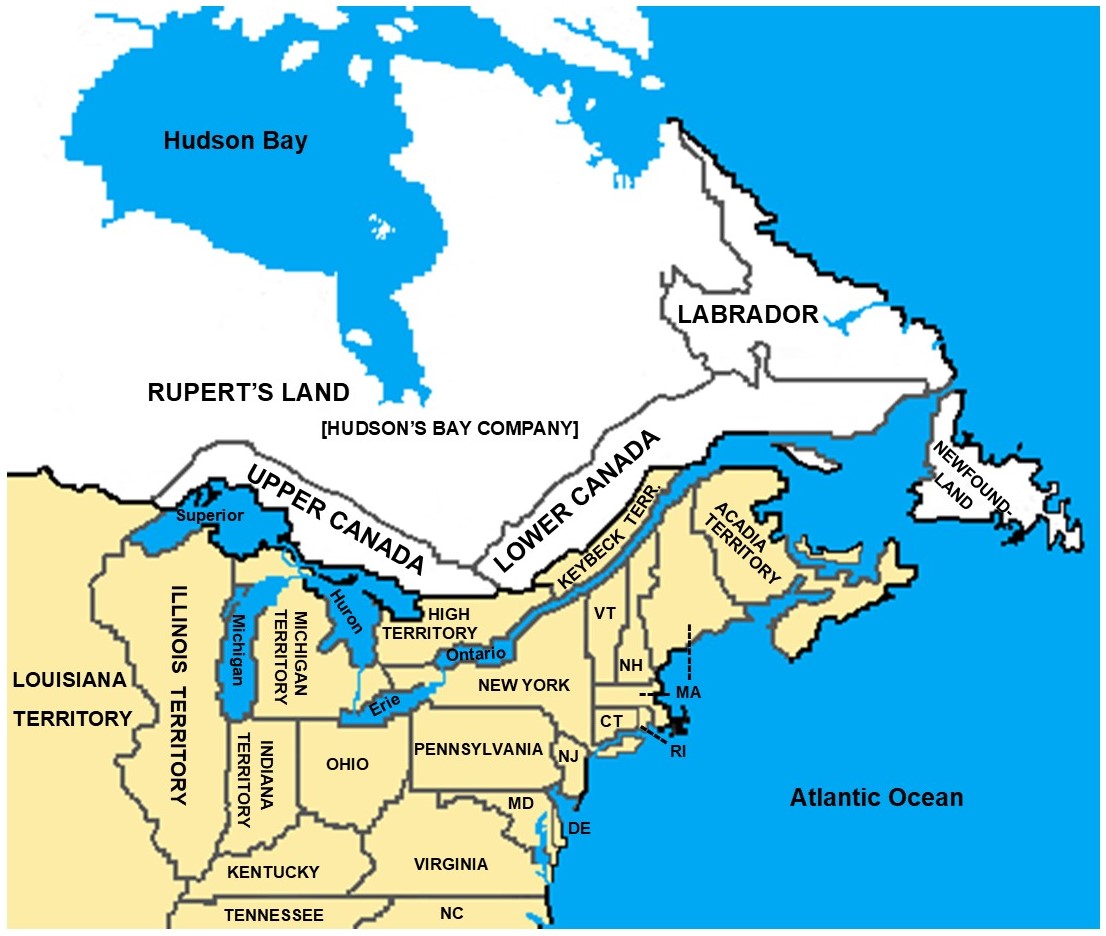

It is assumed that those who could not bear to live under US rule would have fled to the interior of Upper and Lower Canada making use of the trading stations that had been developed to handle the fur trade. Those most likely to have fled would have been those families of Loyalists and the black population especially if their families had found freedom in Canada fleeing the USA after the American War of Independence. It seems feasible that they would have been treated as runaway slaves and hauled back to those deemed their owners in the USA.

The pattern of laws around slavery varied quite considerably from state to state, but the recovery of escaped slaves was permitted at the time even from states which themselves did not have slavery. In addition, it is interesting to note that even as slavery was being eroded in some of the northern states, laws permitting indentured labour continued, notably for former slaves or their children up to a certain age.

Especially given that some leading individuals in the USA at the time wanted to introduce slavery to the Great Lakes region, while they were unsuccessful, I have assumed that they found it easier in the conquered territories taken from British control. Anger at the Loyalists does not seem to have declined much in the thirty years since the end of the American War of Independence so I felt it probable that Loyalists taken in the Canadas - and in New Brunswick and Nova Scotia which had actually received more Loyalist refugees than the other regions - would be punished by being put into indentured labour. I imagined they would be especially sent to aid the development of the new US states. Kentucky had become a state in 1792, Tennessee in 1796, Ohio in 1803 and Louisiana in 1812. 

I particularly became interested in Louisville as a destination for those Canadians captured in this war. In part because Kentucky was more distant from the conquered lands and because Louisville was known very much as a slave trading city and an important link in the trade between the so-called Upper South, i.e. those states south of the Mason-Dixon line but north of the northern borders of the states running east-west from Texas to South Carolina and the Lower/Deep South.

Dealing with the aftermath of the invasion and the selling into slavery and indentured labour of Canadians became the focus of this novel. I decided on using two families - Daniel and Mehitable Jarvis and their children, George and Charlotte and Cyrus and Madeleine Hartwood and their sons Lysander and Pharas. Daniel is a master cabinet maker in York (nowadays Toronto) who employs Cyrus as his journeyman. Both men are part of the York militia so are drawn into the fight against the invading Americans. I found a great resource on the York militia which really helped my story: The War of 1812 Project: https://www.wikitree.com/wiki/Project:War_of_1812 While Madeleine and the Hartwood children escape northwards into the less populated areas of Upper Canada, Cyrus and the Jarvises are captured, separated and shipped to Kentucky.

It is important to know that the Jarvises are white, Cyrus is black and Madeleine is mixed-race with one black grandparent and three white. At the time much was made of categorising races and there was a plethora of terms for different categories of mixed race people for example mulatto, quadroon and octaroon. On the 'drop of blood' principle even someone with one great-great-grandparent who was black, i.e. a  hexadecaroon, would be considered black and thus could be enslaved even if all their other relatives had been white. It seemed important to explore these aspects and note that while indentured labour was bad, slavery was worse.

Immediately this led me to worry about whether people would say I was not permitted to write black or mixed race characters especially in a story set when slavery was in force. Not to do so would have led to a very distorted story and it would almost have been as if I was ignoring that experience. In addition I reflected that while commentators might say I could not get 'inside the head' of a black person or indeed as a man write two women as main characters. I would argue that the same kind of charges could be laid against anyone in 2024 writing about anyone in 1813, not matter what their own or the characters' race. I do accept that me writing the story especially of Cyrus Hartwood is going to accept some readers and commentators, but the alternative was either to produce a very skewed novel that would have looked to be brushing certain aspects under the carpet or to have abandoned the novel entirely.

Much of the action takes place in the rural areas between the towns and especially in the Canadian sections interaction with the indigenous peoples who had settlements and had established routes that the European settlers made use of. The characters cover a great distance going through terrain from northern Kentucky to the northern shores of Lake Huron and I was keen to make sure that the plants and wildlife they encountered were authentic for each area. It did become apparent, especially for the sections in Kentucky and Ohio, how climate change has already altered this and trees, for example, that in 1813 would only have been found in more southern latitudes in the USA have now crept much further north.

This then is the background of the novel. It rotates between the perspectives of the four adults to show different elements of the conflict and its consequences. As such it is very much an adventure story as each of the characters seek to escape American control and keep their children safe. I have tried to reflect how brutal and cheap life was, and how assiduous Americans were in trying to recapture what they felt was theirs. While my alternate history novels are often adventure stories, it is unusual for me to write family dramas, but I enjoyed writing this one. I hope you will enjoy reading it and looking at your own views of how different North America might have been if this often forgotten war had gone down just a slightly different path.


https://www.amazon.com/Loyal-Pursuit-What-novel-1812-ebook/dp/B0DLJT9Z1Y/ref=sr_1_1?crid=TPTQCHWXHXU8&dib=eyJ2IjoiMSJ9.HOIwlRsPbLnrffcDzIim_A.oHox1Qr5v5WJzSJlovo7KesA1obZoBx9gP0lR_mCL70&dib_tag=se&keywords=alexander+Rooksmoor+the+loyal+pursuit&qid=1732304680&s=digital-text&sprefix=alexander+rooksmoor+the+loyal+pursuit%2Cdigital-text%2C169&sr=1-1

Friday, 10 February 2017

The Three Eagles: A What If? Novel of the U.S.A., Mexico and the First World War

The Three Eagles: A What If? Novel of the U.S.A., Mexico and the First World War
 
 
Today I self-published a new what if? novel on Amazon called 'The Three Eagles'.  I have long wondered why, having won the 1916 election on the slogan 'he kept us out of the war', Woodrow Wilson decided to enter the First World War in April 1917.  It was 23 months after the RMS 'Lusitania' with 128 US citizens on board had been sunk by a German submarine and it is clear that, despite the popular view, it had minimal impact on US foreign policy. 
 
Wilson decided to go to war despite him proposing peace terms to both sides of the conflict.  He seems to have been put out by the fact that both the Allies and the Central Powers, made no genuine proposals and simply put forward their list of objectives.  Two factors, however, meant that the USA entered the war on the side of the Allies, though it largely kept its armed forces separate and did not become a formal ally of Britain or France.  The first was the resumption of German U-boat attacks on neutral shipping, notably US ships.  The Germans had curtailed this on two previous occasions following requests from President Wilson but at the start of 1917 reneged on this.  The second was the Zimmermann Telegram sent to the German ambassador in Mexico to encourage the country to attack the USA.  Wilson was always more concerned with Mexico than Germany and US marines had occupied locations in Mexico in 1914 and he sent the so-called Punitive Expedition in 1916 commanded by Brigadier General Pershing to try to catch Pancho Villa, a revolutionary whose men had been responsible for raids into the USA.  The Expedition achieved little and Pershing was sent to Europe to command US troops dispatched to France, the American Expeditionary Force (AEF).
 
One important fact to remember is that in 1917, the US Army was very weak; smaller than that of Serbia.  Many troops had equipment and uniforms left over from the American Civil War which had finished in 1865; on reaching France they were largely kitted out by the French Army.  As the AEF received their own portion of the Western Front they were kept apart from the seasoned British, French, Belgian and Portuguese troops, so they had to learn from scratch.  Consequently US casualties were seven times higher than other units fighting on the Western Front.  Involvement in the war even for such a short time, meant the USA paid a heavy price.  However, the presence of US troops and the food and war materiel that accompanied them, gave heart to the Allies, particularly the French.  US troops were particularly important in defending Paris in May 1918 when the German Kaiserschlacht Offensive almost went further than German troops did in 1914 when they almost won as it was.  With no US troops in France in 1917-18, it is likely that the French and probably the British troops too, would have suffered widespread mutinies and the German Army would have reached Paris in May 1918.  They had already beaten Russia into surrender in March 1918.
 
Thus, this book works from the basis that the Germans avoided upsetting Wilson for a third time and he was left to carry out further action in Mexico, where just as on the Western Front in our world, the ill-equipped small US forces struggled against battle-hardened Mexican troops and the various revolutionary armies.  Meanwhile with the Germans having won a last gasp victory in Europe, they have not gained all that the nationalists fantasised about, but have been able to secure the worldwide empire that the Kaiser had dreamt of.
 
This is the counter-factual background, which, as with all my writing, has been carefully researched.  As with my other what if? books and stories, however, it is the impact on characters that interests me rather than labouring through details of battles.  This book is in three sections, the first features a National Guardsmen sent to occupy a Mexican oilfield in 1917; the second sees a US spy investigating a new German submarine base on the Gulf coast of Mexico in 1920 and the third is set in 1923 covering a pilot sent to root out one of the remaining revolutionaries operating in northern Mexico.  If you enjoy a alternate history setting as the background for adventure stories, then I trust this novel will appeal to you.

Thursday, 10 April 2014

Saturday, 3 August 2013

What If Ronald Reagan Had Been Assassinated in 1981?


My views on this topic can be found in my e-book ‘Other Lives: 'What If?' Essays about Famous People in History’.  It is available for purchase on Amazon:


What If Abraham Lincoln Had Not Been Assassinated?


My views on this topic can be found in my e-book ‘Other Lives: 'What If?' Essays about Famous People in History’.  It is available for purchase on Amazon:


What If George Washington Had Died at Valley Forge in 1777?


My views on this topic can be found in my e-book ‘Other Lives: 'What If?' Essays about Famous People in History’.  It is available for purchase on Amazon:


Saturday, 9 July 2011

What If Latin America Had Developed Politically And Economically Like The USA?

This question is often simplified to 'what if South America had developed like North America?' though that leads to inaccuracies as people seem to forget that Mexico is in North America and that there are states in Central America and the Caribbean region which are considered to be part of Latin America.  This is generally taken to encompass states which have a culture based on that of Spain or Portugal, though in cases like Bermuda, Jamaica, Belize and Guyana they stemmed from British culture; Haiti, Martinique and French Guiana from French culture and Suriname and parts of Guyana from Dutch culture.  For this posting, I have considered 'Latin' America to be all states in the Americas that lie South of the USA; including states like Puerto Rico and US Virgin Islands which are actually controlled by the USA.


I was drawn to this issue by two other commentators, G.H. Kanowitz's Worldohistory blog that covers a number of counter-factuals which I have featured many times before on this blog and similarly Niall Ferguson's 'Civilization: Is The West History?' television series shown this year.  Kanowitz asked the following questions:
  • What if the American political and economic experiment was copied in South America after many countries on that continent gained independence in the 19th Century?
  • Would South America be a centre of power today?
  • Would the U.S. role in Western Hemisphere politics have been diminished?
  • Would the South American countries eventually have united to form a Federation?
Ferguson similarly asked why could the states created by Simon Bolivar: Venezuela, Colombia, Ecuador and Peru and their neighbours, not have prospered both in terms of democracy and economically as the USA did in the 20th century?  There are geographic reasons.  Much of Latin America has hostile terrain with very high mountains, deserts and dense jungle and the diseases that go with the latter.  If you look at the USA regions such as the Everglades, the Rocky Mountain regions and the deserts of South-West USA (and Alaska only has as a result of oil) have never prospered.  However, the bulk of the USA sits across either fertile river valleys that are not too vast or prairie which can be turned to arable farming.  Even if South America had been a single state, the difficulty of running trains from the Atlantic coast, say of what is Brazil to the Pacific coast of Chile would have been immensely harder than cross-USA railways.  Even in Mexico the geography is tough to provide these multiple foci for industrial development.  Mexico might have been the Latin American state that could have prospered like the USA, but of course lost some of its wealthiest territories, Texas and California, to the USA. 

Part of the difficulty for Latin America was that the conquistadors too often encountered urban societies.  Their access to gold effectively made it too easy for the conquerors.  In the Americas North of Mexico, it was not possible for some noble or commander simply to roll up and make himself a millionaire through winning a couple of battles; prosperity really only came, especially up until the early 19th century in working hard in North America on agricultural produce.  Even the luxury item tobacco needed a great deal more work than looting a temple.  The fact that the Spanish colonies made a huge profit almost instantly rather than through long-term investment and work, distorted the establishment of these states.  If the urban civilisations of the Incas, Aztecs and Mayans were not there or had been in severe decline, then even accessing the gold would have been harder.  These states by centralising wealth made it too easy for the conquerors and so we see the development of effectively what is sometimes termed a 'gangster economy'.  This naturally favours force as the economic tool over business acumen and hard work.

Whilst Latin America does have resources such as gold, oil and many types of metals, as was found in Russia and China simply having these resouces was not much use by the time of 19th century industrialisation if you lacked the infrastructure and had to cross vast distances if you were to the raw materials to industry and to foreign markets.  Thus, even before we turn to look at the human factors that have made development along the lines of the USA challenging for Latin America, there are physical ones to consider.  Another aspect especially for smaller states of Latin America is that they have lacked the diversity of product that the USA was able to benefit from and in many ways even when not run by a metropolitan country have suffered a kind of colonial economy, heavily dependent often on single crops or minerals and often tied into supplying one market, notably the USA in exchange for finished goods.  Whilst the USA claims it has not been an imperial power, it has long been an informal imperial power.  As the British, French and Germans were to prove in the 19th informal imperialism was always far more profitable than formal imperialism, i.e. actually occupying and running a territory.  With the declaration of the Monroe Doctrine in 1823, the USA, having snatched independence 50 years ahead of its Latin American rivals, effectively made all states South of it into its imperial region.  The geographical challenges made Latin American states vulnerable to be being exploited in a imperialistic way.  Though the Americans were dominant, the British too were heavily involved in informal imperialism in the region, notably in Argentina and Chile.

Ferguson did concede that Brazil, the former Portuguese colony, has now become one of the leading economies of the world, part of the so-called BRIC bloc (of Brazil, Russia, India and China), former second world economies that are now so vital to the global economy and in many ways driving it.  However, certainly in the 19th and 20th centuries all of the states of the region I am considering have battled to maintain democracy and have often fallen to dictatorship, typically of the military, but in some cases such as Mexico and Cuba and now Venezuela, also left-wing regimes.  Part of the problem has been foreign intervention, notably by the USA which undermined left-learning democracies such as Chile in the 1970s and Nicaragua in the 1980s amongst others.  The USA has always been more concerned in creating regimes that permit a cheap and stable supply of the raw materials that it has needed like fruit from Guatemala, sugar from Cuba and copper and nitrates from Chile than with supporting democracy.


Ferguson always seeks simple answers, his 'killer apps' [applications] to explain why the West, notably the USA prospered.  He feels that property ownership linked to voting rights were the reason why the USA was able to develop economically in the 19th century.  The nature of land ownership in the USA which allowed people from ordinary or even poor backgrounds in Europe to become prosperous, and vitally, to become voters in the USA many decades before people of their level of income or social class had such rights in Europe. In contrast the Latin American pattern of property ownership, rather than comparative small farms covering a few hundred acres instead had vast estates like the haciendas of Spain or latifundia of Italy.  In an age when property ownership was related to having the vote, in the UK, USA and across other burgeoning democracies, this meant that for many Latin American states voting was detached from large parts of the population long into the 20th century.  In its place was the caudillo and patron-client systems which so stultify democracy and successful capitalism.  Of course, to some extent such systems exist in the USA.  You only hvae to look at the poverty of so many people in the country and the dominance of a few leading families in business and politics to see that US commentators whining that it is only Hispanic immigrants bringing this culture to the USA are deluded.  The USA has had a stronger civil society and especially post-1945 this gave the impression that it was really a land of opportunity.  Ordinary people could progress further through education, business or the military in a way their counterparts to the South could not have done in as many cases.  However, US society does tend to ignore how many people lacked opportunity and distinguish themselves rather too sharply from the much of the Americas.

Democracy is not alien to Latin America, but if you simply look at the history of the region in the second half of the 20th century you can see that as a political system it has always struggled in a way that it has not in the USA.  As Ferguson noted, it almost comes down to the political framework that was put in place at the founding of the states.  Whilst what became the USA had been colonies of European powers, many of the settlers rather than being royal officials and their entourages were people actually seeking to break from the European powers.  Even if the political break did not come until the late 18th century there was already and ideological and religious separation.  Many of the settlers were Nonconformist in religion whereas in Latin America they tended to come from Catholic countries and practice standard Catholicism when in the colonies.  In additon, whilst countries like Argentina have seen immigrants from Britain and Italy, never formal colonial controllers, the USA drew people from countries which were not powers at all, from Ireland under British control, from rural Sweden and from fragmented Germany and Italy, which even when united were not colonial powers in the Americas.  Consequently they were seeking a different system to the hierarchies in Europe and had no affinity to those of the states which ruled or had ruled the colonies they settled in.  For Latin America, too much of Spanish and Portuguese society of the 16th-18th centuries was trasplanted to the Americas; from the start people coming to North America aimed to precisely leave behind British or French society and its practices.

Ferguson is correct to see slave ownership and the enduring legacy of racial tension it left as an obstacle to the USA becoming a modern industrialised state.  He contrasts this experience with the greater racial mixing of South America.  Whilst this is true, it tends to ignore the fact that the Atlantic slave trade in the period 1519-1867 saw far more slaves go to Latin America than the USA. Of course, some of the Spanish colonies were established earlier and some parts of the Spanish empire now form parts of the USA, for example Florida began receiving African slaves in 1581.  Of the 10 million Africans shipped to the Americas, 38.5% went to what is now Brazil and 17.5% to Spanish territories, admittedly including California, Texas, Arizona, New Mexico and Florida, but predominantly to modern day Latin American states notably Cuba, Colombia, Costa Rica, Honduras and Guatemala.  The percentage of slaves going to British colonies outside North America, primarily Caribbean islands, was 18.4%; those to British-held North America 6.45%; those to French territories 13.6% and those to English-speaking American states, i.e. the USA after independence, 3.25%.  To some extent this was because the USA only came to slavery in an industrial way, more than two centuries after the Spanish colonies had been receiving slaves.  In addition, with slavery inherited, actual African slaves increasingly became a pool from which American-born slaves were descended, reducing the need quite quickly to import more slaves from Africa.

In neglecting to see the amount of slaves who went to places other than North America Ferguson actually missed an element which could have strengthened his argument.  Whilst initially slavery was permitted right across what was to become the USA, by the 19th century it had become regionally focused and in fact in the rural areas away from the North-East which even now remains a cornerstone region for US industry.  Slavery stultifies a capitalist economy.  In many ways as Karl Marx would have said, it is a feudal hangover which prevents effective capitalist development, which needs people to believe that through their own efforts whether simply labouring, but certainly through innovating and creating new business, that they will be rewarded financially, and typically, in terms of status too.  As Ferguson noted, in semi-democratic USA property brought men a say in the running of their area and their country.  This worked even more in the USA where the class structure had been disrupted, than it did in the UK which also saw its democracy grow on the basis of property equalling voting rights.  In a slave society as a slave you know that however hard you work, you will always be a slave and that even your children and grandchildren will be slaves.  There is no opportunity for you to advance the capitalist system.  Even for owners and free people in a slave society, as the Roman Empire ably proved, there is no incentive to innovate or find more efficient methodologies when the prime source of labour is cheaper than any waged labour might be.  Thus, what was vital for the USA was that its industrial regions moved away from slavery even before it had been abolished nationwide and that they were able to assert their authority over the slave owning parts of the country, thus freeing up not only former slaves but the innovation and entrepreneuralism of the former free people of the southern states.

Latin America, whilst, like the USA finally freeing itself from slavery then had an experience like Russia rather than the USA.  Whilst retaining a great deal of inequality, in the USA people could get on in small business and factory work generally not held back by a rigid social class structure.  In Latin America and Russia even moving into virgin regions the rigid class structure remained, so that once slavery/serfdom was removed, though it released a potential force of industrial workers and business people they found their opportunities choked off by the hierarchy still firmly in place; the same applies to China in many ways too.  These countries had none of the tradition of breaking away from former structures, instead they either retained the structures that had been in place within the country for centuries (in the case of Russia and China) or found that they had imported almost wholesale those structures from the metropolitan countries and Spain and Portugal themselves were going to suffer industrially as a result of this, in the 19th century and fall quickly from the prime positions they had held up to the 18th century. 

Possibly the most extreme case was the future King of Portugal, João VI, leaving his country in 1808 and settling in Brazil.  In 1815 Brazil became a part of the Portuguese Empire on the same level as Portugal itself and in 1820 it became an independent country, but rather than a republic, in 1822 it became an empire in its own right with the crown prince of Portugal, Pedro, becoming emperor.  The replication of European monarchical patterns or at least the hierarchies around a land-owning aristocracy, was a model across Latin America that in many ways held back these states from developing capitalism successfully the way the USA and in fact the UK too, was to do.

These problems were not even shaken off by Latin American states in the 20th century.  In the 1950s Venezuela experienced the regime of Jimenez and it is under only semi-democratic rule now; Colombia that of Pinilla; Argentina that of Peron; Brazil that of Vargas; Cuba had Batista and then a Communist state under Castro which still persists; Mexico had a revolution in the 1910s but then had a de facto one party state up until present day; Ecuador, Bolivia and Argentina experienced more than 25 coups or attempted coups each in the 1950s and 1960s; Peru is still suffering from civil war.  The involvement of the USA in Latin American states has helped fuel such conflict and give rise to regimes like that of General Pinochet in Chile after 1973 and General Noriega in Panama until the Americans themselves overthrew him. US involvement in Nicaragua, El Salvador and Honduras has simply helped prolong unrest and violence in these states. The rise of drug cartels in the 1980s added an extra element to the corruption and unrest especially in Colombia.  The development of these states with rich landowners concerned with their own wealth and influence at the heart of everything they do and political systems that are not strong enough to survive coups has meant that the region has been plagued by instability and loss of life even if it had had socio-economic structures in place which would have helped promote a non-corrupt successful approach to capitalism.  The truth of this is demonstrated by the very rapid economic rise of Brazil in the 21st century when it has begun to reduce some of these harmful aspects.

Turning away from what actually happened to the counter-factual, it is apparent that Kanowitz's first question really starts too late.  It seems for Latin American states to have gone down the path of the USA would have needed very different structures in place right from the start of colonisation.  Those who went to Latin America from Spain and Portugal rather than being aristocratic land-owning military leaders would needed to have been businessmen with a desire to establish societies that would allow other entrepreneurs to succeed.  As the model of Dutch colonisation of North America shows, entrepreneurs can be as exclusive and as controlling as a conquistador, so this additional element would also have been required.  It would have needed more of the settlers of these colonies to be people at odds with the monarchical systems in Europe, perhaps with a different religion, so in some ways you can even trace the nature of Latin America back to the lack of success of the Reformation on the Iberian peninsula in the 16th century; Spain even lacked its equivalent of Huguenots.  Perhaps a later removal of the last of the Moors and Jews from Spain would altered Spain's colonies as these would have been the type of people who would have developed the kind of robust, distinct colonial society that the USA benefited from.  The Thirteen Colonies did not really prosper because they were like Britain but because they were different from Britain.  However, offering resettlement to Jews and Moors in America would have been blasphemy to the Spanish monarchs as there was a common view that South America somehow had gateways to Heaven, perhaps even that the Orinoco River led into Eden.

What the Latin American states would have needed, as Ferguson identifies, is both a social structure and land ownership that allowed ordinary settlers to 'get on' and to have a voice in the running of their state.  Replicating Spain/Portugal of the 18th century in the Americas, meant that there was as little chance for progression as there was back in Europe, thus choking off all the individual acts of capitalism that were necessary to lead to a property-owning democracy.  Coupled with this, too much of the area of these states had a slave economy.  In addition to the tens of thousands of Africans shipped to Latin America, in these regions, especially in South America, indigenous peoples were effectively enslaved or at least indentured, again draining off people who had the potential to develop the state.  Thus, too quickly Latin America became a region in which vast areas of property were in the hands of very few people and even on the 'virgin' frontier because of the prevailing socio-economic and political structures entrenched, ordinary people were never going to be able to rise much higher than their level on arrival in the country, in contrast to many of their counterparts North of Mexico.

In my mind only an uprising across the Spanish and Portuguese colonies at the time of the American War of Independence or the French Revolution, would have given these states the chance of adopting a system that would have allowed them to prosper in the long run.  Even before this, the states would have had to have been established on the basis that a single man could not simply own half a valley or at least areas would have to have been set aside for small holdings to exist, as the USA was not lacking in large landowners, it was just there were areas where smaller properties were always being opened up.  If the independence, say in 1791 had also ended slavery (though remember neither the USA nor revolutionary France did that) then it would have moved Latin American states to adopt different ways of getting labour and so would have promoted the immigration necessary to provide these states with the urban and rural free workers and small property owners necessary for a prosperous capitalist society.  Without these, whether they came from Spain or other states like the Italian and German states, the Latin American states were going to be condemned to the economic and political stagnation that was to plague both Spain and Portugal through the 19th and 20th centuries (remember they only became lasting democracies in the mid-1970s).  The more rapid growth of industrial cities and agriculture to feed the population as much as supply exports, would have helped develop a robust capitalist economy.  It takes decades to construct a robust democracy as countries like Russia have found.  However, with an educated, prosperous middle class with an interest in advancing democracy rather than turning themselves into the latest generation of aristocrats, it would have advanced as it did in France, in some ways similar, a country short on industrial raw materials and with a former very hierarchical society.  The American or French models or even the British model of the 19th century in new Latin American states would not have stood much chance without a social structure which permitted it to thrive.

In many ways, particularly in the case of Brazil, Latin America is a power today.  However, if the states there could have avoided the vast social gaps and had far more robust democratic systems, then they would likely to have had this role much sooner.  There was an anticipation that at least Brazil if not Argentina and Venezuela too would have reached this global standing back in the 1970s.  Then it was abortive, with the growth sapped by political unrest and corruption.  As with China, it is not really surprising that these states are becoming economically powerful now, rather why it took them so long to do so.  Of course, with a different political and economic path going back to the late 18th century, then it seems feasible that these states may have been spared the instability that weakened their status in the world.  Just as China was a genuine superpower in the 1950s and 1960s but this was not apparent because its people were being starved and fighting among themselves, so the real strength of many Latin American states has long been curtailed by conflict.  In addition, their economic strength has been overshadowed by the neo-imperial relationship with US companies.  The USA's difficulties with the Chavez government of Venezuela stem as much for his sale of oil to countries other than the USA as it does from his left-wing, increasingly less democratic, political stance.  The informal imperial relationship between the USA and Latin America has only ebbed to some extent and China is replacing the USA as a type of imperial exploiter of Latin American resources, notably in Brazil, however much China continues to protest (as the USA has too) that it is no colonial power.   A number of Latin American states can become powers with Brazil in the lead and probably Venezuela and Argentina in the next league down, but still as important as members of the G8 are today in terms of global politics.

Historically, I think if one of the larger states such as Brazil, Argentina, Venezuela or even Chile had managed to adopt a system closer to the USA that it would have faced more of a challenge, particularly if it had been a state with an Atlantic or Caribbean coast.  It seems feasible that this strong Latin American state would have contested US dominance in the Caribbean, with, for example Cuba and Panama coming under their control, the latter might have remained in Colombia, for example.  There seems a chance too that the USA would have had a rival for other former Spanish territories, notably the Philippines.  Given the weakness of Latin American states the USA was spared much rivalry in the Caribbean and Pacific.  The only country which came close was Mexico which the USA warred with and by the 1840s it had been decided in the USA's favour.  If Mexico had been able to retain the lands it was to lose to the USA then it would not have been as strong because of its weaker industrial base, but it would have been a regional power that the USA would not have been able to ignore.  If the USA had been unable to cow Mexico before the American Civil War or if the French and then Emperor Maximillian's intervention in the state had succeeded then the USA's almost absolute power in its own hemisphere would have been challenged at least to a degree.  Having to tussle more with a Latin American even second strength Power, may have distracted the USA from intervention elsewhere, notably the Pacific region.  It may have, conversely, brough earlier US intervention in Central America and the Caribbean to counter-balance the Latin American power.  This kind of scenario is envisaged to some extent in 'C.S.A.: The Confederate States of America' (2004) which envisaged the CSA in colonial wars in South America in the early 20th century. 

Globally, a stronger Latin American state would have meant that Hispanic culture would have been viewed differently.  Too easily, people make the assumption that it is all about poverty next to immense wealth and political unrest leading to dictatorship.  A Brazil or Argentina which had propsered with a democracy right through the 20th century would have shifted that view and made Latin American culture more influential than it has even become today.  In addition, it may have impacted on Spain and/or Portugal themselves, perhaps encouraging an earlier overthrow of their dictators, perhaps greater industrialisation.  Argentinian republican troops being shipped to help defend the legitimate Spanish Republic in 1936 would be one of the eye-catching outcomes of this scenario.

I do not think that the Latin American states would have become a federation, perhaps unless they had been formally colonised by the USA, especially in Central America.  Even then, if you look at what happened to French Indochina fragmenting into four states after the end of formal colonialism, even a US Central American colony may have broken up.  As for the Caribbean there is too much diversity in language and culture between islands and too many links to former colonies or in the past to one of the superpowers, for them to come together.  If you look at the conflicts just in South America over borders: such as the Buenos Aires region of Argentina becoming an independent state 1852-9; the Paraguyan War 1865-70 which saw Paraguay lose 70% of its population as territory was taken by Bolivia, Argentina and Brazil; Bolivia losing the nitrate rich Atcama province and its only outlet to the sea to Chile in 1879-83; the Acre free state formed on the border of Brazil, Peru and Bolivia 1899-1903; the dispute over the Oriente territory which now makes up the eastern half of Ecuador and Colombia losing Panama when it became an independent state under US influence in 1903 suggest that the region was doomed to experience fragmentation.  In part this comes back to the hierarchical societies of these countries in that to progress many of the elite saw success through promoting local interests which fragmented even the states we know.  With different twists in history, Bolivia, Colombia and Paraguay might be far larger than in our world; Argentina, Chile and especially Ecuador, much smaller and there could be other states easily the size of modern day Uruguay, that do not exist in our world.  Many of the states, like Brazil and Colombia were entitled 'United States of' anyway.  This reflects the geographical areas they cover and the diversity of territories which fall within their borders each with local interests. 

Of course, many Latin American states may have hoped to become like the USA.  However, we need to look at how the USA came together.  In effect it was a New England hegemony over other regions enabled by the industry that developed in this region and its hinterland, expanding along the southern side of the Great Lakes.  The main challenges to this hegemony were territories like Deseret and the CSA based on a different perspective to the liberal, bourgeoise North-East and these were only defeated by military action.  However, the toleration of a degree of federalism and distinctiveness in individual states took the sting out of opposition to the over-arching state, though even today a lot of tension against 'big government' comes from the same kind of irritation with this North-Eastern hegemony.  For a federation to have worked across South America would have needed a grouping which could address itself to all social classes and, as we have seen, that was lacking in any of the states anyway.  Secondly, it would have needed military success exceeding that of Simon Bolivar not only to unite the states but to keep them from fragmenting especially with the drive for particularism in the 19th century.  A key rift would naturally be around the Spanish/Portguese divide of Brazil and the other states.  However, given that many of the states called themselves 'united states' or 'empire' suggests that with communications of the 19th century the states of South America were deemed large enough and an even larger state, even if confederal, would have been too large, especially given the physical geography, to have seemed feasible.

It seems bleak to say that Latin America was condemned to the kind of development it has experienced from the moment the first conqusitador stepped ashore or even that it went back to the expulsion of the Moors and Jews from the Iberian Peninsula.  However, it does seem that pretty quickly, as Niall Ferguson has suggested, the basic structures of the economics of these societies and the political links to them did mean that it would be difficult for a different type of country to have developed in Latin America.  Whilst the USA tends to think it has followed a path of manifest destiny, in fact, only a few different steps would have seen the Thirteen Colonies and Louisiana ruled over by barons and marquesses (as John Locke wrote into his constitution for Carolina which also enshrined popular property ownership), commanding vast estates based on slave labour, with anyone between landowner and slave having no hope of ever owning land or having a political voice.  To some extent, though, North America like South reflected the different approaches of the metropolitan countries and even France before the revolution and Britain with enclosure tended to lack the haciendas of Spain and had tenancy rather than share-cropping.  The basis on which colonies were established coupled with the nature of the settlers drawn to them, often in what became the USA, deliberately turning their back on the European culture they were leaving, was the basis on which the successor states to the colonies functioned and consequently were able/unable to claim the wealth and power that their size and resources otherwise permitted.

Tuesday, 3 May 2011

Resisting Counter-Factual Speculation: China And Time-Travel Movies

In past postings, I have looked at how uneasy Americans can be about counter-factual discussions around the history of the USA:  http://rooksmoor.blogspot.com/2007/11/denying-counter-factual-issues-around.html and http://rooksmoor.blogspot.com/2008/06/when-counter-factual-becomes.html  This seems to stem from an enduring if unstated faith in the so-called 'manifest destiny', i.e. that the USA was always destined to turn out the way that it has and so any discussions of alternatives is a waste of time.  Naturally I strongly oppose that viewpoint, not least because it allows a state to argue that whatever policy it adopts must be correct because it was 'destined' to happen.  The ridiculousness of that is immediately apparent if you compare the policies of President Barack Obama and his immediate predecessor George W. Bush.  Which was truly manifesting the USA's destiny?  Clearly that is not happening, unless it is the USA's destiny is to constantly chop and change. 

All states exist as a result of a series of accidents combined with deliberate actions, some of which succeeded, some of which failed.  As I have noted before, not every alternative, in the long run, would have led to a great change in history as we have known it.  Conversely, small differences can lead to vast changes in what happened.  Each counter-factual needs to be weighed on its own merits.  In addition, we have to recognise that this is no more than an intellectual exercise, we cannot 'prove' the propositions, but saying that, in many branches of science, that is the same.  Some dismiss counter-factual analysis as a 'game'.  It can be entertaining and is the basis of an extensive sub-genre of fiction dating back many decades.  However, counter-factual analysis is also a vital tool in properly weighing up the different elements which went into our history.  Thus, as I have argued before, it is something that should not be dismissed: http://rooksmoor.blogspot.com/2007/05/usefulness-of-what-if-history.html

Now, it is probably on the basis of the usefulness of counter-factual analysis, that on 31st March 2011, China announced 'guidelines' effectively banning time-travel movies and television programmes.  In a statement from Li Jingsheng head of television drama at China's State Administration for Radio, Film and Television (SARFT) has said that such dramas (and comedies): 'lack positive thoughts and meaning'; 'its content and the exaggerated performance style are questionable'; 'Many stories are totally made-up and are made to strain for an effect of novelty';  'They casually make up myths, have monstrous and weird plots, use absurd tactics, and even promote feudalism, superstition, fatalism and reincarnation.'  Of course, many of these things could be charges laid against many genres of fiction, for example, romance, Westerns, crime stories and even historical drams.  It is the last elements about promoting feudalism and fatalism which really cut to the heart of the issue. 

ommentators about Chinese society believe this move has been prompted by recent programmes featuring happy times in China's past (though it is pretty difficult to find any era in Chinese history when a substantial group of Chinese were not suffering).  The key example is 'The Palace', as pointed out by Professor Nie Wei, from the School of Movie and Television Drama Studies of Shanghai University.  The series features a 21st-century girl travelling back in time to the Qing dynasty (which ruled China 1644-1911).  The episodes for the next series are being rewritten.

The movies and series has effectively banned in China on this basis include 'The Terminator' (1984) and presumably its sequels and television series; 'Bill & Ted's Excellent Adventure' (1989) and its sequel; any version of 'A Christmas Carol'; 'Planet of the Apes' (1968) and its sequels, series and remake; 'Austin Powers: International Man of Mystery' (1997) and its sequels;  'Back To The Future' (1985) and its two sequels, 'Black Knight' (2001), 'The X-Files' (1993-2002) though I am not certain that many episodes of this actually featured time travel, 'Doctor Who' (1963-) and 'Star Trek' (1966-9) and presumably all the movies and sequel series.

I can only think of one time travel episode, in the original 'Star Trek' series, 'The City on the Edge of Forever' in the original series which the crew prevent a woman (played by Joan Collins!) being run over in 1930s USA so leading to a subsequent Nazi victory in World War Two including the USA coming under Nazi control.  Apparently, however, three other episodes feature time travel, one taking crew members to 1968, one to 1969, one taking them back 3 days and one to two historic time periods on an alien planet. There is also time travel in the movie, 'Star Trek IV: The Voyage Home' (1986).  

The fatalism would be seen in movies like 'The Butterfly Effect' (2004) in which a man tries to change his own life by travelling back in time on a number of occasions only to constantly make things worse; in 'Running Against Time' (1990) the repeated attempts by three time travellers to avoid US intervention in the Vietnam War only exacerbate the conflict.  However, this then shows up the contradictions in the Chinese guidelines.  They oppose both time travel that can make things turn out better and they dislike time travel that worsens the situation.  They oppose time travel stories that only impact on the fate of a few individuals and also ones which affect the whole world such as 'The Terminator' and 'Star Trek IV' or 'A Sound of Thunder' (2005) which radically sees humans replaced by a reptillian species as a result of a time traveller to the Cretaceous period treading on a creature.  Of course, the Chinese government could insist that all time travel stories adhere to the Novikov self-consistency principle, that, in fact you cannot alter history as it has happened, any attempt to do so will fail, as shown in 'Twelve Monkeys' (1995) and 'The Time Machine' (2002). 

One movie not mentioned by the Chinese is 'Fatherland' (1994) perhaps because though the book it was based on was a best seller, the movie had little success, especially in the USA.  The movie does not feature time travel, rather it is one of the only actual counter-factual movies in that it envisages a world in which Nazi Germany won the Second World War.  Though not stated, it must be assumed that in such a scenario Japan would have been victorious in the Pacific as victory in Europe would have allowed its forces to be supplement by Germany and its allies.  Despite the fact that Germany and Japan were always awkward allies (as history of wartime Shanghai show), Germany presumably would have put experienced U-boat packs into the Pacific; experienced German pilots and aircraft into the Pacific and China and provided SS units to exterminate Chinese Communists behind the frontlines.  It seems unlikely Japan would have conquered all of China but it would have held the major cities and wealthiest regions, so today, North-East China would still be Manchukuo and Communism would have been eliminated from the Japanese colonies in eastern and central China. 

I believe the movies listed owe more to their international renown than the portrayal of events in specific movies that is what has drawn Chinese state attention to them.  However, there is also the factor of discussion around time travel and the possibilities it may offer to change a country which is what alarms the Chinese government the most.   Despite this, It seems that, in the opposition to time travel, the Chinese are also dismissing a lot of general science fiction.  This may be the authorities' intention. 

Many of these series and movies have other concepts, discussion of which would be seen as a threat, especially 'Star Trek' which often handled moral judgements in story lines and elements such as discrimination.  A fuller part of the SARFT statement suggests this is the case: 'fantasy, time-travel, random compilations of mythical stories, bizarre plots, absurd techniques, even propagating feudal superstitions, fatalism and reincarnation, ambiguous moral lessons, and even a lack of positive thinking.' 

The timing seems to be in preparation for the 90th anniversary of the Communist Party of China being established (and, of course, the centenary of the 1911 Revolution which established the Chinese Republic which the Communists did not control entirely until 1950) and so '[a]ll levels should actively prepare to launch vivid reproductions of the Chinese revolution, the nation’s construction and its reform and opening up.'  Of course, if we travelled back to 1971 for the 50th anniversary, the party members then would be in horror of the capitalist economy now in place in China and would see predictions for 2011 which featured China as one of the leading capitalist states of the world as completely counter-revolutionary and in need of suppression.  Thus, even in its own history, the Communist Party of China has gone down 'alternative' paths that would have been considered highly inappropriate to discuss, even within living memory.

You can see the easy step from thinking about time travel to challenging the current regime, whether to argue that the more Maoist era or the Imperial era or the brief periods of democracy were better than the current state.  Of course, the kind of question that the Chinese regime fears most is 'what if the democracy movement of Tiananmen Square had not been suppressed in 1989?' and other similar ones about Mao being ousted or the Chinese Civil War having a different outcome, all things that may allow people to think that an alternative path would have been better for the country's people. 

China has not been alone in having such concerns.  When the National Curriculum for the UK was launched in 1992, the history section of it instructed teachers specifically not to even suggest that any time period or country was better to live in than the UK at the time.  The Conservative government was seemingly as insecure as the current Chinese government. 

It is interesting that the two greatest Powers in the world at the moment, the USA and China are the ones who are most nervous about any speculation that their histories could have turned out very differently to how they did.  In the USA pressure tends to come by brow-beating or dismissal as irrelevant.  In China, a totalitarian dictatorship which practices extensive censorship, the approach is much more direct.  However, in my view this only adds value to the role of counter-factual analysis. After all, if the Chinese government sees counter-factual speculation as potentially such a threatening tool, one leveraging greater democracy and liberty in the country, to the extent that movies even speculating about it must be censored, then it has some real potency beyond mere entertainment.

Saturday, 9 October 2010

Who Really 'Won' the Cold War?

I remember back in 1989 when the Berlin Wall was broken through.  I had just returned to the UK from living West Germany; ironically, whilst there, I had focused far more on the rise of the far right Republikaner party which no-one seems to remember now, rather than being interested in the collapse of the Communist regimes of Eastern Europe.  Anyway, this was seem as the symbolic step in what had been a process that had really been going on for almost five years then, triggered by Mikhail Gorbachev becoming head of the USSR in 1985.  Things moved quickly and with Hungary opening its borders to the West in 1989 the Iron Curtain was breached and though the Communist regime in East Germany clung on its days were numbered.  Incredibly by 1991 East Germany and West Germany had been reunited ending the situation in Central Europe which had prevailed really from 1945.  The changes had been so momentous that in 1991 historian Francis Fukuyama declared that we had reached 'the end of history' because with the collapse of the Soviet bloc it appeared that liberal democracy (wedded to capitalism) had 'won' the Cold War.  Of course, Fukuyama was rather too wrapped up in the jubilation of the end of the European Communist regimes that he neglected the fact that millions of, in fact more than a billion, people remained under the control of right-wing or left-wing dictatorships that had no truck with liberal democracy.  I believe Fukuyama aimed to be ostentatious in his language in order to startle people and get them to reflect on actually what was happening in the world at the time.  Certainly I can remember no other article in 'The National Interest' journal (it became the backbone of the book, 'The End of History and the Last Man' (1992)) being discussed 18 years later.  If you search for Fukuyama, most search engines have 'the end of history' appended automatically to his name.

In some ways Fukuyama is almost turning traditional Marxism on its head.  Karl Marx argued that human society would naturally progress through a series of socio-economic phases such as feudalism, mercantilism and capitalism before inevitably reaching socialism.  For Marx, technology especially in industry drove this process on which is why he anticipated the first socialist revolutions occurring not in relatively industrially backward Russia, let alone China, Korea and Cuba, but in Germany and Britain, the leading industrial states of his time.  Fukuyama also sees a role for technology for moving world society on, but it worries him as he sees humans as in fact unable to control the technology they create properly.  Perhaps this was encouraged by the environmental impact of air and water pollution and the Chernobyl nuclear power station disaster of 1986.  However, basically Fukuyama saw liberal democracy as the most robust and appropriate system for human society and felt it inevitable that eventually the whole world would end up using it; thus the end of the Soviet bloc was a key step of this in moving millions of people away from rule by totalitarian dictatorship.

Of course, Fukuyama proved to be only partially right.  Democracy in parts of Eastern Europe was as weak as it had been in the 1920s and 1930s, you only have to look at the Yugoslav War 1991-5 and the decline of democracy in the Russian Federation in the era of Vladimir Putin.  Even the USA, seen in 1989 as the 'victor' of the Cold War, has shown how feeble the 'liberal' element of liberal democracy can be with its use since 2001 of illegal detention and widespread implementation of torture; something the UK has also participated despite supposedly having the 'mother of parliaments' (half of which, of course, is unelected).  Fukuyama's largest oversight is in connection with China.  Critiques of Fukuyama's line, notably from Israeli academic Azar Gat, points to regimes of authoritarian capitalism and this certainly seems to be how we can characterise contemporary China.

Part of the problem is that too many people in the West, especially at the time of the fall of the Berlin Wall still seemed to cling to the views of Friedrich Hayek, who in 'The Road to Serfdom' (1944) basically argued that unless you had a free market economy you could not have democracy.  This was aimed not really at the Nazi and the Communist states being formed but at those in Western capitalist countries, not only as a consequence of the Second World War, but also in seeking a way to avoid a return to the Depression of the 1930s saw a greater role for the state in organising the economy.  I believe Hayek feared that in the post-war world Roosevelt's New Deal economic approach would persist and go even further.  He was to be alarmed by the economic direction and planning adopted briefly in Britain and more extensively in France in the late 1940s onwards, as he felt such an approach would inevitably condemn democracy in these countries.  As France has proven he was wrong.  China has also now proven the opposite, that a free market economy need make no impact on a country's steps to democracy.  It is interesting to read books written in the 1990s which seem to see the destruction of the Chinese democracy movement at Tiananmen Square in 1989 as a futile step against an unstoppable force.  Read a copy of 'China A New History' by John King Fairbank and Merle Goldman, published in the 1990s.  The late Fairbank had anticipated no change in China's political structure and Goldman who took up the work was almost patronising in seeing this as an out-of-date, Cold War attitude, and instead believed that change towards democracy simply had to come as China became more capitalist.  The book has been revised in 2006 and I wonder if Goldman has changed her tune yet.  It is ironic that even Taiwan which has been a capitalist state since gaining independence from Japan in 1945, only became a democratic state in 1996.

The Cold War is usually seen as having started around 1948 stemming from tensions predominantly between the USA and USSR over their respective spheres of influence across the world.  It was given an added dimension by the two states having different economic and political systems: the USSR Communism and a centrally planned economy and the USA democracy and an economy that was generally unplanned.  However, the phase 1948-89 can be seen as an episode in a longer running and more complex conflict, curiously, probably most accurately perceived by the planners of Imperial Germany in the lead up to the First World War.  This perception of the Cold War is that as technology advances, conflict between continental empires is inevitable as each battles for control of the resources it needs.  The arena in which Russia and the USA were expected to conflict was the Pacific, especially over dominance in China.  At the turn of the 20th century the Kaiser and his advisors felt that unless Germany could secure dominance of the bulk of Europe then it would always be beholden to one of the world powers, which at the time were seen as the British Empire, the USA, and potentially Russia if it could modernise quickly enough.  Japan's colonial activities from 1895-1945 can be seen as being motivated by a similar uneasy perception of the world of the late 20th century.

To a great degree the German view of the 1900s came true with the post-1945 era.  They had overlooked that colonial empires could not continue to be sustained, something they should have realised from the crumbling of the Ottoman empire and weakness of the Austro-Hungarian empire in the late 19th century.  However, at the time, overseas colonialism and subjugating different nationalities was seen as the norm.  Even if it had not been exhausted by two world wars, the British empire would have dissolved as did the French and the Dutch empires and, I imagine, would have the Japanese empire, if somehow it had persisted beyond 1945.  For the 20th century and beyond it was to be contigous empires with a clearly dominant nationality of a single ethnicity with its language the one used right across its lands.  This meant Russia, the USA and, of course, China.  In the 1920s and 1930s it looked like China would remain fragmented, but there was too much common culture and too much desire for a unified state to allow this situation to persist.   Napoleon I, Kaiser Wilhelm II and Sir Winston Churchill all foresaw the strength of China if it could be a united country and 'awoke', i.e. engaged with the modern world rather than tried to ignore it as it had tended to do so at its peril during the the mid to late 19th century.

As I have noted before, until the 1970s, in the West, China was the overlooked element of the Cold War, which certainly from 1950 onwards was about three superpowers not just two.  Especially in the 1960s when the USA worried about a nuclear Third World War between it and the USSR we could easily have suffered one between the USSR and China.  One can argue if the perceived ideological divisions were really as strict as they were seen at the time.  Yes, of course, you could live a freer life in the USA than in the USSR or even now in China.  However, Maoism diverged as far from Marxism as Stalinism did and Hitlerism did from Fascism.  All of these political creeds were dressing for the assertion of power.  Democracies tend to diffuse that assertion of power and so far, even though not always entirely effective, have watered down the control of the population by the privileged and wealthy.  This was why the George W. Bush regime was so alarming as it seemed to side-step such safeguards as effectively as many Chinese Communist Party officials were able to side-step centralised economic control to make lots of money in China.  The conflict may have seemed ideological, but I believe stripping away the rhetoric, it owes more to the competition between the rulers of the different continental powers.

Since the crushing of the Tiananmen Square demonstration in 1989 we have seen no steps in China towards democracy.  It is nominally a Communist state, but it appears to be that only in name.  Supposed equality of opportunity for all, lack of discrimination of women or for people of particular social or ethnic backgrounds, may have been weak in the Communist states, but they have entirely gone from China of 2010 and people have as little chance to progress as they do in any capitalist state.  Centralised economic planning does not work effectively.  It works temporarily to fight a war, but will never sustain a country in prosperity even on the diminished terms supposedly sought by Communist regimes.  This was what the period 1985-9 proved beyond doubt and this is why the European Communist bloc regimes fell.  Abutting or near to states where democracy was comparatively strong, these countries went towards that political system assuming, as Hayek had noted, that it was necessary for prosperity.  In their case many of the states got political freedom, but the prosperity has yet to come even when buoyed up by EU aid and jobs in Western Europe.  China also shed quite a bit of its centralised economic system and this brought it prosperity with it having no need to change its political system which is really no different today than when Mao Zedong died in 1976. 

The danger for the world is that China has become so rich and powerful that it is now behaving just as all the superpowers did in the 1970s.  China, the USA and USSR all tried to export their ideology and economic control into the Third World.  China has gone back to Africa, but to Asia and South America too, and has even began economically penetrating Western nations, to secure the resources it feels it needs.  It whines on about how it has always been the victim of imperialism and how it needs aid to combat environmental damage and yet, its output now exceeds Japan and it has more financial reserves than the entire US economy.  It is a neo-imperial power just the same as the USA is.  It favours regimes which follow its political system, so while the USA struggles to establish some kind of democracy in Iraq and Afghanistan, China supports harsh dictatorships in Sudan and Zimbabwe.

In 1989 one round of the Cold War came to an end.  Just as Britain had been downed in 1918 and knocked out in 1945, the USSR was sent from the arena in 1989.  This leaves the two remaining superpowers still facing each other and China is clearly in the lead.  Despite all the joy at the 'end' of the Cold War that the values embraced by the USA and its allies had triumphed, this was a premature celebration.  One competitor in the challenge not only for the dominant ideology of the world, but economic dominance, especially of raw materials, had been knocked out, but the bout has continued.  The interim score in 1989 was not a clear US victory as far too many people believed, it was: China 1st, USA 2nd, USSR 3rd.  Now were are in the throes of the run-off to see the ultimate winner.

I have often worked with Chinese people from both the People's Republic and from Taiwan and see nothing inherent in the Chinese nature which is anti-democratic.  However, the same could have been said, I imagine for many people from the USSR or Nazi Germany or Fascist Italy, but that did not stop those states being unacceptable, and, of course, like all dictatorships, oppressing their own people before turning on others.  Whilst I am no fan of the USA, I am certainly on the side of freedoms and democracy.  However, I believe that whereas once the focus was on opposing the threats to these, attention has gone away from the key threat to these values and greed has encouraged too many states to trade with China, without recognising the risk it still presents to our way of life.  Of course, as during the Cold War there are other threats, but too many policy makers have preferred to focus on Islamic fundamentalism because there is little that they can sell to or buy from such groups, especially as this approach has not taken hold in oil-rich states (it never did in Iraq, despite what Bush may have believed).  We need to wake up to the fact that we are still in a Cold War, and I fear that the side backing democracy is currently losing.  We need to reinforce democracy in the former Communist states, notably Russia and support it in India and boost it in Indonesia, if we are to have any hope of winning the final round of the Cold War.

Friday, 22 January 2010

The Contradictions of China

It is no surprise that China has become such a potent force in the 21st century world.  Even Napoleon characterised the country as being a sleeping giant even more in his times of the late 18th and early 19th century.  It can easily be argued that China would have assumed its role of a Power in the world far sooner if it had not had a string of poor rulers and policies which have disrupted its economy and led to starvation and millions of deaths.  China was a victim of imperialism both in the 19th century from European powers notably the British, French and Germans and in the 20th century from the Japanese conquest of much of the country 1931-45.  However, it has long had the largest army in the world and exploded its first atomic bomb in 1964 and its first hydrogen bomb in 1967.  It was a superpower alongside the USA and USSR but aside from small conflicts with the USSR which fortunately did not escalate into anything larger, its focus was generally internally, especially when the ideology and internecine fighting of the Cultural Revolution 1966-76 disrupted so much of the economy and society of China.

With the death of Mao Zedong and leaders from the era of the final phase of the revolution of 1945-50, China began to look out into the wider world and effectively became a Communist state with a capitalist economy.  Its huge resources notably of workers meant that it was destined to always be a strong player in the world an if it had not been for Mao's insanities it may have reached this position in the 1960s rather than the 1980s and 1990s.  What has not changed is the political structure which has overseen this vast economic growth.  There has been the liberalisation of things such as where people are allowed to live, necessary to allow the rural-urban migration which has brought cheap workers to the cities though periodically older regulations are enforced to clear out slums.  Anyone who has done business in China knows that influence with leading local members of the Chinese Communist Party is vital for achieving anything.  This political power over economic activity unsurprisingly, as in so many other states, has led to corruption.  Again periodically the corrupt are purged (often facing the death penalty) in some propaganda seeking attempt to reassert the supposed values of Communism but this does nothing to reverse how corruption is an integral part of the economic boom of China.  Of course, there is a lot of ingenuity and hard work done in China, most of which was choked off in the past, so it is unsurprising that the economy prospers.

Despite all the economic shifts in China it remains a totalitarian state that Mao would still recognise.  The suppression of the Tianamen Square protests in 1989, continued occupation of Tibet, suppression of the Falun Gong religion and of Uighur nationalists are all characteristic of a country unwilling to tolerate any political shift especially from ethnic and religious minorities.  People forget that China has 56 ethnic minorities which are highly over-represented in terms of absolute poverty, i.e. earning less than equivalent to US$1 per day.  Thus, while people become multi-millionaires in Shanghai, in Xinjiang province they are as poor as in Third World countries.  Despite the strength of its military and its vast economy, which is now the second strongest in the world, China continues to pretend somehow that it is a poor, defenceless countries bullied by the old Western imperial states.

This dichotomy between China's real strength and how it expects to be treated in the world has come out on a number of occasions recently. In the 1960s, despite being a Communist superpower, China tried to present itself as being in the 'non-aligned' group of nations.  However, it was as happy to spread its ideology, a rural-focused brand of Communism to developing countries, feeling it was more appropriate than the heavy industry focused Soviet Communism.  Similarly these days China still portrays itself as a victim of imperialism, though the last imperial forces left in 1945 and even if you count the British and Portuguese leaving Hong Kong and Macao as late as 1997 they have all gone now.  Chinese people become indignant if you suggest that actually China is behaving like a (neo-)imperial power.  They characterise their investment especially in African states like Zimbabwe and Sudan as being utterly different from the neo-imperialism through investment that the USA, Britain, France and the USSR adopted in the 1970s, when in fact it is no different.  Chinese staff supervise Zimbabwean workers on Chinese projects in the country.  The Chinese steps to secure raw materials across the world even in developed countries does not differ from the efforts of the UK, France and the USA to secure natural resource supplies.  However, always, China says that it is different and is still a victim of imperialism when in fact it is now an imperialist power itself.  Do not even mention the Spratly Islands where the imperialism is even more old fashioned.

China is a totalitarian state.  People seem to keep forgetting that so it is worthwhile emphasising.  It has possibly over 1.6 million prisoners, second only to the USA, with 2.3 million, which has about a quarter as many people.  The difference for China is that the 'crimes' of many of these people are political and they are being 're-educated'.  Bizarrely unlike the US system that seems to think people cannot be changed, the Chinese prison system believes that they can, though to the bulk of us the methodology would appear like brainwashing and certainly involves torture which the USA has only comparatively recently adopted as a method and then only for its political prisoners.  The US population should be utterly ashamed that, as a supposedly liberal democracy, they can be bracketed with a totalitarian regime in this respect.  Anyway, China has censorship, it always had.  With the expansion of the internet promoted in a large part by the rapid economic growth the country has experienced in the past three decades, this censorship has had to expand to the internet.  Singapore has struggled to maintain its censorship system when dealing with the internet.  China with its vast resources has been more successful using a combination of electronic means such as the police officers that appear on screen when you access certain websites, to arresting blogging dissidents, to compelling Google to ban the searching of certain phrases.  Now, in its hacking into Google accounts of dissidents and the launching of a sophisticated cyber attack the Chinese authorities have even angered Google which is now holding back on introducing a new generation of mobile phones to the country.  The Chinese have found that there are sometimes limits even to the powerful renminbi (the Chinese currency often still called the yuan).  The Chinese have not said 'well, we are a totalitarian dictatorship, so we censor' again they have whined that they are victims of imperialism.  They complain that there is an imbalanced 'global information order' again in favour of the West which is trying to impose its culture on China.  In fact China is giving heart to those who want to censor internet activity (of course, leading this is the USA with its desire for a war on terror in all facets) and the UK which has long monitored all email traffic.  China whines that it is being bullied, when in fact we are suffering as a result of the dictatorial, suppressive measures it is pressing on the world.

At the recent Copenhagen climate change conference, powerful China was again portraying itself as the weak country in need of support from the supposedly rich West (even though China's economy is now more powerful than all Western states bar the USA).  It was seeking financial support for steps to ameliorate the impact of climate change, despite China having US$2.272 trillion in foreign currency reserves in September 2009.  This tactic help divert attention from China's appalling record on industrial damage to the environment which has caused poverty and disrupted the lives of millions of its citizens and no doubt contributes heavily to global climate change.  The fact that the government ceased traffic flow during the Beijing Olympics because the air pollution was so severe, indicates the impact of China's booming industrial and transport sectors that have barely been affected by the global recession.  China should be one of the industrialised states looking to reduce its pollution but instead it whines that it is only a developing country which needs support to do this.  The amount of money the USA owes China is sufficient for China to effectively buy the whole US economy and close down every factory and stop every vehicle there, that is not a country which needs help reducing its pollution impact on the world, it is one that needs to be leading the way.

China is immensely strong in so many ways, but it seems constantly to pretend that it is the victim and rebuff any claims that it should comply with international standards on the basis this is bullying by other states.  I have not even mentioned its unwillingness to comply with copyright law.  There is unsurprisingly, given the nature of the regime, an immense arrogance from China that it can behave with impunity in the global context and that its stated values, i.e. censorship, freedom to exploit people and the environment, imprisonment on issues of conscience, continued occupation of a foreign country, should not even be challenged by the world community.  Of course, many powerful states engage in these kinds of policies, but perhaps the irritation with China is that it somehow pretends that it is the best society and that any criticism is based on myths and motivated by a desire to imperially suppress China.  It attacks other states for in fact things it is doing itself.  I guess this is one reason why we find taking official China's statements so hard.  They are both hypocritical and seek to conceal atrocities that we all know are going on beneath an incredibly pathetic line that China is weak and a victim of bullies.  All of us who support freedom of thought, contact, communication, conscience, must keep challenging China (as well as the USA, UK and other states that are doing wrong) and one first step is for the Chinese state to actually admit it is a bully, not a victim.