Showing posts with label General Charles De Gaulle. Show all posts

Sunday, 28 January 2018

Scavenged Days: A ‘What If?’ Novel of the Impact of the Assassination of President De Gaulle
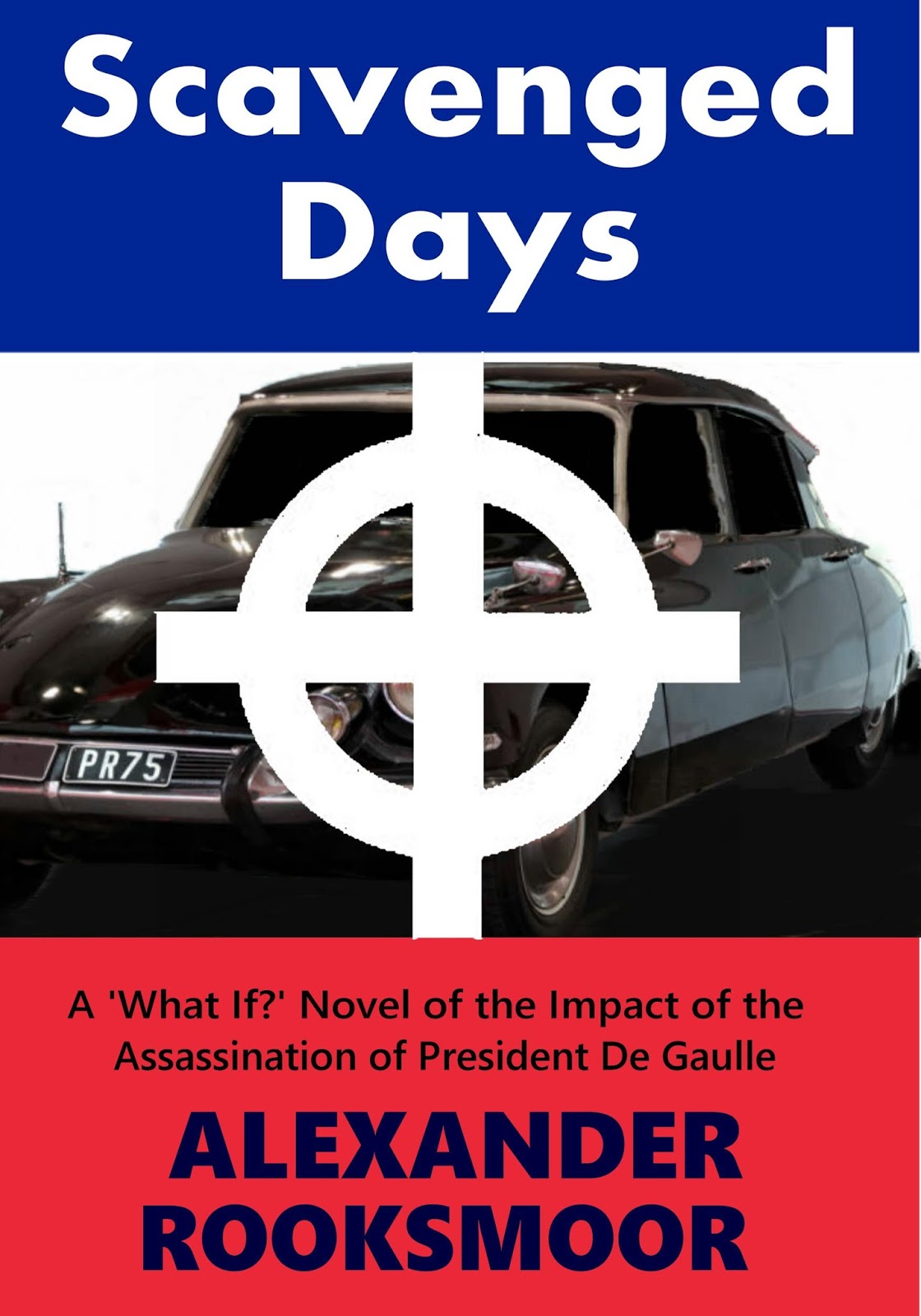
Scavenged Days: A ‘What If?’ Novel of the Impact of the Assassination of President De Gaulle


Certainly since first seeing the movie 'Ascenseur Pour L'Echafaud' (1958; novel 1956) and 'Le Samouraï' (1967) I have long wanted to write a book set in France in the late 1950s or early 1960s.  In part it is because of the style of those days with suave men and sophisticated women in fashionable clothes, eating well and driving around in sleek cars.  The period was also one of great upheaval for the country, with an attempt by disaffected military officers to overthrow the government, a sustained colonial war in Algeria and terrorism both from nationalists and the state there and in France itself.  I had long toyed with writing a detective novel set in that context.  However, I settled on a 'what if?' novel, possibly the genre that I have best become known for.

There are lots of potential points of divergence in French history of the time.  One reason for this is the assassination attempts that the President of France, General Charles De Gaulle faced.  Two attempts came very close to killing him.  The attempt at Petit Clamart in August 1962 when hundreds of bullets were fired at De Gaulle's car features in the opening minutes of the movie of 'The Day of the Jackal' (1973; from novel 1971).  However, I used the September 1961 attempt close to Pont-sur-Seine in which De Gaulle's car was blasted across the road by explosives and napalm.  If it had not been for the age of the explosives and the failure of the assassins to follow up with gunfire, De Gaulle could easily have been killed.

Those targeting De Gaulle were the OAS - the Secret Army Organisation made up of disgruntled officers and their supporters.  It carried out a string of terrorist attacks with the intention of bringing down the French government and so retaining, they believed, French control of Algeria, its colony since 1830.  Initially they believed that De Gaulle would achieve this for hem, but they rapidly turned against him when it became clear he was going to grant the country independence.

This novel focuses on the days following the successful assassination of President De Gaulle in September 1961, when the OAS - its symbol was the Celtic cross featured on the book's cover - in its triumph, aims to seize power in France.  With 'what if?' novels it is often a challenge to show different sides of the story. I am alert to criticisms of my books, that, despite extensive historical notes, I do not give sufficient context for the differences from our own history in the text. You sometimes end up with the leading characters in alternate history fiction taking a convoluted journey in order to witness different events.  Often there is lengthy expository dialogue to fill the readers in which can really deaden a novel especially if it is a thriller.  Having different characters witness different development, can also lead to a charge I have received that it makes the book 'fragmentary'.

In 'Scavenged Days' I have gone for a hybrid approach.  At the heart of the story is young magazine photo-journalist Laure Favager.  I am conscious that many alternate history books are often male dominated.  I have always included female characters and think it is essential to show the impacts on different kinds of people. Thus, police, civilians, old people, civil servants, all appear.  Laure is a modern sophisticated woman, drawing in her lover, businessman Roland Trémaux and her boyfriend, journalist Gilles Vasseur into the danger that France in this situation is facing.  However, in line with my sense of the importance of the vulnerability of lead characters, she is highly flawed and her involvement with the conspiracy to seize power challenges her.  As always, while the 'what if?' is the focus, I feel it is a weak book that does not reflect it through people and simply ends up something like a wargaming scenario.

As is the case with all my work, I have done immense research on the historical details of the setting, not simply the politics, but also the fashion, the food and the cars, to give it that finesse that I envisaged when first thinking about a book set in this era.  I am sure that there will be people queuing up to condemn the book as pure fantasy and that it could not have gone that way or to moan about the fact that there is not enough shooting.  They will complain about some pistol one of the characters is shown using, or more worryingly that too many women feature in the book, which, in their eyes should all be about men.  However, no author can choose their audience.  I hope you find this both an exciting and interesting book, taking a look at a slice of modern history which, certainly in the English-speaking world, is sorely overlooked.


https://www.amazon.co.uk/Scavenged-Days-Impact-Assassination-President-ebook/dp/B079J2FBV1/ref=asap_bc?ie=UTF8

Sunday, 1 February 2009

'The Day of the Jackal' Movie (1973)

As regular readers of the blog know, I am interested in the what might have beens of history.  One that has always intrigued me is the possibility of the assassination of General Charles De Gaulle, especially when he was the President of France (1958-69) and overseeing the withdrawal of France from its colony (since 1830) of Algeria.  He was a politically ambivalent figure seeming to side with the military and to reassure colonialists concerns, but also defending democracy and extricating France from Algeria.  However, the steps to leave Algeria, in the face of Algerian nationalist opposition to continued rule, provoked hostility from elements of the French Army.  The opposition element organised a terrorist group, the OAS, with the intention of killing De Gaulle and also staging a coup to overthrow the government.

De Gaulle faced 31 assassination attempts during his life. There are few people in history who could not have been replaced by someone else and the world have witnessed a similar outcome. However, I believe, De Gaulle stands beside Bismarck in terms of being a man whose death would immediately have led history down different pathways, even, one might argue, after they had retired, let alone at the height of their activities. I will do a proper 'what if?' posting on De Gaulle another time, but wanted to indicate why I have been drawn to the book, and especially the movie, of 'The Day of the Jackal'. The small differences between the story in the two formats are nicely summarised at IMDB, see: http://www.imdb.com/title/tt0069947/faq and there are more details on the Wikipedia entry for the movie.

The novel of 'The Day of the Jackal' was written by newspaper and television journalist Frederick Forsyth (born 1938) and published in 1971, the year after De Gaulle had died of natural causes. It was Forsyth's first novel of the fifteen he has published so far. He has also written non-fiction on aspects of African politics. He left the BBC in 1968 after allegations of bias towards the breakaway African state of Biafra and, in 1973, he helped finance a coup in Equiatorial Guinea. Forsyth has been a bestselling author with a number of his books becoming movies, including 'The Odessa File' (novel 1972; movie 1974, also features Derek Jacobi who is in the movie 'The Day of the Jackal'), 'The Dogs of War' (novel 1974; movie 1981) drawing on Forsyth's coup experiences and 'The Fourth Protocol' (novel 1984; movie 1987).

'The Day of the Jackal' begins with actual historical events, notably the Petit Clamart assassination attempt on Charles De Gaulle in which, in August 1962,OAS assassins fired over 100 bullets into his car in the Paris suburb of Petit Clamart. De Gaulle survived and was able to escape because he was in a Citreon DS.  All models of this car have specific self-levelling hydraulic suspension and so allowed the skilled driver to continue driving even when two of the tyres on one side had been shot out. The car did not have bullet proof glass. Aside from De Gaulle and his driver, De Gaulle's wife, Yvonne, and son-in-law, Colonel Alain de Boissieu were in the car.  De Gaulle was more angered that his wife, who was riding beside him in the car, had been targeted, (having been a soldier most of his life, he presumably had long ago reckoned he might be shot) and so accelerated the sentencing of the conspirators and insisted on their execution, generally ignoring the standard legal processes.

In the book and movie the next step the OAS take in 1963, following the execution of the Petit Clamart attackers, is to hire a British assassin to kill De Gaulle. Of course, we all know that the assassin, known as 'the Jackal', cannot succeed as this is not a counter-factual book, but the skill of the story is in still keeping us interested. To some extent, it is the technical aspects that draw us in and these come from two perspectives. The first is the preparations by the Jackal and the second is the work carried out by the French and British police to identify and try to stop him. This is the kind of challenge that the forthcoming 'Valkyrie' movie about the real-life attempt to assassinate Hitler in 1944 will face, though it seems that they have engaged audiences through adopting a thriller-style approach.

It is difficult to put a finger on how the 'The Day of the Jackal' movie manages to make you interested in long-drawn out preparations, but it does. It is pretty tightly edited and various meetings among British and French security officials are handled differently on each occasion so that they do not appear too samey. There are some hurried moments, especially in the closing minutes of the movie, but, in fact, for a lot of the time things move very tranquilly, raising the tension steadily. The interesting thing is that there are large stretches of the movie in which no-one speaks and incidental music intrudes only from sources that the characters encounter. There is a long stretch in which we see the preparation for the liberation day ceremony in which we only hear background conversation and the music from the military bands.

One interesting thing about the movie is how amoral the characters are. Clearly the 'hero' is an assassin who we know has killed leading politicians before. In the movie he kills three people: a forger and a woman and a man whose house and flat he has used, respectively. This violence is often muted, shown in shadow or out of view. However, it does not make him a sympathetic character. He seduces the woman and the man simply so that he can use their properties.

Now, I think it is the casting of Edward Fox (born 1937), as the Jackal, which aided this element so much. Fox was 36 at the time and looked the archetypal English gentleman (he had been a lieutenant in the elite Coldstream Guards in his youth, one of his daughters is now a viscountess). He is very handsome, suave even, and this makes it credible that he could pick up women or men in the way that he seems to with ease. To some extent, this behaviour may be a touch anachronistic for 1963 and is more about 1973 moral behaviour, but it does not stretch belief that far. The way he goes about picking up and discarding people using sex, stands out even today and would no doubt have been quite stunning in 1973. Homosexuality in the UK had only been decriminalised in 1969 so, to see a straightforward, clearly gay pick-up, effectively 'normalised', was unusual especially in a movie which was about a different topic, not sexuality.


I cannot believe that the other candidates for the role of the Jackal would have worked at all: Michael Caine (born 1933), though possibly back in the days of 'The Ipcress File' (1965) he would have suited, but 8 years later, at the age of 40, he would have looked wrong. Jack Nicholson (born 1937) never could have been a convincing Englishman: his face is physically too American.  Roger Moore (born 1927 - so 46 by 1973) has the English gentleman appearance, but is useless at acting and would have seemed like a robot in this role that has little dialogue.

Fox works because he is convincing physically and acts well when not speaking. However, as was noted at the time, he was not particularly well known, in contrast to these other actors. I look at the other British actors involved below, but none of them, despite often having long careers was really a leading man. In addition, about half the cast was French making them unfamiliar to English-speaking audiences. De Gaulle is not heard to speak in the movie and is only seen at a distance, so there is no sense of him as a hero trying to avert an assassination attempt on him. In fact, De Gaulle, in reality, was very blase about attempts on his own life, especially having survived so many.  He did not even duck when the bullets tore into his car at Petit Clamart.


In 'Easy Rider' (1969), Nicholson, of course, had already famously played in a movie as a hero who dies at the end. Caine had notably appeared in 'Get Carter' (1971) which is again very amoral with the 'hero' acting in a brutal way throughout and dying at the end. However, I think his Jackal would have been a more working class, like Carter, than an upper class character. Perhaps his Jackal would have been like his anti-hero in the Harry Palmer films ('The Ipcress File'; 'Funeral in Berlin' (1966) and 'The Billion Dollar Brain' (1967)). It is interesting to think, given that Caine lobbied for the role of the Jackal, where he saw his career going in the early 1970s. A higher profile actor may have attracted a different audience, but it may have raised tensions.

In some ways it is clear that the movie was filmed in 1973. France was in a far better economic state than it had been in 1963. The movie is almost entirely shot on location, using real places such as the reading room of the British Library, run-down parts of Genoa and genuine locations in Paris, so the contemporary features could not be by-passed. The dress of the public is less stark than it would have been in 1963 and, as is noted on Wikipedia, there are vehicles featured that were not built in 1963. To some extent, the scale of the final scene with the public display compelled the movie makers to go with what they could get. The anachronisms do not jar immensely as they are background rather than where the focus of the story is. The abrupt change from hot sunny weather to post-rainfall when De Gaulle appears to give the medals is rather more unsettling. Trainspotters note that the Jackal sets off for Paris with one locomotive and arrives with a different one, but I imagine, as happens nowadays  in reality, even then, sometimes, locomotives were switched mid-route.

The other side, the authorities, you would assume, would have the moral authority to and that we, the audience, would be able to affiliate with them. However, quite cleverly, the story avoids that, even more so in the movie than in the book, primarily because the leading French detective on the case Deputy Commissioner Claude Lebel (played by Anglo-French actor Michael Lonsdale (born 1931)) is not henpecked by his wife. We are interested in Lebel and his assistant, Inspector Caron (played by Sir Derek Jacobi (born 1938 - he holds both a British and a Danish knighthood) rushing all over France trying to track down the man, but they are working for an amoral government.

The British side are involved in a pretty half-hearted way, primarily given the frosty relations between the governments of De Gaulle and Britain's Harold Macmillan of the time. It is interesting in how they uncover what the Jackal has done, but you feel the British are not overly bothered if De Gaulle is killed. To some extent the British are shown almost as caricatures of southern and northern English detectives and officials. Terence Alexander (born 1923) is the mannered gentlemanly MI6 contact, Lloyd; Donald Sinden (born 1923) as the blustering, indignant leading Scotland Yard detective, Mallinson; Tony Britton (born 1924) as the northern English Special Branch detective, Inspector Thomas.  However, to some extent, that reflects how the audience would expect such characters to appear. British actors also play French: OAS members Colonel Rodin (Eric Porter; 1928-1995); Montclair (David Swift; born 1931) and officials General Colbert (Maurice Denham; 1909-2002); Bernard (Anton Rogers 1933-2007); Bethier (Timothy West; born 1956) and Italians: the Forger (Ronald Pickup; born 1940) and the Gunsmith, Gazzio (Cyril Cusack; 1910-93).

Now, as to the amorality of the French government. This is to a great extent based on reality. De Gaulle was willing to let the authorities behave in a way that is reminiscent of how the Israeli government agents behaved in the 1960s in seeking out Nazis and how the US government has worked to stop al-Qaeda. De Gaulle had the Action Squads, his 'barbouzes' as he called them, that could effectively act outside the law. This involved both abducting people from other states with no concern for what these governments thought and using torture to gain information. Thus, we know that, even the respectable policemen and officials shown in the movie, are working on information derived from torture.

This ambivalence was characteristic of De Gaulle's regime: it was felt necessary to behave in dictatorial ways in order to defend democracy from threat and that argument escapes generally unchallenged today. So, even though we may have sympathy with a couple of the authority characters, this is limited and we are left with agencies working with amoral/immoral methods to stop a man behaving both amorally and immorally. Perhaps this is why the movie was not a commercial success. People, even in the 1970s, wanted some genuine heroes.

The quality of the movie, I believe, stems in a large part from its director Fred Zinnemann (1907-1997).  He was the director of movies such as 'High Noon' (1952), 'From Here to Eternity' (1953), 'A Man for All Seasons' (1966), 'Julia' (1977) and what I feel is an under-rated movie, 'Behold a Pale Horse' (1964 - about the aftermath of the Spanish Civil War). Zinnemann who was born in Austria-Hungary never shied away from politically interesting movies, often featuring aspects of the fight against Nazism and the consequences of the Second World War as in 'Act of Violence' (1948) and 'The Men' (1950 about disabled war veterans). It might seem odd that Zinnemann, who had a vein of morality in his heroes, would come to the amoral Jackal. However, if we think about the fact that the state machine countering the Jackal also behaves in an amoral way, it does throw up interesting questions for those watching his movies that he might have sought to raise.

To some extent Zinnemann touches on similar issues in 'Behold a Pale Horse' but, given that the hero/terrorist/assassin is going up against General Franco's regime, and one particularly nasty police official, we can sympathise more easily with him than we can the Jackal. Zinnemann's skill lifts 'The Day of the Jackal' from being just another thriller and keeps that tension up even when you know the likely outcome. Thus, if you want a thriller which has interesting period feel (even with the anachronisms) and style, will engage you when you do not expect it and will leave you thinking about the behaviour of individuals and the state, then I recommend you watch this movie.

Monday, 13 August 2007

What If? Art 3: The History Book That Never Was

Last night I was thinking that in my recent counter-factual book covers, though I am not certain what the University of West of England's definition of a 'history book' is most of mine so far had been memoirs or books written at the time of the divergence from our world's history. Then I got to thinking, why not try some history books, i.e. looking back from somewhere around 2007 in an alternate world, back in time to a period which would be different to ours. One advantage of this was it was difficult to fake up contemporary book covers from any period much before the late 19th century. So to address earlier issues a history book of the 20th and 21st centuries would work better. As before, what I have done is look for the type of book that I am seeking to replicate with an alternative history. I try to use the same fonts and colouring as they use for those books in our world. I have tended to avoid putting actual publishers on them, especially in the cases of dictator's books, but hope they are not offended that I have done a few others that clearly reference their style.

I hope that it is clear to all that as with the millions of manipulated images of celebrities that are available on the internet, these are meant in parody and not to cause offence. In fact I think they are mildly educational as, at a glance they can provoke debate about history. As I have noted before, counter-factual history is a legitimate academic tool for testing the relative importance of causes of particular events. If anyone is upset by what I produce, please let me know via a comment and I will alter the offending image.


'The Failure of the Holy Land Crusade 1095-98'
By Steven Runciman (1951; 11th edition 2004)


My views on this topic can be found in my e-book ‘On Other Fields: Alternate Outcomes of the Middle Ages’ by Alexander Rooksmoor.  It is available for purchase on Amazon: http://www.amazon.com/On-Other-Fields-Alternate-ebook/dp/B008LMT9WO/ref=sr_1_8?s=digital-text&ie=UTF8&qid=1342436531&sr=1-8


UK readers might prefer to access it through: http://www.amazon.co.uk/On-Other-Fields-Alternate-ebook/dp/B008LMT9WO/ref=sr_1_9?s=digital-text&ie=UTF8&qid=1342436579&sr=1-9

'Patterns of Byzantine Industrialization: The Eighteenth Century'
By W.A. Lewis (1958; 4th edition 2002)


My views on this topic can be found in my e-book ‘On Other Fields: Alternate Outcomes of the Middle Ages’ by Alexander Rooksmoor.  It is available for purchase on Amazon: http://www.amazon.com/On-Other-Fields-Alternate-ebook/dp/B008LMT9WO/ref=sr_1_8?s=digital-text&ie=UTF8&qid=1342436531&sr=1-8


UK readers might prefer to access it through: http://www.amazon.co.uk/On-Other-Fields-Alternate-ebook/dp/B008LMT9WO/ref=sr_1_9?s=digital-text&ie=UTF8&qid=1342436579&sr=1-9


'Selected Congressional Speeches of Senator Harold Wilson
1950-62; With Foreword by Governor Douglas Jay' (1965)


For this one I was trying to imitate Harold Wilson's actual book 'The New Britain: Labour Plan Outlined by Harold Wilson' which was published by Penguin in 1964 and in line with their current affairs books of the time had a very red cover. Unfortunately I could not find an online image of that so this was as close as I could come. In reality Harold Wilson was an MP from 1945 and in 1947 at the age of only 31 he became President of the Board of Trade, a post he held until 1951. In 1964-70 and 1974-6 he was Prime Minister. Whilst not as pro-American as contemporaries in the Labour Party, notably Hugh Gaitskell, he was not opposed to the Americans either and continued Britian's 'special relationship' with the country as prime minister. A Wilson whose political career had developed in a more US-focused Britain would no doubt have had a different, possibly even more positive outlook on relationships with the Americans.


How would this have come about that a Briton would sit in the US Senate? Well, Following the First and Second World Wars in the space of just over 30 years, the UK which had fought in both almost throughout, was financially and industrially exhausted. It also faced the burden of a huge empire that had always cost more money than it had generated. The UK was facing bankruptcy and had to take out another loan from the USA in 1946 (which was only finally paid off in 2006) with harsh terms such as to make the pound convertible in 1947, which the UK did though had to stop as it almost wrecked the economy.


In 1948, seeing how difficult Europe was finding it to recover (there was starvation in Germany) and fearing that this would drive countries like France and Italy to Communism (the Americans were even a little hesitant over the British Labour Government's views) they launched Marshall Aid which gave dollars for the Europeans to buy the necessary resources and machinery from the USA. UK alone got half of the total sum given. The UK was also plagued by harsh weather in the Winter of 1947 and 2 million people went unemployed as a result. Some Americans politicians suggested that the UK should become a full part of the USA as the 49th state (Alaska and Hawaii did not become states until 1959) and have senators sit in the Senate. The UK is only the size of Rhode Island, but with about 50 million people in 1951 it has more than even the most populous state in the USA in 2006 (California with 36 million people), but as with the senatorial system it would still get 2 senators as the largest and smallest states of the USA do. British politicians rejected the offer but the USA and UK have remained politically close ever since.

This what if? envisages that the UK could not sustain itself in the late 1940s and that by 1950 it was electing senators to Congress. There is no limit on how often a US Senator can stand. Their term of office is 6 years and a third of the Senate is re-elected every two years. So, if Wilson had won in 1950 he would have served until 1956 and could easily have won again to serve to 1962. I have also added in Douglas Jay as Governor of the State of the United Kingdom. Jay was a 'moderniser' in the Labour Party and an Atlanticist. He supported Hugh Gaitskell who, if he had not died in 1963 would have led the party towards being more like the Democrats of the USA; he was opposed to British involvement in the EEC. Jay served under Wilson as President of the Board of Trade 1964-7, so it seems that he might have been a good candidate for governor in an Americanised UK.


'The Causes and Consequences of the Assassination of Charles De Gaulle, 8th September 1961' by Serge Bernstein (1995)

I have been more cheeky with this one as Serge Bernstein is actually author of a book called 'The Republic of De Gaulle 1958-1969' (1993) which is in the Cambridge History of Modern France series. The book above of course has never existed. General Charles De Gaulle, leader of the Free French Movement 1940-5, prime minister of France 1944-46 and 1958 and president of France 1958-69 died peacefully in 1970. This was quite an outstanding achievement given there probably 31 attempts on his life from 1940-69. He came back to power in 1958 to resolve the situation of Algeria which had been owned by France from 1830 and was considered part of France rather than a colony. About 1 million out of a population of 9 million were Europeans (including Spanish and Italians as well as French) and at the time Algiers was the second largest French city after Paris. Colonists were unwilling to give up Algeria to Algerian control and received much support from sections of the Army. In May 1958 French paratroopers seized Corsica as the first step in a coup to overthrow France's government. Only De Gaulle's credibility among the military combined with his willingness to fight for democracy enable that crisis to resolved and another attempt at a coup in April 1961 called the Generals' Putsch which followed the French referendum decision of January 1961 to grant Algeria independence. De Gaulle went on to reform French politics to a more stable basis, establishing the 5th Republic in 1958 which remains in place today.

De Gaulle's opponents in the 1950s and 1960s were the CNR (Council of National Resistance) of those who supported Algeria remaining French. They had a military arm, the OAS (Secret Army Organisation). They tried repeated assassination attempts on De Gaulle. He was in an almost unique position as the only person who could keep France away from civil war or a dictatorship. Not many people have been in such a position in history that there is not someone who could have replaced them: Hitler and Stalin could easily have been substituted for by someone else in their party. The most famous attempts against De Gaulle came at Pont-sur-Seine 8th September 1961 when a bomb combined with napalm misfired as De Gaulle was driving past. It showered his car in flaming napalm but the explosion was too weak to cause damage. The other well-known attempt was at Petit Clamart 22nd August 1962 when assassins sub-machine gunned De Gaulle's car putting over a hundred bullets into it. De Gaulle's wife and son had been in the car and his retribution was swift and brutal: he acted outside the law to have the would-be assassins picked up by snatch squads and had them executed without trial. The Petit Clamart attempt (and its many blunders) is reconstructed in the first 10 minutes of the movie 'The Day of the Jackal' (1973).

So, with this book, I envisage that the assassins at Pont-sur-Seine built a better bomb with newer explosives. De Gaulle is killed in the explosion. What then for France? Well, though the coups of May 1958 and of April 1961 were seen down, I doubt there would have been anyone who could have stopped a third. I imagine troops would have seized power in Paris and you would have seen another general, probably General Jacques Massu (1908-2002) who had led the attempted coup in 1958. The referendum would have been revoked and France would probably have fought a bloody colonial war stretching on into the late 1960s. This would have meant upheaval across Europe as refugees fled the fighting. France along with Germany was the cornerstone of the EEC (European Economic Community) which had excluded dictatorships such as Spain and Portugal from joining. So the EEC which has now evolved into the EU may have dissolved. Would the Americans have intervened? They were not yet involved in Vietnam, but they also had not problem with dictatorships and may have let the French go their own way. I do envisage that the stability and thus the prosperity of Europe would have been disrupted severely and the development of its economy and the EU which now includes so many European states would have been greatly retarded: things that might be discussed in this book.