Saturday, 3 August 2013

What If Julius Caesar Had Not Been Assassinated?


My views on this topic can be found in my e-book ‘Other Lives: 'What If?' Essays about Famous People in History’.  It is available for purchase on Amazon:


What If Alexander the Great Had Lived Longer?


My views on this topic can be found in my e-book ‘Other Lives: 'What If?' Essays about Famous People in History’.  It is available for purchase on Amazon:


Wednesday, 31 July 2013

The Book I Read In July

Non-Fiction
'Benito Mussolini' by Christopher Hibbert
This is an old biography of Mussolini, published in 1962.  It is not bad on specifics but the focus is terribly imbalanced.  I think most readers would expect more on Mussolini's behaviour when in office.  However, what we get is far more on his life before becoming prime minister and 60 pages out of the 392 pages of narrative, focused on his last few months with some chapters looking at a single day.  This detail of Mussolini going back and forth in his final days adds very little to the picture of him. Even his wife and mistresses really only appear in relation to his fall.  We have little idea of how they came into his life or what they meant to it during his rise and at his height.

The material about his character as a young man and his move from left- to right-wing politics is good.  Then for the bulk of his career the book is far weaker with years of things such as his view on foreign or domestic policy, skipped over far too quickly.  It is interesting on Mussolini's relationship with Hitler.  However, this comes over very much as biography-as-story.  There is no need for the specifics of the furniture of the rooms he was confined in or what he ate at particular meals.  Thus, the book feels very unsatisfactory and as if it needed much stronger editing to produce a thorough look at Mussolini's life rather than a clutch of unnecessarily detailed sections against the background of other rushed elements.

Thursday, 18 July 2013

The Male Clothing Disadvantage

As I pull off my tie and unbutton my collar; with sweat coating the body beneath my shirt, let alone how uncomfortable the rest of me feels, as a man I feel hard done by.  I know that the increasingly obsolete nature of men in the 21st century is our gender's punishment for centuries of oppressing women.  However, in this hot weather, I just wish companies were less complicit with making men endure discomfort day in/day out.  A couple of months ago when selecting which shoes to put on to go out, the 11-year old boy who used to live in my house, complained to me that all the shoes he had looked like 'girls' shoes'.  This is not because he has a cupboard full of pink pumps, it is because every style of shoe a boy might wear is now worn by girls.  Yes, girls can wear pumps and court shoes, they can wear calf-high, knee-high and even over-the knee-boots; they can wear them with heels of various types or flat; smooth-soled or with tread; they can be shiny or matt.  Yet, these days it is acceptable for an 11-year old girl to wear trainers (sneakers in the USA), DM boots,  flat ankle boots, basketball boots, worker boots, lace-up or slip-on brogues even wellington boots, all styles once seen as 'boys' shoes'.  No wonder he had no style that he did not feel would make him look feminine.  Gender identity is something we are all conscious of especially when growing up.

In the recent hot weather, I have similarly become very conscious of how many more options my female colleagues have in what to wear to work compared to me.  The can wear a suit and tie the way I am compelled to, whenever they wish.  However, in the hot weather, that is the only option I have.  I could wear a short-sleeved shirt, still with a tie, but immediately would look as if I had become 65, not something desirable in the current workplace.  The best I can do is take my jacket off.  My female colleagues, however, flaunt their freedom and come in a wide range of clothing seen as suitable for the office and which is immensely cooler; many have a different outfit for each day whereas I just have different coloured suits to choose between.  A man is ridiculed if his trousers are above his ankle and yet my female colleagues can come in skirts above the knee, or midi or even maxi so large they can swirl around in them; even skating-style skirst.  They can wear tight or loose trousers, harem pants, long or short culottes, long leggings, cropped leggings, capri pants, pedal pushers, Bermuda shorts, cycling shorts (if matt) and traditional length canvas shorts.  About the only fashion off limits for the workplace are the bum-hugging denim shorts so favoured by female students.  Women can wear blouses with long sleeves, short sleeves or no sleeves; tops with some, a few or no buttons and all of these things in a range of shades. 

The dichotomy between how comfortable a man is allowed to be in this weather and how comfortable a woman can choose to be is shown every morning by the difference between the male and female presenter on the BBC Breakfast programme on BBC1.  This morning the man was in a suit, with jacket on, and a tie; the woman was in a sleeveless dress.  Studios may be air conditioned, but it is very hot under those lights.

A large percentage of my female colleagues are in sleeveless dresses and sandals, seen as acceptable for the workplace.  If I turned up in a teeshirt (let alone a sleeveless one), even a short sleeved shirt unable of having a tie, and shorts, no matter how much they looked like those worn by the Bermudan police, I would be sent home.  I read some months ago a comment that the tie shown on the novel 'Fifty Shades of Grey' (2012) did not reflect what men actually wore to work.  I have no idea what it is like in newspaper offices, but every day you see men heading to work and indeed in offices (I just walked past an accountants' office full of them) with the ties on.  This is the expectation in many British workplaces, there is no other option when you work in an office.  Pity those compelled to turn up in uniforms fit to work outside in December.

Ridicule and condemnation awaits any man who wears sandals even on his days off let alone at work.  Dressing in a way which would give me some modicum of comfort in work, is liable to damage my standing in the job.  I have two interviews next week.  The interviewees I have seen at my workplace this week have all been in sleeveless dresses, so each probably carrying many hundreds of grams less in weight than I will be compared to do and without it all pulled tight by the top button and the tie.  I will have to drive in these clothes, I will have to sit waiting in these clothes, I will have to concentrate while being interviewed in these clothes.  I am not going to perform as well as my rivals.  In my department there are 7 men and 53 women.  The imbalances of the past can be seen that even though there are so few men two of the four deputy-heads of the unit are men, though the current and past two heads have been women as is her boss.  This suggests that in my industry, though, there is no need to further favour women in interviews, by making the men feel so uncomfortable.

I am not a transvestite.  I have no desire to wear 'women's clothes', but certainly when the temperatures reach a certain level, I think there should be more leeway for men.  We should be allowed to remove ties for a start.  I am tired of having a chafed neck every evening; it is agonising when the sweat pours into yesterday's wounds.  An open-necked, white short-sleeved shirt can be very smart.  For trousers, long shorts in cotton, say in navy blue, again would look smart.  If sandals are unacceptable then slip-on pump-like shoes in a dark shade and allowed without socks again could take a lot of heat off male employees and yet look as if they mean business.  However, I know this is never going to happen in my lifetime and I simply have to pray for more summers like 2012.

I have taken a bold step and looking around the world at what men who want to look smart in hot countries do, I have ordered a white thobe (also known as a thawb, dishdasha, kandura or suriyah), a long loose garment warn in North Africa and the Middle East.  I doubt I have the courage to wear it to work and if I did that would probably be my career over, no matter if it was a 'dress down' day.  In addition, given that I now walk to work, the chances that I would be reported as being 'suspicious' as people travelling on public transport in London are advised to look out for and would be picked up by the police as a terrorist threat before I reach work.  Being bald I had been tempted to buy a skull cap too as my head burns as I walk home; I have worked out a route which is most shaded, to reduce the damage.  However, I may try a brimmed hat, a little like those Australian ones, and hope that the clash of cultures will reduce the apparent threat I pose.

In the mid-Victorian and the Edwardian periods there were campaigns for 'rational dress' for women.  These did not really win through until after the Second World War.  I think we need to introduce 'rational dress' for working men which allows them to work without being endanger of over-heating in the office and having to spend the evening tending to the chafed skin around their necks and other parts of their bodies.  Men have been backed into a single option for office wear and puts us at even more of a disadvantage in the workplace than is already the case.

Saturday, 6 July 2013

Bacchus and I: Drinking in Esher

I am surprised I have not thought about doing this before.  Since the 1990s I have periodically met up with a friend of mine, affectionately known as Bacchus and we have walked around an area, usually in London, trying out a range of pubs and typically having a meal along the way.  Sometimes we do not stray too far, sometimes there is a lot of walking involved.  I should have made more effort to capture our journey in 1995 that began at 07.00 at the 'Hope & Anchor' pub next to Smithfield Market and included a huge cooked breakfast and beer.  It involved going up into the dome of St Paul's Cathedral, lunching close to The Clink in Southwark and finished off in Lambeth around 19.00.   The walking tended to counter-balance the beer intake. Other trips have involved Wapping, Whitechapel-Bethnal Green, Walthamstow, Battersea, Twickenham, Holloway-Archway-Hampstead-Highgate, Charing Cross Road-Tottenham Court Road-Euston, Bloomsbury-Fitzrovia, Holborn, Mayfair, Marble Arch-Edgware Road, Hammersmith with sojourns to Cookham, Oxford, Reading, Norwich, Winchester, Guildford and Bournemouth. My preference is for lager, Bacchus favours good bitters and real ales.

There are a couple of reasons for including such exploits on here.  Not on the basis of boasting of how much alcohol I can consume.  My limit is usually 4 pints, perhaps 6 if spread over a longer period and alternated with tomato juice.  Bacchus has protested that too many people 'spread their lives all over the internet', something of which I am now worried about doing.  I am torn by seeing it as egotistical yet the whole purpose of this blog was for me to cast stuff out into the internet in large part for my own benefit.  Latterly this has become a tool for mentally sticking my life back together.  Along the way I have found I actually lost more than I realised.  Along with the house and chickens went probably my only chance to ever marry.

The main purpose of covering such activities on here is a bit in the line of the flaneur approach, i.e. recounting what you might encounter walking through various parts of the country and also may suggest to you some pubs and even restaurants you might want to try out or in fact avoid.  On this basis, I certainly recommend breakfasting at 'Hope & Anchor'.  A visit to 'The Mitre' in Holborn, if you can find it, is worthwhile doing as it is the closest you will get to a Harry Potter like pub in how concealed it is.  I know Bacchus would mention 'The Prospect of Whitby' in Wapping.  I have also returned to 'The Sussex Arms' in Twickenham which actually plays records and sells a wide range of beers and ciders, always changing.

So, today's posting is about our trip to Esher.  We went on a Sunday, so it was pretty quiet, there was no horse racing on which changes the whole nature of the town.  The first thing to note is that it a 20-minute walk from the station and there is just busy residential road and then the horse race track to get passed before there are any commercial outlets, bar a branch of 'CafĂ© Rouge' which ironically we ended up eating in.

On this trip we visited three pubs.  The first was 'The Bear' which says it is a hotel but has a substantial bar area with stripped wood floors and a mixture of sofas and high stools.  It looks pretty much like a stylish wine bar and maybe the attitude of the staff come from that.  Being stockbroker belt Surrey you are not going to pay less than £4 (€4.60; US$6.12) for your pint of beer.  There is a reasonably large outdoor area.  The staff were young and while seemed to be good enough at doing their jobs, seemed to view the customer as the least of their concerns, they would rather play around with people.  For Esher the clientele were quiet.  I was surprised they were not doing more business selling food being a Sunday, but maybe their prime time is evenings.  I bought peanuts and they were very expensive, you only get a small dish for paying £2.50, I would rather have a packet.  However, I guess I was not the kind of customer 'The Bear' is looking for; it might have been different if I had bought wine.  The range of lagers was not particularly good; Bacchus very much disliked the place.

We crossed the very busy road to 'The Albert Arms'.  The exterior was being refurnished, but did not really impinge on the experience.  In some ways it reminded me of a narrower version of 'The Three Kings' in Twickenham, with bright wood flooring.  Its range of beers was better than 'The Bear' opposite.  Perhaps this was why, in contrast to 'The Bear' where women had been in the majority, this was dominated by men, some of whom were loud and very pretentious, but again, what you would expect in most places in Esher, they are bred like that.  I could have tolerated this place.  Bacchus is not usually overly picky about the environment, especially if the beer is reasonable.  However, we pressed on to the best pub of the day.

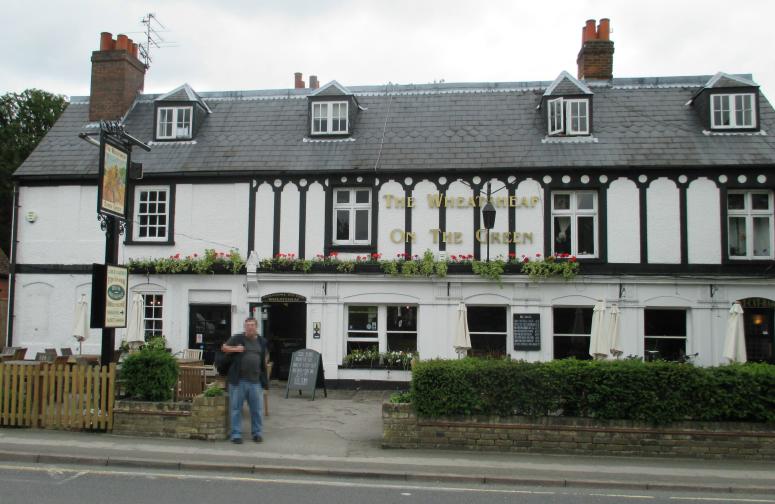
'The Wheatsheaf on the Green' as the name suggests is in a quieter part of Esher, it is worth walking up the low hill from the high street to reach it.  The interior somehow reminded me of a colonial hill station refurbished around 1965, but that was nice compared to the samey looking pubs you find everywhere.  Whilst we do not eat there, food seemed popular with the locals and they had a good range of Thai dishes and seemed to be doing very good business.  The attitude of the staff was in sharp contrast to the previous two pubs and we stayed here for another feeling very comfortable.  The pub managed to straddle successfully between dining families and serious drinkers like us.  Overall, a pleasant place to be and I would not mind returning.  It is pictured below with Bacchus pixelated to spare his discomfort.


As it now seems possible that I will be leaving London for the South Midlands, this may be my last review from this region and you will see others from elsewhere.  It might be of no interest, but this posting has been enjoyable and I regret not capturing my trips of the past.

Sunday, 30 June 2013

Books I Read In June


Fiction
‘The Foresight War’ by Anthony G. Williams
This is a well rated alternate history book which envisages what would have happened if two military historians one from Britain, called Dr Erlang who seems to be a version of the author and one from the former East Germany were transported back to 1934.  The two men are soon advising their respective leaders, Dr. Herman, the German historian, seeking to at least hold back the Soviets so that East Germany is not created which his son died trying to escape from.  The book is very technically focused which is probably unsurprising given the focus of Williams’s non-fiction books.  There is much discussion of calibres of guns and the engines of aircraft.  Both men successfully advance technology so that fruitless projects are abandoned and developments that only appeared at the end of the war in our world are in place by the outbreak of war in this. 

There are political changes too.  The British are persuaded not to give up their naval bases in the Irish Free State and not to make any commitment to supporting Poland.  No British Expeditionary Force is sent to France and instead Norway is successfully taken over by the British.  Later there is no invasion of Italy.  In the Far East, Hong Kong is abandoned but Malaya and Singapore successfully defended.  The war ends in 1943 when with the Allies having invaded northern France through western Normandy, Herman kills Hitler with a suicide bomb. 

The book is very interesting on these grounds and has substantial appendices to outline the differences from our world.  However, it is clear that Williams is a historian and not a novelist.  The main characters are not developed a great deal, despite the fact that Erlang has a relationship with the woman assigned to oversee him and they marry and have a child who is called Hope, which seems anachronistic for Britain; she might have been Faith or Hester.  I am content, unlike some readers for there to be no explanation of why the two men went back in time.  However, to be a novel rather than a technical book, these men have to be developed more.  One technique that Williams uses that is commendable is dropping in on particular commanders and their troops or civilians mixed up in specific conflicts.  This might seem to lead to fragmentation, but it allows him to look at the differences that the changes are making whilst avoiding lengthy exposition and I would suggest other alternate history authors look at this approach for their own work. 

I understand that Erlang and Herman are able to overcome official suspicion, but they also seem to be able to push against official resistance to innovation.  Notably Erlang is able to stop the RAF obsessing about strategic bombing and to focus instead in protecting convoys across the Atlantic.  He is able to overcome Churchill’s obsession with the Mediterranean and the British under-estimation of Japanese abilities in particular in terms of defending attacks on Singapore from the land.  He is also able to break the British concern for defending France.  I think he is too successful too often and more resistance to his ideas would have seemed credible.  Herman experiences this much more especially his failure to get the German forces to encourage states in the western USSR to break away and ally with the Germans.  He is able to temper Hitler’s enthusiasm for exotic vehicles and have a focus on creating jet fighters sooner. 

Overall, this novel feels like a first draft that needs work to be a proper novel.  It is not a long book and unlike many would have benefited from being longer.  As some reviewers have noted there is minimal tension; Erlang and Herman face too little resistance to their ideas.  In addition, once Hitler is dead the book stops abruptly as if Williams has lost interest.  However, handling a post-Hitler Germany in 1943 even with the Allies not having insisted on unconditional surrender is an interesting aspect.  Would a civil war have broken out in the way the SS was preparing for?  The book has many fine and interesting ideas, but it would have been better, given his ‘trainspotter’ approach to weaponry if Williams had gone down the Tsouras path and gave a kind of ‘battle report’ style approach.  If he had favoured the Turtledove approach of an actual story with developing characters then he needed to put in more work.  The Authors publishing company seems to be a low budget outfit that seem to lack editors and this again will have had an impact.  Williams has a website on which he lists numerous reviews of his books and refutes some of them. 

This book is interesting for anyone into alternate history.  However, it is more like the raw materials for an alternate history novel rather than being a novel in its own right.  I have not read subsequent books by Williams but I hope his fiction writing skills have developed.


Non-Fiction
‘One Way Or Another’ by Richard Meredith
I bought my copy of this book from the author himself.  It was self-published and he travelled the country marketing it.  I admire him for that.  It is also clear that he is a modern day adventurer.  This book published in 2002 was about him as the ‘balding backpacker’ travelling around the world becoming involved in a range of adventures including anti-capitalism riots in Canada, the US Presidential election and an attempted coup d’etat in Fiji.  Meredith is a former journalist and the style of this book is really like a collection of articles and there is an appendix of articles he wrote during his travels.  He has subsequently driven right across Asia in an Aston Martin. 

The book is witty and gives an interesting perspective.  However, I found it very fragmented.  He covers the stories almost in reverse chronology.  There are large chunks of his journey that only are mentioned in passing, so you have little sense of the year-long adventure as whole.  It would really have helped if there was linking text to contextualise where every component fitted into the broader story.  Something along the lines of ‘having spent three weeks travelling from the Atlantic coast to the Pacific coast of Canada, I headed South into the USA where this next big thing happened to me’ or ‘by this time it was May and I decided to head into Egypt where I encountered …’  There is no conclusion to the book about how he got back home or how he reflected on what he had experienced.  As a result you feel this was put together to make money rather than as a result of capturing personal experiences. 

This was an interesting read which would have been better for me to reach nearer the time it was written but I am currently on a decade-long lag in my reading.  It shows that shifting from being a journalist to being an author is not always straight forward.  Articles can be chapters but the book needs to be more than a sum of its parts.  This was another book that would have benefited from being longer and having much more ‘mortar’ between the different chapters.

Thursday, 27 June 2013

Has Cycling Become Simply A Poser's Hobby?

As regular readers will know, after being bullied for twelve months, I went into melt down and ended up losing my house and living with my parents, something which proved to be more of a challenge than I had anticipated.  Not only were there the issues of being around them but also the fact that they have lived in the same house since 1968 meant that there were far too many ghosts of the people who had bullied me for around a decade in my youth in the small town where they live to allow me comfortably to go out around there.  Consequently, I tend to keep to my room and play games.  Eventually I managed to find a room closer to my work and moved to South-West London, into districts I had never visited before.  Whilst many of the locals are very rich and come with attitudes of the kind that make the government insufferable, I felt pretty comfortable here.  With my mental health a lot better, I started looking at my physical health.  I had put on about 5Kg since things had started going wrong.  I am supposed to be 82Kg for my height, but have typically been 90Kg since the mid-2000s; 95Kg was certainly too much.

My job is not well paid and given that I am so physically unattractive I can alarm people in sporting venues, gym membership was out of the question.  I have failed at fencing and Aikido, so such sports seemed to be pointless, though I did consider badminton, though was worried it would simply be too middle class all round.  I was not able to find any swimming pools around.  I considered taking up running.  It seems to be a common urban sport.  In addition, I have always had a curiosity to find out where specific roads go to.  My interest in modernist and other 20th century architecture means that I can actually find going through suburbs pretty interesting.  I know it is sad, but there it is.  Given I have spent much of my life living in suburbs, I suppose it is a good safety mechanism.  Saying that I would never go back to Perivale.  That exceeded my tedium level and I could not get out of there fast enough.  I imagined that running would be a comparatively cheap sport.  Yes, I might need so decent shoes and one of those fluorescent tops that would keep me safe but not sweat too much.  However, reading 'The Guardian' guide to running last month: http://www.theguardian.com/lifeandstyle/the-running-blog/2013/may/28/running-etiquette-10-commandments  I was utterly put off even trying.  It might have been good for my fitness but facing up to the scrutiny and the disdain were too much and threatened to throw me into the haunted state I had when living with my parents.  I know the locals now and disdain flows from every pore even if you skulk away from them.  Shoving myself into their line of sight so clearly was bound to lead to heckling.  I have experienced this when cycling for not wearing cleats, but the advantage is you can get away from it easier than when running.

With running ruled out, I thought of a return to cycling.  As regular readers know, I used to cycle a great deal, even going on cycling holidays of my own making.  One key problem is that I cannot cycle fast enough.  I average 14.5kph (around 9mph) whereas cycling clubs require you to go at 15mph (24kph).  My father averages 10kph but he is 75 so I think they give him some leeway.  My father only cycles mid-week and whilst he comes past my work, I would only cycle on weekends so there would be no chance of humiliatingly running into him.  There was one big challenge and that was that whilst I had a bike that had once cost £329 (I got it in a terrible state for £90), I had not ridden it much.  The last time had been when unemployed in 2012 and I had felt terrible vertigo as if I was constantly going to crash over the handlebars; I often felt nauseous though never actually vomited.  That was on a 3Km ride to and from the job centre.  I thought that given my blood pressure was down, I should be in a better state.  However, thinking about it the woman who used to live in my house had similar symptoms and had to stop motorbiking as a result, so maybe there was some inner ear infection we caught, I do not know.

Anyway, the decision about whether to return to my bicycle was soon made for me.  I know I live in a snobby area, but no-one who cycled passed me did not look like they were about to race for a leading team.  The bicycles were generally more expensive than my car (it is insured for £1000); I have now seen bicycles for sale at twice that amount.  Even Halfords sells bicycles for £850 (€977; US$1300); let alone the Giant dealership I passed, with bicycles for £4499 (€5699 - their exchange rate; US$6883).  As when I drive it is clear that I would be disparaged for simply what I was using.  The other thing is the clothing.  Very few people ride around on a bicycle in normal clothes, let alone work clothes.  The time when people would ride in their suit or overalls to work are long gone.  The only people in ordinary clothes on a bicycle are either children generally in school uniform or people riding on the pavement.  These days adults riding on the road, whether it is a weekday or the weekend must ride in a pristine cycle team strip.  I used to have the Credit Agricole strip because Chris Boardman rode for that team and they were only bank in Falaise which would change my traveller's cheques.  That was my kit until I got chocolate ice cream on it at a restaurant somewhere South of Fecamp.  I guess these people change when they reach work and probably shower too.  Given that my workplace has no air conditioning and the window beside me does not open; it has an extractor fan embedded in it which does not work but madly is cleaned periodically.  I would arrive with sweat dripping from me and having to squeeze into a toilet cubicle to change.

What soon became apparent is that like football and running, cycling is no longer a democratic sport.  Football was captured by the prosperous middle classes (as opposed to me who was middle class and not prosperous) in the 1990s and running soon after.  In swimming there has been a similar attempt, but fortunately most pools at least leave some segments of the pool clear of the swimming lanes that these 'elite' practitioners favour to demonstrate their skills.  Heaven help you if you attempt to swim in them, you will be swamped and even kicked to get back into the non-laned area.  The sense that 'you are not doing it right' and thus open to public ridicule, sometimes very vocal, has now become embedded in all of these sports, cycling among them.  It is as much about how you appear as about what you do or what benefit you are gaining.  The other day I sat in central Esher for about an hour; 34 cyclists in small groups of individually came passed me going off in different directions.  It is clearly a crossroads for different routes around that part of Surrey.  Of those that I saw, and there may have been others I missed, only three cyclists, all men, were not wearing a pristine cycle team strip and riding a bike which, at least, would be at the top of Halfords range if not that of Giant.

As they whizz past, you get that look of disdain and often are told to get off the road, back on to the pavement, apparently nowadays the cycle path for those just using a bicycle as a mode of transport rather than a status symbol.  Non-status symbol cyclists now get it from all sides.  Of course, we have always been shouted at or pushed by car drivers, for 'being in the wrong place' or 'not knowing the law' especially when turning right or using a cycle lane.  On the pavement the large pushchair mothers shout as if cycling there is tantamount you trying to abduct or crush their child and now the poser cyclists have a go at you for being where they want to be and not dressed 'right'.

Yes, you can have your Sky Rides around city centres and all of the initiatives to get more people cycling.  However, it is too late, certainly in southern England.  Too many influential people want to keep the average person off their bicycle.  As with running and visiting gyms, cycling is now the preserve of the rich.  They identify themselves by what they wear and ride and have no tolerance for 'plebs' trying get in on the game.  It is all about status, as Professor Felipe Fernandez-Armesto when lecturing on the cultural perceptions of fatness, it has all been turned on its head from three centuries ago.  Then it was the rich who were seen as fat as they could afford to eat well.  Now it is the rich who are the slim ones, sometimes looking as if they are starved, because they can still afford to eat well; our definition of 'well' having changed.  Thus, they are going to prevent any ordinary person from exercising so that they cannot aspire to even look like their 'betters'.  They do this by making it so unpleasant to take part that individuals abandon it for not wanting to suffer further chastisement.  I was blind to this, but realise now that I own no house, living in a sub-let room and drive a 15-year old car, there is no way I would be accepted into the ranks of cyclists and to even try is to open me up to more of the bullying I have too often experienced in my life.

P.P. 06/08/2013
I read an article in 'The Guardian' on Saturday 3rd August 2013 which seemed to sum up my fears.  One person interviewed said that 'cycling has become the new golf' for upper middle class males.  The newspaper's own coverage of Sunday's 100-mile ride for serious amateurs seemed to reinforce this view.  It is all about the kit and now increasingly about downloading the statistics regarding your ride from some on-board device.  Performance now seems to out-rank achievement.  Despite the newspaper arguing that cycling has become 'less cliquey' in fact itself is showing that simply the clique has shifted from rather nerdy individuals of the past to snobby ones of the present.  Nothing is going to keep me away from cycling more than knowing I am going to be heckled for not only what I am wearing and riding but also what electronic equipment I might be carrying.  Cycling, like running is now an elitist hobby.  What is going to be next?  Darts?