Saturday, 6 July 2013

Bacchus and I: Drinking in Esher

I am surprised I have not thought about doing this before.  Since the 1990s I have periodically met up with a friend of mine, affectionately known as Bacchus and we have walked around an area, usually in London, trying out a range of pubs and typically having a meal along the way.  Sometimes we do not stray too far, sometimes there is a lot of walking involved.  I should have made more effort to capture our journey in 1995 that began at 07.00 at the 'Hope & Anchor' pub next to Smithfield Market and included a huge cooked breakfast and beer.  It involved going up into the dome of St Paul's Cathedral, lunching close to The Clink in Southwark and finished off in Lambeth around 19.00.   The walking tended to counter-balance the beer intake. Other trips have involved Wapping, Whitechapel-Bethnal Green, Walthamstow, Battersea, Twickenham, Holloway-Archway-Hampstead-Highgate, Charing Cross Road-Tottenham Court Road-Euston, Bloomsbury-Fitzrovia, Holborn, Mayfair, Marble Arch-Edgware Road, Hammersmith with sojourns to Cookham, Oxford, Reading, Norwich, Winchester, Guildford and Bournemouth. My preference is for lager, Bacchus favours good bitters and real ales.

There are a couple of reasons for including such exploits on here.  Not on the basis of boasting of how much alcohol I can consume.  My limit is usually 4 pints, perhaps 6 if spread over a longer period and alternated with tomato juice.  Bacchus has protested that too many people 'spread their lives all over the internet', something of which I am now worried about doing.  I am torn by seeing it as egotistical yet the whole purpose of this blog was for me to cast stuff out into the internet in large part for my own benefit.  Latterly this has become a tool for mentally sticking my life back together.  Along the way I have found I actually lost more than I realised.  Along with the house and chickens went probably my only chance to ever marry.

The main purpose of covering such activities on here is a bit in the line of the flaneur approach, i.e. recounting what you might encounter walking through various parts of the country and also may suggest to you some pubs and even restaurants you might want to try out or in fact avoid.  On this basis, I certainly recommend breakfasting at 'Hope & Anchor'.  A visit to 'The Mitre' in Holborn, if you can find it, is worthwhile doing as it is the closest you will get to a Harry Potter like pub in how concealed it is.  I know Bacchus would mention 'The Prospect of Whitby' in Wapping.  I have also returned to 'The Sussex Arms' in Twickenham which actually plays records and sells a wide range of beers and ciders, always changing.

So, today's posting is about our trip to Esher.  We went on a Sunday, so it was pretty quiet, there was no horse racing on which changes the whole nature of the town.  The first thing to note is that it a 20-minute walk from the station and there is just busy residential road and then the horse race track to get passed before there are any commercial outlets, bar a branch of 'Café Rouge' which ironically we ended up eating in.

On this trip we visited three pubs.  The first was 'The Bear' which says it is a hotel but has a substantial bar area with stripped wood floors and a mixture of sofas and high stools.  It looks pretty much like a stylish wine bar and maybe the attitude of the staff come from that.  Being stockbroker belt Surrey you are not going to pay less than £4 (€4.60; US$6.12) for your pint of beer.  There is a reasonably large outdoor area.  The staff were young and while seemed to be good enough at doing their jobs, seemed to view the customer as the least of their concerns, they would rather play around with people.  For Esher the clientele were quiet.  I was surprised they were not doing more business selling food being a Sunday, but maybe their prime time is evenings.  I bought peanuts and they were very expensive, you only get a small dish for paying £2.50, I would rather have a packet.  However, I guess I was not the kind of customer 'The Bear' is looking for; it might have been different if I had bought wine.  The range of lagers was not particularly good; Bacchus very much disliked the place.

We crossed the very busy road to 'The Albert Arms'.  The exterior was being refurnished, but did not really impinge on the experience.  In some ways it reminded me of a narrower version of 'The Three Kings' in Twickenham, with bright wood flooring.  Its range of beers was better than 'The Bear' opposite.  Perhaps this was why, in contrast to 'The Bear' where women had been in the majority, this was dominated by men, some of whom were loud and very pretentious, but again, what you would expect in most places in Esher, they are bred like that.  I could have tolerated this place.  Bacchus is not usually overly picky about the environment, especially if the beer is reasonable.  However, we pressed on to the best pub of the day.

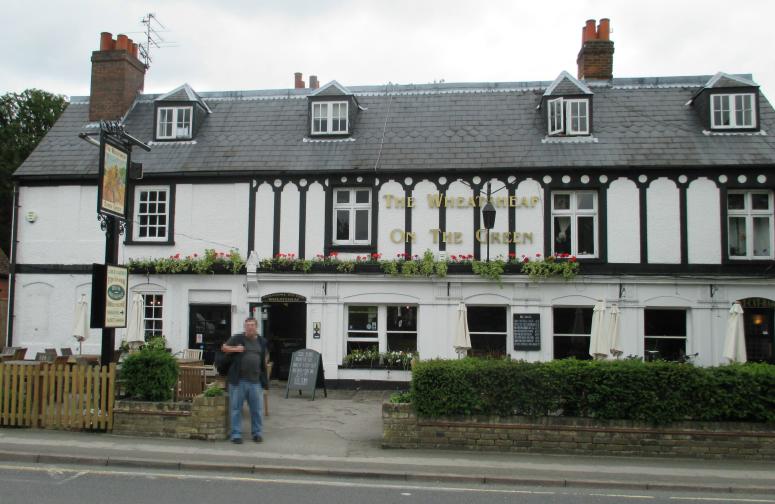
'The Wheatsheaf on the Green' as the name suggests is in a quieter part of Esher, it is worth walking up the low hill from the high street to reach it.  The interior somehow reminded me of a colonial hill station refurbished around 1965, but that was nice compared to the samey looking pubs you find everywhere.  Whilst we do not eat there, food seemed popular with the locals and they had a good range of Thai dishes and seemed to be doing very good business.  The attitude of the staff was in sharp contrast to the previous two pubs and we stayed here for another feeling very comfortable.  The pub managed to straddle successfully between dining families and serious drinkers like us.  Overall, a pleasant place to be and I would not mind returning.  It is pictured below with Bacchus pixelated to spare his discomfort.


As it now seems possible that I will be leaving London for the South Midlands, this may be my last review from this region and you will see others from elsewhere.  It might be of no interest, but this posting has been enjoyable and I regret not capturing my trips of the past.

Sunday, 30 June 2013

Books I Read In June


Fiction
‘The Foresight War’ by Anthony G. Williams
This is a well rated alternate history book which envisages what would have happened if two military historians one from Britain, called Dr Erlang who seems to be a version of the author and one from the former East Germany were transported back to 1934.  The two men are soon advising their respective leaders, Dr. Herman, the German historian, seeking to at least hold back the Soviets so that East Germany is not created which his son died trying to escape from.  The book is very technically focused which is probably unsurprising given the focus of Williams’s non-fiction books.  There is much discussion of calibres of guns and the engines of aircraft.  Both men successfully advance technology so that fruitless projects are abandoned and developments that only appeared at the end of the war in our world are in place by the outbreak of war in this. 

There are political changes too.  The British are persuaded not to give up their naval bases in the Irish Free State and not to make any commitment to supporting Poland.  No British Expeditionary Force is sent to France and instead Norway is successfully taken over by the British.  Later there is no invasion of Italy.  In the Far East, Hong Kong is abandoned but Malaya and Singapore successfully defended.  The war ends in 1943 when with the Allies having invaded northern France through western Normandy, Herman kills Hitler with a suicide bomb. 

The book is very interesting on these grounds and has substantial appendices to outline the differences from our world.  However, it is clear that Williams is a historian and not a novelist.  The main characters are not developed a great deal, despite the fact that Erlang has a relationship with the woman assigned to oversee him and they marry and have a child who is called Hope, which seems anachronistic for Britain; she might have been Faith or Hester.  I am content, unlike some readers for there to be no explanation of why the two men went back in time.  However, to be a novel rather than a technical book, these men have to be developed more.  One technique that Williams uses that is commendable is dropping in on particular commanders and their troops or civilians mixed up in specific conflicts.  This might seem to lead to fragmentation, but it allows him to look at the differences that the changes are making whilst avoiding lengthy exposition and I would suggest other alternate history authors look at this approach for their own work. 

I understand that Erlang and Herman are able to overcome official suspicion, but they also seem to be able to push against official resistance to innovation.  Notably Erlang is able to stop the RAF obsessing about strategic bombing and to focus instead in protecting convoys across the Atlantic.  He is able to overcome Churchill’s obsession with the Mediterranean and the British under-estimation of Japanese abilities in particular in terms of defending attacks on Singapore from the land.  He is also able to break the British concern for defending France.  I think he is too successful too often and more resistance to his ideas would have seemed credible.  Herman experiences this much more especially his failure to get the German forces to encourage states in the western USSR to break away and ally with the Germans.  He is able to temper Hitler’s enthusiasm for exotic vehicles and have a focus on creating jet fighters sooner. 

Overall, this novel feels like a first draft that needs work to be a proper novel.  It is not a long book and unlike many would have benefited from being longer.  As some reviewers have noted there is minimal tension; Erlang and Herman face too little resistance to their ideas.  In addition, once Hitler is dead the book stops abruptly as if Williams has lost interest.  However, handling a post-Hitler Germany in 1943 even with the Allies not having insisted on unconditional surrender is an interesting aspect.  Would a civil war have broken out in the way the SS was preparing for?  The book has many fine and interesting ideas, but it would have been better, given his ‘trainspotter’ approach to weaponry if Williams had gone down the Tsouras path and gave a kind of ‘battle report’ style approach.  If he had favoured the Turtledove approach of an actual story with developing characters then he needed to put in more work.  The Authors publishing company seems to be a low budget outfit that seem to lack editors and this again will have had an impact.  Williams has a website on which he lists numerous reviews of his books and refutes some of them. 

This book is interesting for anyone into alternate history.  However, it is more like the raw materials for an alternate history novel rather than being a novel in its own right.  I have not read subsequent books by Williams but I hope his fiction writing skills have developed.


Non-Fiction
‘One Way Or Another’ by Richard Meredith
I bought my copy of this book from the author himself.  It was self-published and he travelled the country marketing it.  I admire him for that.  It is also clear that he is a modern day adventurer.  This book published in 2002 was about him as the ‘balding backpacker’ travelling around the world becoming involved in a range of adventures including anti-capitalism riots in Canada, the US Presidential election and an attempted coup d’etat in Fiji.  Meredith is a former journalist and the style of this book is really like a collection of articles and there is an appendix of articles he wrote during his travels.  He has subsequently driven right across Asia in an Aston Martin. 

The book is witty and gives an interesting perspective.  However, I found it very fragmented.  He covers the stories almost in reverse chronology.  There are large chunks of his journey that only are mentioned in passing, so you have little sense of the year-long adventure as whole.  It would really have helped if there was linking text to contextualise where every component fitted into the broader story.  Something along the lines of ‘having spent three weeks travelling from the Atlantic coast to the Pacific coast of Canada, I headed South into the USA where this next big thing happened to me’ or ‘by this time it was May and I decided to head into Egypt where I encountered …’  There is no conclusion to the book about how he got back home or how he reflected on what he had experienced.  As a result you feel this was put together to make money rather than as a result of capturing personal experiences. 

This was an interesting read which would have been better for me to reach nearer the time it was written but I am currently on a decade-long lag in my reading.  It shows that shifting from being a journalist to being an author is not always straight forward.  Articles can be chapters but the book needs to be more than a sum of its parts.  This was another book that would have benefited from being longer and having much more ‘mortar’ between the different chapters.

Thursday, 27 June 2013

Has Cycling Become Simply A Poser's Hobby?

As regular readers will know, after being bullied for twelve months, I went into melt down and ended up losing my house and living with my parents, something which proved to be more of a challenge than I had anticipated.  Not only were there the issues of being around them but also the fact that they have lived in the same house since 1968 meant that there were far too many ghosts of the people who had bullied me for around a decade in my youth in the small town where they live to allow me comfortably to go out around there.  Consequently, I tend to keep to my room and play games.  Eventually I managed to find a room closer to my work and moved to South-West London, into districts I had never visited before.  Whilst many of the locals are very rich and come with attitudes of the kind that make the government insufferable, I felt pretty comfortable here.  With my mental health a lot better, I started looking at my physical health.  I had put on about 5Kg since things had started going wrong.  I am supposed to be 82Kg for my height, but have typically been 90Kg since the mid-2000s; 95Kg was certainly too much.

My job is not well paid and given that I am so physically unattractive I can alarm people in sporting venues, gym membership was out of the question.  I have failed at fencing and Aikido, so such sports seemed to be pointless, though I did consider badminton, though was worried it would simply be too middle class all round.  I was not able to find any swimming pools around.  I considered taking up running.  It seems to be a common urban sport.  In addition, I have always had a curiosity to find out where specific roads go to.  My interest in modernist and other 20th century architecture means that I can actually find going through suburbs pretty interesting.  I know it is sad, but there it is.  Given I have spent much of my life living in suburbs, I suppose it is a good safety mechanism.  Saying that I would never go back to Perivale.  That exceeded my tedium level and I could not get out of there fast enough.  I imagined that running would be a comparatively cheap sport.  Yes, I might need so decent shoes and one of those fluorescent tops that would keep me safe but not sweat too much.  However, reading 'The Guardian' guide to running last month: http://www.theguardian.com/lifeandstyle/the-running-blog/2013/may/28/running-etiquette-10-commandments  I was utterly put off even trying.  It might have been good for my fitness but facing up to the scrutiny and the disdain were too much and threatened to throw me into the haunted state I had when living with my parents.  I know the locals now and disdain flows from every pore even if you skulk away from them.  Shoving myself into their line of sight so clearly was bound to lead to heckling.  I have experienced this when cycling for not wearing cleats, but the advantage is you can get away from it easier than when running.

With running ruled out, I thought of a return to cycling.  As regular readers know, I used to cycle a great deal, even going on cycling holidays of my own making.  One key problem is that I cannot cycle fast enough.  I average 14.5kph (around 9mph) whereas cycling clubs require you to go at 15mph (24kph).  My father averages 10kph but he is 75 so I think they give him some leeway.  My father only cycles mid-week and whilst he comes past my work, I would only cycle on weekends so there would be no chance of humiliatingly running into him.  There was one big challenge and that was that whilst I had a bike that had once cost £329 (I got it in a terrible state for £90), I had not ridden it much.  The last time had been when unemployed in 2012 and I had felt terrible vertigo as if I was constantly going to crash over the handlebars; I often felt nauseous though never actually vomited.  That was on a 3Km ride to and from the job centre.  I thought that given my blood pressure was down, I should be in a better state.  However, thinking about it the woman who used to live in my house had similar symptoms and had to stop motorbiking as a result, so maybe there was some inner ear infection we caught, I do not know.

Anyway, the decision about whether to return to my bicycle was soon made for me.  I know I live in a snobby area, but no-one who cycled passed me did not look like they were about to race for a leading team.  The bicycles were generally more expensive than my car (it is insured for £1000); I have now seen bicycles for sale at twice that amount.  Even Halfords sells bicycles for £850 (€977; US$1300); let alone the Giant dealership I passed, with bicycles for £4499 (€5699 - their exchange rate; US$6883).  As when I drive it is clear that I would be disparaged for simply what I was using.  The other thing is the clothing.  Very few people ride around on a bicycle in normal clothes, let alone work clothes.  The time when people would ride in their suit or overalls to work are long gone.  The only people in ordinary clothes on a bicycle are either children generally in school uniform or people riding on the pavement.  These days adults riding on the road, whether it is a weekday or the weekend must ride in a pristine cycle team strip.  I used to have the Credit Agricole strip because Chris Boardman rode for that team and they were only bank in Falaise which would change my traveller's cheques.  That was my kit until I got chocolate ice cream on it at a restaurant somewhere South of Fecamp.  I guess these people change when they reach work and probably shower too.  Given that my workplace has no air conditioning and the window beside me does not open; it has an extractor fan embedded in it which does not work but madly is cleaned periodically.  I would arrive with sweat dripping from me and having to squeeze into a toilet cubicle to change.

What soon became apparent is that like football and running, cycling is no longer a democratic sport.  Football was captured by the prosperous middle classes (as opposed to me who was middle class and not prosperous) in the 1990s and running soon after.  In swimming there has been a similar attempt, but fortunately most pools at least leave some segments of the pool clear of the swimming lanes that these 'elite' practitioners favour to demonstrate their skills.  Heaven help you if you attempt to swim in them, you will be swamped and even kicked to get back into the non-laned area.  The sense that 'you are not doing it right' and thus open to public ridicule, sometimes very vocal, has now become embedded in all of these sports, cycling among them.  It is as much about how you appear as about what you do or what benefit you are gaining.  The other day I sat in central Esher for about an hour; 34 cyclists in small groups of individually came passed me going off in different directions.  It is clearly a crossroads for different routes around that part of Surrey.  Of those that I saw, and there may have been others I missed, only three cyclists, all men, were not wearing a pristine cycle team strip and riding a bike which, at least, would be at the top of Halfords range if not that of Giant.

As they whizz past, you get that look of disdain and often are told to get off the road, back on to the pavement, apparently nowadays the cycle path for those just using a bicycle as a mode of transport rather than a status symbol.  Non-status symbol cyclists now get it from all sides.  Of course, we have always been shouted at or pushed by car drivers, for 'being in the wrong place' or 'not knowing the law' especially when turning right or using a cycle lane.  On the pavement the large pushchair mothers shout as if cycling there is tantamount you trying to abduct or crush their child and now the poser cyclists have a go at you for being where they want to be and not dressed 'right'.

Yes, you can have your Sky Rides around city centres and all of the initiatives to get more people cycling.  However, it is too late, certainly in southern England.  Too many influential people want to keep the average person off their bicycle.  As with running and visiting gyms, cycling is now the preserve of the rich.  They identify themselves by what they wear and ride and have no tolerance for 'plebs' trying get in on the game.  It is all about status, as Professor Felipe Fernandez-Armesto when lecturing on the cultural perceptions of fatness, it has all been turned on its head from three centuries ago.  Then it was the rich who were seen as fat as they could afford to eat well.  Now it is the rich who are the slim ones, sometimes looking as if they are starved, because they can still afford to eat well; our definition of 'well' having changed.  Thus, they are going to prevent any ordinary person from exercising so that they cannot aspire to even look like their 'betters'.  They do this by making it so unpleasant to take part that individuals abandon it for not wanting to suffer further chastisement.  I was blind to this, but realise now that I own no house, living in a sub-let room and drive a 15-year old car, there is no way I would be accepted into the ranks of cyclists and to even try is to open me up to more of the bullying I have too often experienced in my life.

P.P. 06/08/2013
I read an article in 'The Guardian' on Saturday 3rd August 2013 which seemed to sum up my fears.  One person interviewed said that 'cycling has become the new golf' for upper middle class males.  The newspaper's own coverage of Sunday's 100-mile ride for serious amateurs seemed to reinforce this view.  It is all about the kit and now increasingly about downloading the statistics regarding your ride from some on-board device.  Performance now seems to out-rank achievement.  Despite the newspaper arguing that cycling has become 'less cliquey' in fact itself is showing that simply the clique has shifted from rather nerdy individuals of the past to snobby ones of the present.  Nothing is going to keep me away from cycling more than knowing I am going to be heckled for not only what I am wearing and riding but also what electronic equipment I might be carrying.  Cycling, like running is now an elitist hobby.  What is going to be next?  Darts?

Thursday, 6 June 2013

The Return Of The Pedestrian

After losing my house I had no option but to live with my parents or be homeless.  As I have noted on this blog over the past few months, I took the first option.  Though it proved to be stressful it was less debilitating than living on the streets or at some council's pleasure in a bed & breakfast.  That delight will probably come when I am bullied at work again and my parents have died.  Anyway, after weeks of searching for a room; being rejected by the bulk of them because I was too old (at 45) or too male or was impudent to ask that there was heating that worked, I finally found the room I mentioned.  I am a sub-tenant of a Lithuanian family in a house with another lodger plus the family of two adults, a child and a dog.  The dog only understands Lithuanian and looks at me with a bewildered stare whenever I speak to her in English.  In contrast, the child flicks between both languages with immense ease. 

In London it is expected that you commute to work.  My parents live 30Km outside London and the route I took meant I could do that in 30 minutes.  I was offered rooms that were 18-19Km from my workplace but with the trains being radial rather than around the circumference and the traffic in so many one-way systems between these rooms and work it easily too 2 hours to cover this distance.  I was fortunate that the room I ended up with is less than 3.5Km from where I work.  Since losing the house, my weight had risen by 3Kg.  My mother had kept trying to persuade me at least to walk around the town where they live, for exercise.  However, having been bullied for ten years in my childhood, there are very few corners of the town which do not haunt me with memories of being humiliated or physically assaulted.   The neighbouring town is a little better as it has been do smashed around by developers in the past thirty years and continues to be altered that there are few structures left from my memory to remind me of what happened: the library where I was punched has been levelled, the swimming pool where I was held under the water is now replaced by a car park and where the other pool, the one at which my trainers were stolen, used to stand is now a landscaped bank of grass and flowers.

I had never visited my new district ever before, so I can walk through it with no ghosts tugging at my peace of mind.  Like much of London, though the area is generally wealthy, there are pockets where ordinary people live and abruptly you can turn a corner and see a very different society from the street you just left.  It reminds me of London Below in 'Neverwhere' (television series 1996; cassette/CD 1996; novels 1996 & 2006; graphic novel 2005) which I have just recently re-watched on DVD.  It is more like 'London Beside'.  The same applies to the architecture.  I am fortunate on my walk to pass large Victorian town houses, 1930s blocks of flats and semi-detached villas, 1950s bungalows, 1960s blocks of flats, 1990s fake versions of the Victorian houses and terraced houses that could have come from any period in the past century.  I suppose this is better than a route that took me alongside a dual carriage way for kilometres.  There are small shops and pubs on the way, some with a very old-fashioned approach - one chemist advertises that it develops films and one post office closes on Wednesday afternoons.

Walking I see the same people, some occasionally, some almost daily.  Many, of course are oblivious to me, tied up in the sounds and images emerging from whatever device they are grasping.  Conversely, I am watched eagle-eyed by parents.  This is the fate of any man walking within 500 metres of a school.  Everyone no matter how smart or shabby looking is perceived as a potential paedophile.  It is very unpleasant, but something that seems unavoidable these days.  I try to skirt going too close to any school, nursery, playgroup or even college, fearful that some mother is going to thrust an assault alarm at me and have me dragged off for lynching because I simply look 'odd'.  I am jumping ahead of myself as before the parents, thrusting us off the pavement with vast pushchairs, there are the sports fanatics, filling up the park with styles that look like they belong in the Eighties as they run and exercise.  There are also the dog walkers, even more demanding than pushchair pushers as their dogs scurry in multiple directions threatening to snare your knees in their leashes and it is always your fault.  From this you can tell the prosperity of the area.  The poorer the area, the earlier in the morning people head to work, something you can witness if you take a  tube train from Mile End at 06.00.  There are the cyclists, looking like left over domestiques from the Tour de France, in top team kits, with more equipment than I have in my car.  It is only at 07.30 that the locals begin to head to work, appearing like the Eloi in 'The Time Machine' (1960) in this case as if summoned by some silent signal.  Literally five minutes can be the difference between an empty street and it being filled with apparently sightless zombies, only zombies who march and brook no-one else in their path.

Apparently a quarter of adults walk for less than two hours per week; I do four to six hours; the recommended is one hour thirty minutes.  I now walk 6.5Km per day, averaging about 6kph.  As occasionally I drive and sometimes I go out at the weekends too, I cover 25-38Km per week.  However, having my health reviewed by my doctor recently, this was deemed to be 'inactive'.  Thus, though I feel healthier from walking apparently it is far from being enough actually to make me healthy.  I have noticed that the stress brought about by idiots driving has been reduced.  However, I would contest the suggestion made in the reports that came out in May, that walking benefits your mental health.  The time you are left to ponder life and to think that I am in a job that I can only afford two suits and I live as a sub-tenant with an immigrant family, is not cheering.  In addition, living in such a prosperous area I see so much arrogant behaviour even of people walking and cycling, let alone the car drivers who regularly try to kill me on the Zebra crossings.  I often arrive at work or back home thoroughly dispirited by seeing how unpleasant people are and knowing that I will never own a house again, not even one of the small, mid-20th century terraced places.  Perhaps I need to put my brain into an ipod or a smartphone to avoid such daily mental challenges.

I did aspire, briefly, to be a flâneur.  This term these days usually means someone who is pretty much a layabout going back to its 16th century routes.  However in the 19th century in France it took on a more proactive sense of being someone who strolled in order to explore his/her urban environment. The ideal flâneur was seen as an individualist, not willing to fit into the category of the 'badaud', i.e. someone who simply gazed without thought at what they were passing, perhaps like the modern 'rubber-necker'.  The flâneur seems to be having a bit of revival, perhaps not in South-West London but in West London by Will Self, author, raconteur and now professor, who is apparently renowned for his peripatetic lectures, i.e. lectures while walking, an approach in theory dating back to Aristotle (384-332BCE), though that view may stem from a mistranslation.  Self's approach in turn seems to have been highlighted by his book 'Walking to Hollywood' (2010) stemming from his obsessive compulsive disorder and obsessions going back to the early 2000s of walking great distances out from London.  Like myself, he did not find the walks curative or beneficial for his mental health.  From what I have heard from an old friend of this blog, his colleague, John Francis, seems to be developing the flâneur concept in terms of lecturing and in exploring the urban environment, perhaps, it has been suggested, stemming from his background in film studies.  This sense of people walking through London and other urban locations equipped unlike any flâneur of the past to challenge, check and capture the scene is an exciting one.  However, I imagine like running and cycling it will be taken and made into a colourful pose activity with expensive clothing that you simply must buy in order to be into it properly.

The flâneur, even on a daily walk, is exploring the town/city, being alert to its history and its changes even day-on-day let alone over the seasons, years and centuries.  It is seen as then leading on into street photography, not only witnessing the urban scene but capturing it.  Wikipedia refers to Susan Sontag in this respect, but I would go back to Robert Doisneau, who has brought street scenes of his Paris in that era to many people in succeeding decades.  Thus, I equipped myself with small camera and dreamt of having the tools to look at the spaces I walked through an augmented reality application on a smartphone, even adding to the elements available online from my walk.  Yet, it has failed.  Even when I got passed the blood-filled blisters, I found that I simply moved like the blind zombies, in fact not even marching at their pace.  I move furtively, seeking to avoid being close enough to a school to be shouted at for being a potential molester, dodging the cyclists on the pavement (despite the minimal traffic on the roads I walk beside), heads down, the world blotted out by the iPlayer.  Getting to work is a physical and mental survival course.  I am not excited by the day-to-day changes and I am depressed by the streets that show me everything I can never have and more.

My walking saves me some money in petrol and that saves the planet some milligrams of pollution.  I guess the stress is not as bad as when I drove and perhaps my chances of being injured or killed have fallen now I am on suburban pavements rather than the M25.  However, it has shown me that not everyone can be a flâneur.  You need to be rich enough and have sufficient prospects not to be overwhelmed by the weight of other people's opportunities.  You certainly need an arrogance to face down the arrogance of those unhappy at you being in the space they want to move into.  It probably helps if you are a woman so that you are not considered a potential burglar, rapist or paedophile at every step.  So I guess the flâneuse it possible in this world.  Perhaps then you can get some benefit from walking through a city.  For me, there are no mental benefits, bar the fact that I am not pursued by the ghosts of my hometown bullies.  Even the doctor's system claims that there is no physical benefit and that walking 25Km is insufficient to render me anything more than 'inactive'.

Friday, 31 May 2013

The Books I Read in May


Fiction
‘Search the Dark’ by Charles Todd
This is the third book in the Inspector Rutledge series.  Though written by an American they are set in Britain immediately after the First World War.  Rutledge is an amiable detective literally haunted by a man he executed as an officer during the war.  Many of the characters in the book have been damaged by the war which provides unpredictability in their actions and contrast with the setting.  The reason why I picked this particular book was because it is set in Dorset which I love.  One of the previous books was set in Cornwall.  It is clear that Todd has a love of these counties and a highlight of the book for me is his description of what marks Dorset out:
 
‘This was Hardy country.  But it was the difference in light that impressed Rutledge more than the author’s dark and murky characters.  There was a golden-brown tint to the light here that seemed to come from the soil and the leaves of the trees.  Not washed pastel like Norfolk, nor rich green like Kent.  Nor gray [sic] damp like Lancaster.  Dorset had been wool trade and stone, cottage industry and small farming towns strung along old roads that the Saxons had laid out long before the Norman conquest.’   

Todd refers to real places such as Charlbury, Lyme Regis and Kingston Lacy (which he wrongly spells ‘Lacey’).  He relocates Singleton Magna from Lancashire to Dorset, but Magna, as in Canford Magna and Fontmell Magna, is a name used in the county.  Stoke Milton does not exist in reality but there is East Stoke and Milton Abbas in Dorset and New Milton close by in neighbouring Hampshire. 

It is unsurprising that Todd uses American English to refer to things though this leads to the oddity of a Dorset person referring to a ‘program’ of films at a cinema.  I know that readers these days are unwilling to accept characters speaking in ways that might be more historically accurate, so I can forgive Todd sometimes modern turns of phrase, people simply will not accept anything else and bitterly complain when you try even just to give a flavour of the way people spoke at the time. 

There are a few historical errors that Dodd should have spotted given that he is writing novels in this period.  For a start it would have been difficult for anyone to be travelling in a Second Class train carriage at this time.  Very few train companies, and none going to Dorset, had them.  Instead there were only First and Third Class carriages.  Todd shows the detective having tea in the garden of a pub in the middle of the afternoon.  This would have been impossible even when I was a child, let alone back in the 1920s.  It was only really in the late 1980s that pubs began to sell tea or coffee.  It would have been more accurate for Todd to show them having tea at the hotel he mentions. No-one has cream in their tea in Britain. There is something called a 'cream tea', but this refers to the meal called 'tea'. In Britain both the drink and the afternoon meal are called tea and Dodd has clearly mixed them up. A 'cream tea' is a tea (the meal) at which you have a drink of tea and scones with jam and cream on them; there may be other foods such as sandwiches and cakes as well. People in Britain have milk in their tea and occasionally lemon.

A key error which I am surprised that he and his editor missed is a farmhouse with two inside bathrooms.  Again even in my youth, this would not happen.  Certainly in the 1920s, many houses lacked bathrooms entirely and the toilet would be outside even in cities let alone in the countryside.  If he had been referring to the house of the local lord of the manor, then that was acceptable, but for a run-down farmhouse, it would have never been the case.  It is likely that there would have been no running water to the house and it would have had to be drawn from a pump by the back door.

The story of a man seeing a woman and children from a train and thinking they are his lost family, hunting for them only for a woman to turn up dead is a good basis for the story.  However, the key difficulty is that the book takes far too long.  I know he wants to sum up the slow-moving nature of the countryside, but the toing and froing of Rutledge really diminishes the horrors he is referring to and the revelations that appear about various local families.  Cut by 50-70 pages (my edition of the book is 344 pages long) this could have been a far more effective novel with the balance between the horrors of war and the bucolic setting shown more sharply and so with more punch. 

Despite my interest in the setting, I felt reading this book was a labour and consequently would not relish reading others set in contexts with which I do not have such a connection. 

Non-Fiction
‘Louis XIV’ by Philippe Erlanger
It is quite stunning just how many biographies there are of the French King Louis XIV; a quick search of Amazon shows twelve let alone the books covering particular policies and significant individuals at his court.  I cannot remember why I bought this book.  It was published in English in 1970 and one in a while it can appear dated, most notably when speaking about Louis’s first queen Maria Theresa of Spain and says that her indolence and her ignorance might be attributed to her having some Arab ancestry, a bigoted comment that properly would not be tolerated these days.  Louis XIV’s long reign was a complex one but Erlanger is best when painting brief portraits of the people that Louis associated with.  He is good at highlighting phases in which alternate paths could have been taken, something I always like.  When he is dealing with the political manoeuvring and the incessant wars Louis engaged in, he is far weaker.  I came away from this book having less clarity about the period of the Frondes than I did before I started reading it. 

Erlanger’s pace accelerates as the action becomes more complex or pressing and you yearn for him to get back to issues from a period of greater stability.  Furthermore whilst he may be correct to use the designations such as ‘Monsieur’ and ‘Mademoiselle’ for members of Louis’s family, once you have got a few pages on you have forgotten who these signify and adhering to their actual names would aid comprehension. 

The book was written in French, I was reading a translation and maybe not being as familiar with French history as he may have expected his readers to be, I was more easily lost.  However, a key purpose of a biography is to allow you to understand better what motivated an individual and what they took part in.  Coming away from Erlanger’s book, I feel I do know more about Louis’s character and how it changed over the years.  However, in terms of the domestic political and international relations aspects of his reign, I would need to turn to a different source to get to grips with them.

Sunday, 19 May 2013

Life After Europe

This is certainly a topic I know more about than many others as I used to teach on European Integration and even got to grips with the complexities of farming subsidies.  I do not need to tell you that the key political development in the UK of recent months has been the success of UKIP, a right-wing party primarily aiming to have Britain leave the EU.  Receiving around a quarter of the vote and going from 8 to 147 councillors in the local election has unsurprisingly attracted attention.  Though it is important to note that there are 165 Independent councillors and that the Conservatives have 1116, i.e. more than Labour, the Liberal Democrats and UKIP put together.

Of course UKIP’s impact has been greater than simply the number of councillors it has.  It has again exposed the long-running fracture in the Conservative Party over the question of the extent to which even if the UK stays in the EU it actually participates in the political process.  This is because the Conservative Party has two main wings, one which is primarily business focused and welcomes being part of a vast free trade system and the other which is more nationalistic and simply baulks at the perception of giving any degree of sovereignty to any non-military organisation.  This fracture has not really troubled the Conservatives since the closing days of John Major’s administration in the mid-1990s, but is now back in force.

In recent days David Cameron has been compelled to accelerate the movement to a referendum and without anyone really noting this it has quickly mutated from being about redefining the relationship with the EU to the now trumpeted ‘in/out’ referendum.  Cameron has had to play some politics because he is coalition with the most pro-EU of the British political parties, the Liberal Democrats.  Labour has had an ambivalent attitude towards the EU through its history.  This is because back in the 1950s and 1960s it was seen as a project brought forward by conservative, largely Catholic, businessmen.  It was only in the 1980s when with the pressure that working people were facing in Britain and the EU’s introduction of labour and social policies that most, though not all, Labour members began to see a benefit in the EU, as it is now known.

One reason why Cameron is under so much pressure from UKIP is because, whilst it is primarily a single-issue party, it has also managed to adopt a populist stance that taps into a strong sentiment in British society personified by the presenter Jeremy Clarkson, who in fact has been the most successful ‘political’ author of the past decade.  Cameron has been weak on the populist side of Conservative support right from the start as I noted as far back as October 2010: http://rooksmoor.blogspot.co.uk/2010/10/camerons-blunder-with-electorate.html  The nostalgia for a kind of edited golden days of the 1970s when people were apparently free to damage themselves through speeding, not wearing seatbelts and smoking, is very strong in Britain.  Cameron, unlike both Margaret Thatcher and John Major, has never even attempted to speak to those Conservatives in Britain who are not wealthy, but in fact, make up the majority of the people who vote for them.  This is why Nigel Farage is succeeding where Jimmy Goldsmith and his rather elitist Referendum Party which was also anti-EU did not thrive.  Farage may flirt with racism but he manages to do it on the ‘down the pub chat’ basis of ‘I’m not racist but …’ which less alarms the bulk of voters than the more explicit rhetoric of Nick Griffin and the BNP.  Cameron, though elitist has a modern outlook which is all about high-tech global business.  However, that is not the world that the bulk of Conservative supporters feel comfortable with even contemplating.  Britain is a country which lives in the past and any attempt to move away from that, especially when people feel insecure in terms of jobs and the economy, is to make yourself unpopular: http://rooksmoor.blogspot.co.uk/2007/05/britain-land-that-time-forgot.html  This is why it may benefit Ed Miliband to adopt the trappings of ‘Old’ Labour at least to appeal to a sector of working people who liked the certainties of the past but with a more labour-focused approach.

Anyway, there are loads of commentators with more time to explore these issues so I will move now from the current political turmoil to look longer-term.  It is clear that there will be an in/out referendum.  Even if Labour comes to power in 2015 they will find it difficult to resist the head of pressure for this.  It is something that the bulk of the population have wanted for decades and had to accept assurances that it was not possible.  Now Cameron has opened the door, it cannot be closed again.  All politicians have to face the fact that the vast majority of the British public loathe the EU.  Many of the reasons for this loathing are based on misinformation which has been provided by the media decade after decade.  However, the support for UK membership of the EU is limited to business people who like the free trade aspect and the ability to bring in cheap labour legally from Eastern Europe and middle class people living in South-East England who own property in France or lower middle class people from Essex and Liverpool whose parents retired to Spain.

One key myth about the EU is that it compels Britain to accept regulations that hamper the freedom of Britons to be exploited and to have their environment wrecked.  The EU only got into social and labour legislation in the 1980s but it has meant better conditions for maternity leave and eventually for limiting working hours.  These things are seen as hampering the potential success of British business which feels compelled to work on a cheap labour, long hours approach with workers accepting lower wages as they compete for jobs against cheaper workers from Eastern Europe.  The ironic thing is that in terms of health and safety legislation countries outside the EU have gone down the same route.  In issues such as farming and fishing quotas Britain has always enforced these far more rigorously than the more pro-EU states like France, Germany and Spain.  It is the British government that has made these rules apply.  Yet, the propaganda portrays that the assertion of regulation comes from Brussels.

As Tony Benn has long noted, the EU does not have a democratic structure.  The European Parliament which all UK electors can vote for, is seen as the ‘government’ of the EU, in fact does not create legislation and is little more than a talking shop.  EU business is carried out by the Council of Ministers, the prime ministers and in some cases foreign ministers, of each of the member states.  It is no more than a club of democratic leaders.  Thus democracy is not direct, it is filtered through whoever is in power in each state.  Yet, this is not the perception that has been peddled to the British over all these years.  Of course, to a large extent, this is irrelevant, because the British even now we have a coalition government which is sort of working, we dislike other countries negotiating with us, we just want them to do what we say and leave us alone.

All EU members have nationalism and bigotry, it is an element of the modern nation-state.  However, the lack of travel by young British people and the general inability to speak foreign languages: http://rooksmoor.blogspot.co.uk/2007/05/british-and-foreign-languages.html  exacerbates the situation in which the only view of the EU is the one that comes from the BBC and is heightened by ‘The Sun’ and ‘Daily Mail’ even when people bother to read them.  It is far easier to make a scare about immigrants taking jobs and school places than explain the opportunities of the EU.  The sustained rise in the cost of living in Britain is making British people more and more insular.  It is expensive even to travel within the UK let alone abroad.  As a result, increasingly it is only the children of those who own houses in France that are experiencing neighbouring cultures and they are generally pro-EU already.

In the next decade, perhaps as early as 2017, maybe even before that, there will be a referendum regarding the UK leaving the EU.  There will be an overwhelming vote in support of immediately leaving.  There is no question of this given the extensive hostility to the organisation.  What will life be like once Britain is out of ‘Europe’?

The first thing is that trade would be affected.  I know this from working part-time in an import/export business which brings in goods from the USA and China as well as EU countries.  With EU countries the company pays not import duties and customers in those countries similarly can get their goods at the price they see on the website.  The moment the UK is outside the EU, this will stop.  However, we are fortunate that there is a drive for international free trade so leading to a reduction of tariffs and so the impact on British trade would be less than if we had left the EU in the Thatcher years.  Overall 48% of the UK’s exports in goods and services is with the EU; of all the EU states the UK is least dependent on trade within the union, but currently there is a trade gap with Britain importing £6.1 billion more items from the EU than it exported to these countries.

According to the Confederation of British Industry, the USA with over 300 million people takes 17% of the UK’s exports, but Germany with 80 million takes 9%, France (65 million) takes 6.6%, the Netherlands (16 million) takes 6.9%, Eire (4.4 million) takes 6.1%.  Thus both per capita and as an overall figure, the EU is the largest consumer of UK exports which would now not have free trade with.  You could argue that we could replace this with exports elsewhere.  This is certainly the case, but we need to move quickly.  Between them India and China have 2.3 billion people but only 2.0% of UK exports go to China and 1.2% to India; 1.1% go to Russia and only 0.1% to Brazil, the other two burgeoning ‘BRIC’ countries.  The USA only provides 2.8% of Britain’s imports whereas Eire sends 9.4%.  We have a large trade imbalance with the BRIC states with China providing 9.4% of Britain’s imports, India 8.0%, Russia 4.0% and Brazil 4.1% despite how little we sell to them.

Yes, it is likely the EU would remain Britain’s prime trading partner, even after we had left but access to the EU marketplace would be harder.  In addition, US and Japanese investors are already concerned that their manufacturing in Britain would now be the wrong side of the free market ‘wall’ and it would be better to move to a country remaining within the EU.  This might be of benefit to an independent Scotland.

Leaving the EU would provide a set-back for British trade that is clear.  However, this would fit in well with the populist UKIP attitude and to attract business and produce competitive exports, the UK would rely on cheap labour costs and deregulation.  Former Chancellor of the Exchequer, Lord Lawson, has argued that EU regulation is hampering the financial companies of the City of London, always a strong element in Britain’s export of services, from making as much profit as they can.  The City of London while it may see itself as an autonomous element of the British economy is in fact currently integrated into it.  The separation is moving far too slowly.  This integration was why reckless activities by its bankers impacted so heavily on high street banks and the general public: http://rooksmoor.blogspot.co.uk/2011/04/myth-of-alternative-to-bank-bail-out.html  The cuts in welfare and other spending are a result of insufficient regulation of the UK banking sector and we need, not simply want, more regulation if ordinary people are going to be spared suffering once again from bankers pushing to make even more stupendous profits.  Regulation does not have to come from the EU.  However, this disengagement from the EU does seem to be increasingly linked by other extreme right-wing policies.

The one factor that probably wins greatest support from those seeking to leave the EU is the barring of the immigration of EU citizens, in particularly those from Eastern Europe.  This is where the populist view goes against that of the business community who love cheap labour that can be used to push down wages for British workers too and reduce overall costs.  The impact on the construction, catering and care industries as a result of the loss of these people would be great.  In 2011, there were 2.7 million people in England and Wales (not including Scotland and Northern Ireland) who came from other EU states, this included 579,000 from Poland and only 79,000 from Romania.  The peak for migration from Eastern Europe was in 2007 and the monthly figure is now a quarter of what it was that year.  The economic crash of 2008 naturally made the UK far less appealing.

The balance across the country is uneven; 27% of Polish immigrants live in London as do 56% of Romanians.  In the mid-2000s, 10% of the population of Southampton was Polish but this fell sharply after 2007.  The majority of citizens of other EU countries, 59% are from states which were in the EU before 2004, for example at any one time 300-400,000 French live in London making it the city with the sixth largest French population in the world.  There are around 270,000 Germans, 54,000 Spaniards and over 100,000 Italians.  This can be compared with the 761,000 Britons living in Spain permanently with a further 229,000 living there for part of the year; 150,000 live in France; 120,000 live in Germany and 29,000 live in Poland.  In total around 1 million British people live in other EU states though there are seasonal fluctuations; 660,000 Britons live in the USA.

With Britain leaving the EU, the rights of all these people to live in the UK would suddenly go.  This does not mean that there would be mass deportations because Britain does allow some immigrants even from outside the EU to settle here still.  What would make an impact is what laws restricting provision for immigrants would be introduced either before or after the exit from the EU.  Currently there are plans to limit the access of Bulgarians and Romanians to free health care and policies like this, it seems likely, would be quickly extended to other EU citizens with Poles being the top of the anti-immigration supporters’ list.  In such a climate many EU citizens would choose to leave anyway.  There was a fall in the Polish population in 2008 at the time of the economic crash, particularly noticeable in some towns.  The impact would be very varied across the country with London experiencing the greatest changes.  There are likely to be tensions especially for cases of the children of EU immigrants who have only lived in the UK or for people who have been living here for many years.  The large increase in immigrants from other EU states came in 1992 meaning that some will have been in the country for over two decades.  How would families in which one parent is British and the other an EU citizen be treated?  Expelling one, might mean the other going too.

Immigrants are always people with ‘get up and go’.  If you have worked in the civil service you will be familiar with working alongside multi-lingual French, Spanish and German workers.  The stereotype of the Polish and Lithuanian builder is based on a degree of fact as are Eastern European waiting and pub staff.  Thus, these sectors which employ a sizeable percentage of especially skilled or cheap foreign labour will suffer most.  There do not seem to be loads of UK people waiting to fill these posts and it seems that ahead of the exit a training campaign would have to be introduced to get young British people ready to fill the lower paid posts or see numerous shops and cafes close; certainly all the Polish grocery shops would disappear and again it is not as if there are Britons waiting to fill those slots.

A further challenge would come if there was a ‘tit-for-tat’ approach from EU states and Britons found they were no longer welcome living in Spain or France and either would be ordered to leave or face increasing restrictions of the kind these states’ populations would be encountering in Britain or that we already see for expatriates in Australia.  Spain would be foolish economically to expel Britons, but they may leave anyway in this new climate.  New locations, notably Turkey, still outside the EU, might become increasingly attractive in the post-EU era.  The difficulty for the UK is that whilst the bulk of immigrants coming into the UK are young and economically active, the bulk of emigrants are retired.  Thus, their return would not only not contribute much to the economy but add a new burden to health and social services.  It is actually of benefit to have so many old Britons looked after by Spain and Cyprus.  It would be interesting to see how the UK’s relationship with the Republic of Ireland would change.  There is a special relationship between the two countries which mean that Irish have more rights than other EU citizens.  This might shift once Britain left the EU and Eire remained in.  There are over 600,000 Irish living in Britain, again focused in specific areas including London; they are the only nationality group which has continued to see a fall in their numbers in the UK in the past decade before and after the economic crash.

Overall on leaving the EU in the following years around 2 million people might be compelled to leave the UK, primarily from London.  In general these would be economically active tax payers who up until the break had been living in the UK legally.  There is likely to be some influx of retired people coming back from EU states but also workers from Germany in particular.  Some would argue that this would solve unemployment in the UK in one go.  However, it ignores the number of businesses run by migrants that would close and the fact that many Britons are not skilled or willing to take the jobs that migrants fill.  Ahead of the exit British teenagers would have to be schooled in accepting posts as cleaners and waiters and be trained in construction and administration in order to fill the gaps left by the missing EU citizens.  Once the EU citizens had been removed, which group would the government turn on next: Commonwealth immigrants?

This represents the changes on a very clinical basis, and that is what people like UKIP want.  However, it would be far messier than that.  Anti-foreign attitudes would be crystalised and people suspected of being from another EU country even if this was not the case, would come under pressure.  Thousands of people in the UK are descendants of immigrants from Poland in the 1940s and from Italy, France and Germany going back decades; who would draw the line between them and more recent arrivals from these countries?  Some people would seek to buy false identities and hide from the authorities.  The policy would also dent the economies of certain districts especially in London, exacerbating the impact of the decline in EU trade on the UK economy as a whole.  Along with the people expelled, would go all the funds that these EU citizens have in the UK.  Of course, as in all these things, wealthy French or Germans or even Poles, could buy exemption, the government is always nationality blind when dealing with the rich.  It would represent the largest organised removal of people in Europe since the end of the Second World War which is unlikely to make Britain look good on the world stage.

Following the UK’s exit from the EU there would certainly be economic and social upheaval.  Britain’s exports and imports would fall and there would be gaps in towns from where EU citizens had been removed.  Attitudes would become insular and xenophobic, something that the UK does not need more of.

What would be the greatest impact for ordinary people?  Well, aside from the economy going downhill further, it would be the difficulty of going on holiday or even a ‘booze cruise’ day trip to France.  If you want to know the difficulties that would occur just ask an Australian or South African who has the right to permanent residency in the UK.  Just to go for a two-week holiday in France requires them to spend eight hours at the French Embassy in South Kensington.  They are interviewed; their children are interviewed separately and you have to battle with the officials to be allowed to have a parent present even with a five year old (this is based on my experiences in assisting a South African planning a trip to France).  They have to produce proof that they have a job in Britain and if they are self-employed, need a letter from their Chamber of Commerce.  Of course there are loads of forms to fill in.  The visa is only valid for six months so if you want to holiday in France again next summer you have to go through the whole process again.  From the Kent coast you can see France, but who is going to bother trying to go to visit it if you have to spend all of this time and expense even for a short visit.  As it is, the French and German embassies are going to be full of business people trying to get visas to visit to carry on at least a little trade with EU states.  No school trips to France or Germany any longer, it would just be too hard to organise.  I guess this severing of the UK (or perhaps by then England, Wales and Northern Ireland – ‘Ewani’ – we need a term for this grouping) from the EU, is the ultimate goal of UKIP.  We can then all speed around not seeing anything much beyond a Britain whose economy would be in further recession and prone to insularity and xenophobia.
Wednesday, 8 May 2013

Debilitated by Downtime

This posting has been put on this blog at work.  That is because for the past six days there has been no internet connection in the house I am living in.  Since the start of April I have been living as a lodger in the house of a Lithuanian family; they have a Lithuanian lodger too.  The rent was good especially in this part of London and the room seemed to come with a range of facilities: a bed, a table and chair (it is amazing how few people include these in a rented room), a very large wardrobe, curtains covering two-thirds of the window, two cupboard slots and space in both a fridge and a freezer.  I have use of the toilet, a rather unreliable washing machine and the first sunken bath I have ever been in, decked out in the most popular bathroom colour (according to the BBC website) of the 1970s: avocado.  When looking for rooms I specified I needed parking and wireless internet connection.  I still have the former, but the latter has now disappeared.

My laptop is my prime source of information and entertainment.  I was enjoying excellent internet service for three weeks, watching television (with a licence) and playing those online games that I had been unable to indulge in while living with my parents because they only had internet to one computer and that was a very old one with stronger defences against downloads than the Pentagon.  Then one Thursday morning I woke up and it had gone.  I explained this to the landlord and his wife explained it to him again in Lithuanian.  He rooted around but nothing changed and now I am left bereft.  Yes, there are other things I can do.  I still have games that run off disk and do not need me to log on to Steam or Blizzard.  Living with my parents I built up a good range of DVDs from charity shops which can last me a while.  To some extent I can still write fiction.  However, I find unable to apply myself to any of these things.

I discussed this problem with the woman who used to live in my house.  She had no internet connection for three weeks when a worker cut through the telephone line near her house.  Getting this resolved proved a nightmare as her provider has no control over the physical provision and even BT’s abilities to repair it were hampered by what work the council would permit.  This loss of internet affected her even more than me as she was unable to pay her rent or apply for housing benefit or a motorcycle licence and certainly found it impossible to apply for most jobs she is qualified for or to find property to rent in order to restart her business.  However, like me, she also found that there were mental effects, she found herself unable to concentrate even on activities that did not require the internet; she would go to bed earlier so that the evenings would not seem so long and dreary.  I am suffering these precise symptoms and cannot write even though, in fact, I have fewer distractions than normal.  Partly I have become so used to checking facts online that now I do not trust myself to write without making grave errors that I might not spot.  This sense has been fostered by online reviewers who see a book as completely contemptuous if it gets even very minor facts wrong, or indeed, diverges from the ‘accepted’ viewpoint on a topic.

It is incredible how mentally an internet connection has not only become necessary in order to carry out various activities, but we feel somehow debilitated when it is not there.  I am going to see if I can buy some add-on to enable me to link to cloud provision as otherwise I see my life suffering because I have lost my connection to this mental umbilical cord.  The only benefit seems to be that I am now in a better position to understand the feelings that teenagers feel when they have lost their smartphone or have not checked it in the past ten minutes.